AIToday

AlphaFold redesigns CRISPR proteins to cut gene-editing errors

Ars Technica AI3h ago
AlphaFold redesigns CRISPR proteins to cut gene-editing errors

Key takeaway

Researchers used AlphaFold to identify which amino acids in CRISPR's Cas9 protein tolerate mismatches in DNA, then redesigned those sites to cut off-target editing errors from 28 percent to 5 percent. The finding offers a general method for tailoring gene-editing systems to prevent known mistakes, potentially removing a safety barrier to therapeutic development.

Summaries like this, in your inbox every morning.

Sign up free →

3 Key Points

  • What happened

    Researchers used Google's AlphaFold AI to identify which parts of Cas9 proteins enable off-target DNA edits in CRISPR gene-editing systems. They then modified those specific amino acid positions—making 23 different swaps across 10 key sites—and created a variant that reduced off-target activity from 28 percent to 5 percent while maintaining normal activity at intended target sites.

  • Why it matters

    Gene-editing therapies must edit many cells to be effective, making even rare off-target errors inevitable at scale. Current approaches rely on guide RNA design or protein evolution to minimize mistakes. This work offers a new method: using AI to predict exactly which parts of the Cas9 protein cause mismatch tolerance, then redesigning them—potentially making therapies safer and unlocking clinical applications where off-target effects were a bottleneck.

  • What to watch

    The approach appears adaptable to other Cas proteins (the team tested it with Cas12) and may be combinable with existing improved Cas9 variants developed through other methods, though that combination was not tested. The method could also extend beyond gene editing to fine-tune other protein-DNA interactions.

In Depth

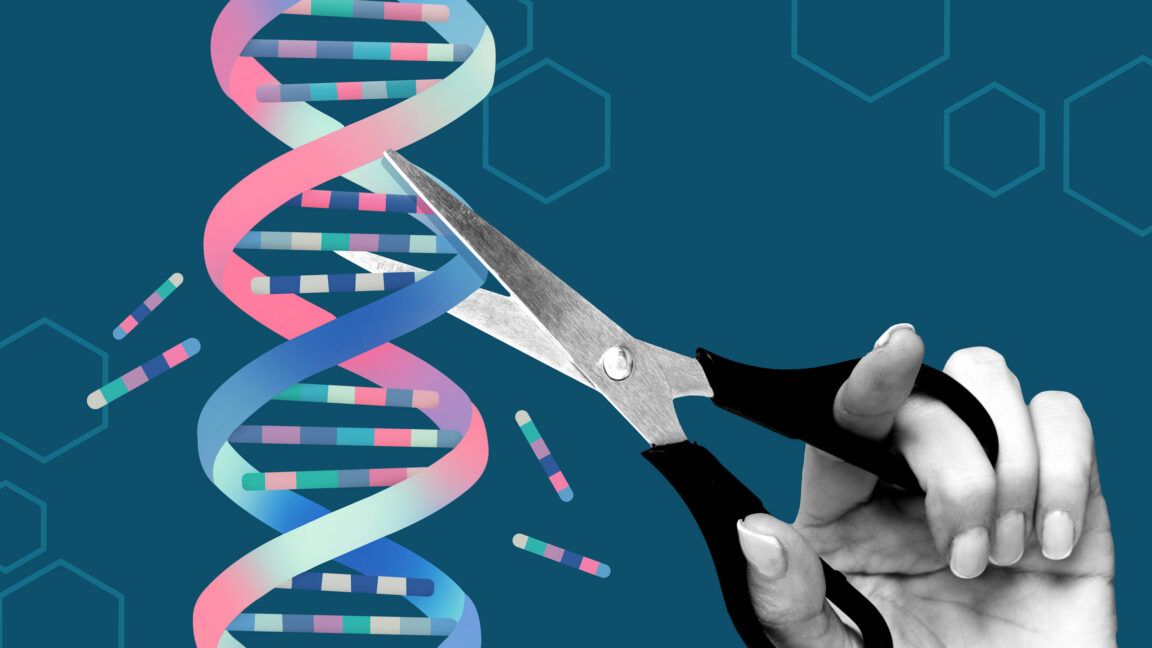
Gene-editing therapies based on CRISPR and related systems have struggled with a persistent safety problem: off-target effects, in which the editing machinery modifies the wrong DNA sequence. The system has three main components: a guide RNA that base-pairs with the target sequence, a Cas protein (most famously Cas9) that interacts with both guide and genomic RNA and enforces specificity, and a separate protein that chemically modifies the DNA once Cas has found the site. The challenge is that guide RNAs are typically about 18 bases long—a sequence expected to appear only about once in 70 billion bases. The human genome is roughly 3 billion bases, so by that calculation, off-target matches should be rare. However, Cas9 can tolerate a small number of mismatched base pairs without losing its grip on DNA, and the exact number and location of tolerable mismatches varies, making it hard to predict which guide RNAs are risky.

A team of researchers from institutions in China approached the problem by first building a large library of off-target editing sites. They used a modified CRISPR system to convert the base adenine to inosine, then isolated DNA fragments containing the modification. They repeated this process with 10 different guide RNAs and analyzed many modified fragments from each. Next, they used AlphaFold—an AI software trained to predict protein folding, updated to handle protein-nucleic acid interactions and multi-protein complexes—to examine how the CRISPR machinery interacted with these sequences. An initial attempt to include all four components (DNA, guide RNA, Cas9, and a base-modifying enzyme) failed; AlphaFold misplaced one protein. Simplifying to just DNA, guide RNA, and Cas9 worked much better, producing structures that matched experimental data.

By comparing AlphaFold's output for on-target and off-target sites, the team found a striking pattern: about two-thirds of off-target sites caused Cas9 to adopt a slightly different overall structure, but over 95 percent altered which amino acids made contact with the RNA. This meant Cas9 sometimes kept its normal shape but allowed amino acids within it to flex and accommodate mismatched bases. Using AlphaFold's built-in "contact probability" metric—which calculates the likelihood that two items (amino acids or nucleotides) sit within eight Angstroms—the researchers compared contact patterns for on- and off-target sites. They called this analysis "ContactSeek" and used it to identify exactly which amino acids in Cas9 shifted their contacts during off-target binding. Focusing on regions where these amino acids clustered, they identified 10 key positions to test. They then synthesized 23 different Cas9 variants, each with a different amino acid substitution at one of these sites.

The best variant maintained activity similar to wild-type Cas9 at matched target sites while reducing off-target activity from 28 percent to 5 percent. The same approach worked with different guide RNAs and even transferred to Cas12, a different Cas protein used in related systems. When compared with other improved Cas9 variants developed through directed evolution, the newly designed versions showed similar or slightly better activity and specificity. The key distinction is that these changes may be more specific to a given guide RNA and mismatch combination rather than broadly effective across many targets. The researchers note that some of the individual changes they identified could potentially be combined with modifications in previously developed Cas9 variants, though they did not test this combination. They suggest the method represents a general approach to tailoring gene-editing systems to prevent known off-target events and could have broader applications in fine-tuning protein-DNA interactions beyond gene editing.

Context & Analysis

Gene-editing therapies face a fundamental safety challenge: while guide RNAs can be designed to match specific target sequences, the human genome is large enough that even rare DNA sequences appear by chance. Cas9, the protein that binds to those sequences, can tolerate some mismatches between the guide RNA and DNA without losing its ability to stick. This tolerance varies by location and number of mismatches, making it difficult to predict in advance which guide RNAs might trigger off-target edits. Researchers have pursued several routes to address this—optimizing guide RNA selection, engineering improved Cas proteins through directed evolution, and now, using AI to pinpoint the exact structural features that enable mismatch tolerance.

The team's innovation was to use AlphaFold not merely to visualize protein structures, but to systematically compare structures formed at on-target versus off-target sites. By tracking which amino acids change their contact patterns with RNA when the DNA sequence is mismatched, they identified a small set of positions that consistently adapt. The "ContactSeek" method—comparing contact probability outputs for matched and mismatched scenarios—turned an overwhelming list of candidate amino acids into a focused set of high-impact sites. This allowed rapid testing and successful redesign. Notably, the resulting variant performed similarly to other engineered Cas9 variants in published literature, suggesting the method yields genuinely competitive improvements rather than isolated gains.

FAQ

How much did the researchers reduce off-target editing?
Off-target activity dropped from 28 percent to 5 percent in the redesigned Cas9 variant, while activity at correct target sites remained similar to the original protein.
What did the researchers change to improve safety?
They made 23 different amino acid swaps at 10 key positions within the Cas9 protein that AlphaFold identified as mediating interactions with mismatched DNA-RNA sequences.
Did the new approach work for other gene-editing systems?
Yes, the researchers showed the approach also worked for Cas12, a similar system that uses a different Cas protein to recognize the DNA and guide RNA combination.

Get the latest AI in Healthcare news every morning

AI-summarized, only the topics you pick — one digest a day via Email, Slack, or Discord.

Free · takes 30 seconds · unsubscribe anytime

Discussion

No comments yet. Be the first to share your thoughts!

Log in to join the discussion

Related Articles

Stay ahead with AI news

Get curated AI news from 200+ sources delivered daily to your inbox. Free to use.

Get Started Free

Free · takes 30 seconds · unsubscribe anytime