Amazon has become the world's largest company by revenue, displacing Walmart from the top of Fortune's Global 500 list after more than a decade. The company is investing $200 billion(約32兆円) in 2026 on AI and cloud infrastructure, with a particular focus on custom chip development (Trainium and Graviton) that Bezos calls the foundation of AI. AWS alone generated $128.7 billion(約21兆円) in revenue last year, and Bezos expects the chip business to become Amazon's next major profit pillar.
Summaries like this, in your inbox every morning.
Sign up free →What happened
Amazon has become the world's largest company by revenue, surpassing Walmart's decade-long hold on the Fortune Global 500's top spot. The company plans to spend $200 billion(約32兆円) on capital expenditures in 2026, largely on AWS and generative AI infrastructure, and is developing custom chips (Trainium and Graviton) to compete in the AI arms race.
Why it matters
AWS generates $128.7 billion(約21兆円) in annual revenue with $45.6 billion(約7.3兆円) in operating income, powering roughly a third of the internet. Bezos believes Amazon's chip business is positioned to become a major profit pillar comparable to Marketplace, Prime, and AWS—meaning the company's size could grow substantially larger than it already is.
What to watch
Amazon will launch its next-generation Trainium4 chip next year. The company's expected $200 billion(約32兆円) 2026 spending on AI puts it at the top of Big Tech's capex arms race, which analysts expect will exceed $700 billion(約110兆円) across the largest hyperscalers in 2026.
Jeff Bezos founded Amazon in a Bellevue, Washington garage in 1995 with a makeshift desk made from a wooden door slab, initially calling the startup Cadabra before changing it to Amazon. What began as an online bookshop has grown into the world's largest company by revenue, now topping Fortune's Global 500 list after Walmart held the position for over a decade. Bezos, now 62, handed the CEO role to AWS chief Andy Jassy in 2021 but remains executive chair.
The company's growth was neither obvious nor rapid. When Bezos sought investors, he had to explain what the internet was; he spoke with roughly 60 investors and raised one million dollars, with 22 investors each contributing roughly $50,000. Amazon went public on May 15, 1997, at $18 per share with a valuation of nearly $440 million(約700億円) (now $2.6 trillion(約420兆円)). A 1999 Barron's cover story titled "Amazon.bomb" questioned the startup's ability to ever turn a profit. According to Evercore ISI analyst Mark Mahaney, "It was so speculative when it went out. The company, the management team, Jeff Bezos's prior business experience running a large company: zero." Amazon did not become profitable until the early 2000s, after expanding beyond books.
The company's transformation accelerated with the 2006 launch of AWS, a cloud-computing division that now powers millions of businesses and governments—from Netflix streaming to DoorDash food ordering. In 2025, AWS generated $128.7 billion(約21兆円) in revenue (up 20% from the prior year) with operating income of $45.6 billion(約7.3兆円). Beyond AWS, Amazon launched Prime in 2005 (now with 200 million subscribers and expanded to include groceries, music, and video), the Kindle e-reader in 2007, acquired Whole Foods for $13.7 billion(約2.2兆円) in 2017, and purchased MGM for $8.5 billion(約1.4兆円) in 2022, gaining a 4,000-film library and the James Bond franchise. The company bundled video into Prime in 2011 and began producing original series, winning two major Emmys for Transparent in 2015.
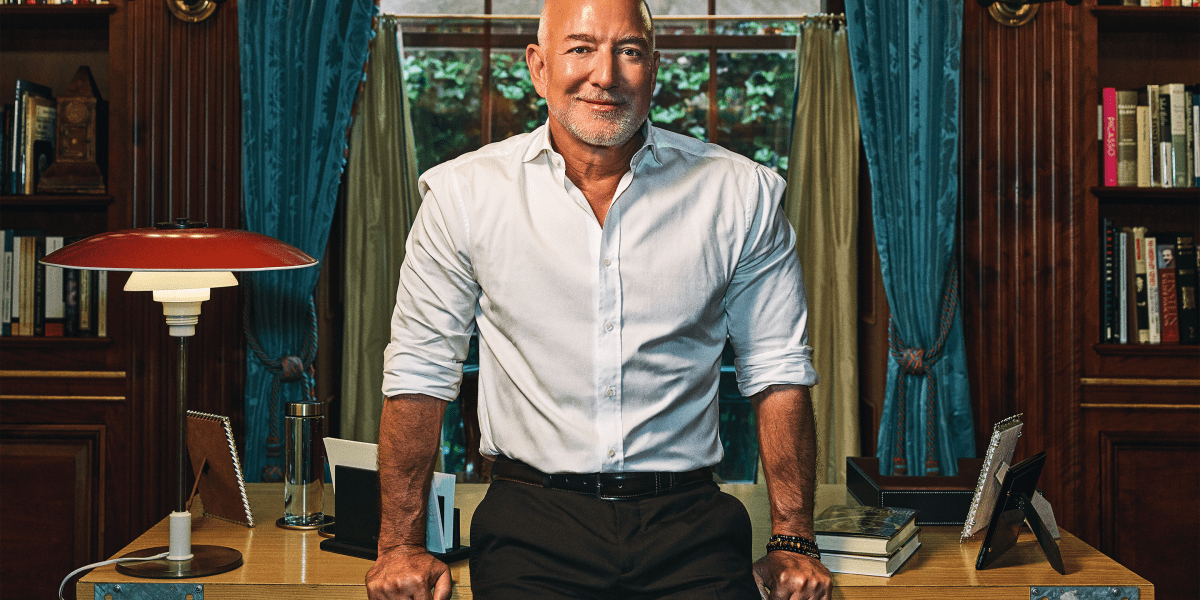
Bezos credits the company's success to its leadership principles emphasizing constant innovation and customer obsession. He used the phrase "customer obsession" 10 times during an April interview with Fortune, sitting at that original door-desk now in his Washington, D.C. study. "I don't want us to take pride in being big," Bezos said. "I want us to take pride in servicing customers. And it turns out, if you service customers really well, that will drive growth." He notes that most companies claiming customer obsession are actually competitor-obsessed, and that Amazon's cultural strength lies in its ability to both obsess over customers and love inventing.
As Amazon faces intensifying competition in the AI arms race, the company is making a massive bet on chips and cloud infrastructure. In 2025, Amazon devoted $131 billion(約21兆円) to capital expenditures and estimates it will spend $200 billion(約32兆円) in 2026—largely on AWS and generative AI. In April, Amazon inked a multibillion-dollar deal with Meta, which will use Amazon's Graviton chips to support AI initiatives. The company has also partnered with Anthropic, agreeing to invest as much as $25 billion(約4兆円) in the AI startup, which will purchase more than $100 billion(約16兆円) of Amazon's cloud services. Bezos said Amazon's Trainium and Graviton chips are positioning the company's silicon business to be its next pillar, comparable to Marketplace, Prime, and AWS. The company will launch its next-generation Trainium4 chip next year. Amazon's expected $200 billion(約32兆円) 2026 spend puts it at the top of Big Tech's AI capex arms race, which analysts expect will exceed $700 billion(約110兆円) across hyperscalers in 2026.
However, observers note that Amazon got a sluggish start in the AI era. In October 2025, influential tech analyst Mark Shmulik of Bernstein mused that AWS appeared to be "in last place in AI." By January, he shifted his view, naming Amazon a top pick for 2026 and expressing optimism that AWS could reverse the narrative about its struggles with AI. Bezos acknowledged that Amazon's trajectory since 1995 was improbable: "You could not at that time have predicted the magnitude of change that would occur—and anybody who did predict that magnitude of change would probably have been quickly institutionalized and sent to the mental hospital."
Amazon's ascent to the top of the Fortune Global 500 represents the culmination of three decades of expansion driven by what Bezos calls 'customer obsession'—a philosophy emphasizing low prices, fast delivery, and vast selection. The company's trajectory was far from inevitable: when Bezos founded Amazon in 1995 as an online bookstore, he had to explain to investors what the internet was, speaking with roughly 60 investors to raise just one million dollars. The company did not become profitable until the early 2000s, and a 1999 Barron's cover story titled "Amazon.bomb" questioned whether it would ever turn a profit. AWS, launched in 2006, proved to be the transformative move that changed everything, eventually powering roughly a third of the internet with $128.7 billion(約21兆円) in annual revenue and $45.6 billion(約7.3兆円) in operating income in 2025.
Now, as the company faces intense competition in the AI arms race, Bezos is positioning Amazon's custom chip business as the next major pillar. With plans to spend $200 billion(約32兆円) on capital expenditures in 2026—largely on AI and cloud infrastructure—Amazon leads Big Tech's capex arms race, which analysts expect will exceed $700 billion(約110兆円) across hyperscalers in 2026. Bezos describes these chips as 'the foundation upon which all of this AI sits.' Partnerships like the multibillion-dollar deal with Meta and the $25 billion(約4兆円) investment in Anthropic (which will purchase over $100 billion(約16兆円) of Amazon's cloud services) reinforce the company's commitment to owning AI infrastructure. However, some observers note that Amazon got a sluggish start in the AI era compared to competitors, though analyst sentiment shifted from October 2025 (when Mark Shmulik of Bernstein suggested AWS was 'in last place in AI') to January 2026, when he named Amazon a top pick and expressed optimism about AWS reversing its AI narrative.
AI-summarized, only the topics you pick — one digest a day via Email, Slack, or Discord.
Free · takes 30 seconds · unsubscribe anytime
No discussion yet for this article
Get curated AI news from 200+ sources delivered daily to your inbox. Free to use.
Get Started FreeFree · takes 30 seconds · unsubscribe anytime
