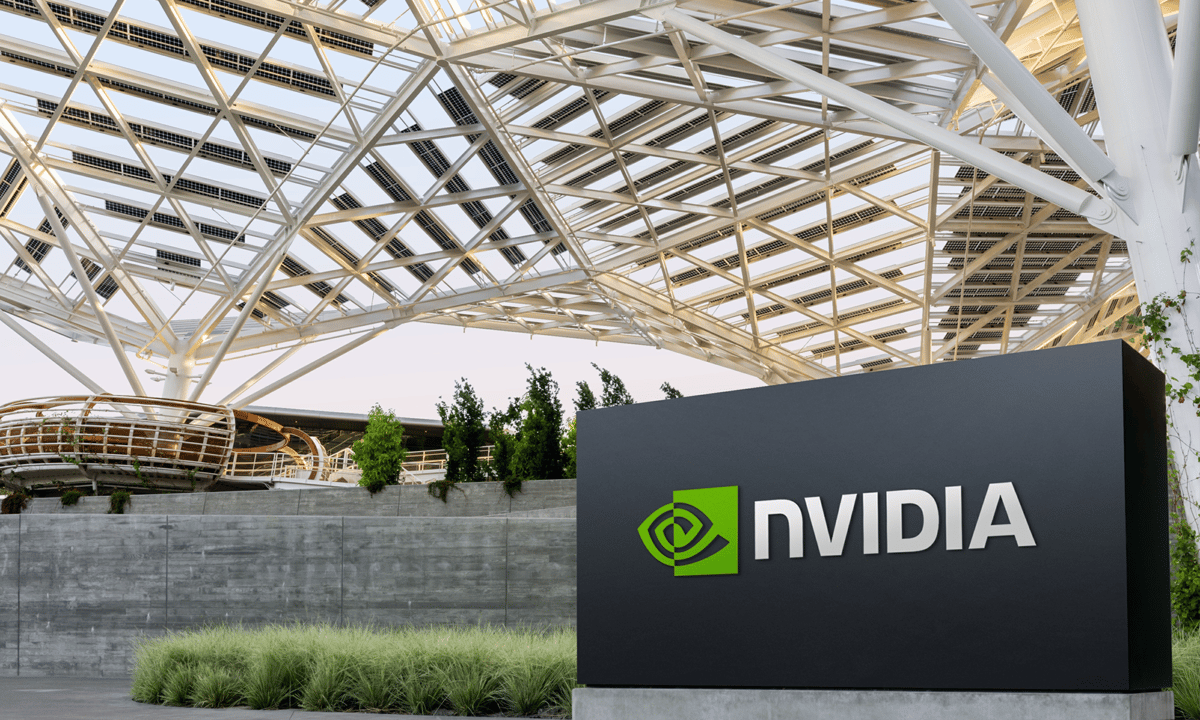
Nvidia, the dominant maker of AI chips (graphics processing units), has delivered extraordinary returns—its stock up more than 300% in three years—yet currently trades at a valuation discount compared to industry peers and typical growth stocks.
The company reported latest-quarter revenue exceeding $81 billion(約13兆円) and net income of $58 billion(約9.3兆円), maintaining gross margins above 70%.
At a forward price-to-earnings ratio of 23, Nvidia sits between the 17 ratio of typical value stocks and the 29 of growth stocks, potentially attracting both investor types, though rising concerns about AI spending levels pose a near-term risk.
What happened
Nvidia's stock has climbed more than 300% over three years, driven by its early entry into AI chip manufacturing and sustained double- and triple-digit revenue and profit growth. In its latest quarter, the company reported sales exceeding $81 billion(約13兆円) and net income of $58 billion(約9.3兆円), with a gross margin above 70%.
Why it matters
Despite its commanding position in the high-growth AI market, Nvidia trades at a forward price-to-earnings ratio of 23—a significant discount to peers like Advanced Micro Devices and Broadcom, and below the 29 ratio typical of growth stocks. This valuation suggests the stock may appeal to both value and growth investors seeking exposure to AI's long-term potential without paying a premium.
What to watch
Nvidia's ability to sustain its competitive lead as concerns about massive AI spending levels persist. The company has expanded beyond chips to offer complete systems, platforms for specific industries (healthcare and automotive), and related services, positioning itself as an AI ecosystem provider rather than a pure chip designer.
Ask the AI about this article →
Nvidia's transformation from a gaming-focused GPU maker to the central pillar of AI infrastructure represents one of the most successful strategic pivots in tech history. The company's 30-year foundation gave it deep expertise in graphics processing, which translated seamlessly into the computational demands of AI model training and inference. By recognizing this opportunity early and maintaining relentless innovation, Nvidia captured the market at the precise moment when enterprise and consumer demand for AI accelerated, generating earnings growth that outpaced virtually all competitors.
What makes the current valuation remarkable is the disconnect between Nvidia's market dominance and its stock price. The company has not merely sold chips; it has built an integrated AI ecosystem including complete systems, industry-specific platforms for healthcare and automotive applications, and ancillary services. This breadth of offering and the company's gross margin above 70% demonstrate pricing power and operational efficiency. Yet the market prices the stock at 23× forward earnings, substantially below growth-stock norms—a gap typically reserved for mature, slower-growth businesses. This suggests either that the market is discounting genuine risks (such as sustained AI overcapacity or spending pullback) or that Nvidia's valuation has genuinely de-rated despite unchanged fundamentals, creating a potential opportunity.
For example, today's edition would include:
AI-summarized, only the topics you pick — one digest a day via Email, Slack, or Discord.
Free · takes 30 seconds · unsubscribe anytimeWhat is AIToday? →
Ask AI anything about this article. Q&As are published on this page for other readers too.
Phonely Ltd. launched Alma, a large language AI model built for voice agents and trained on over 10 million re…

Aranya Inc., a startup founded last year, launched today with $11 million in funding

CBTS Technology Solutions LLC launched Forge Agents, a platform that turns a plain-language job description in…

Imec CEO Patrick Vandenameele said at SEMICON Taiwan 2026 that the Belgian research center is broadening its c…

Alphabet's AI Overviews now reach over 2.5 billion monthly users through Google Search, and its ad business ge…

Sarah O’Connor's book 'We Are Not Machines' explores how mechanization and AI have transformed the workforce…