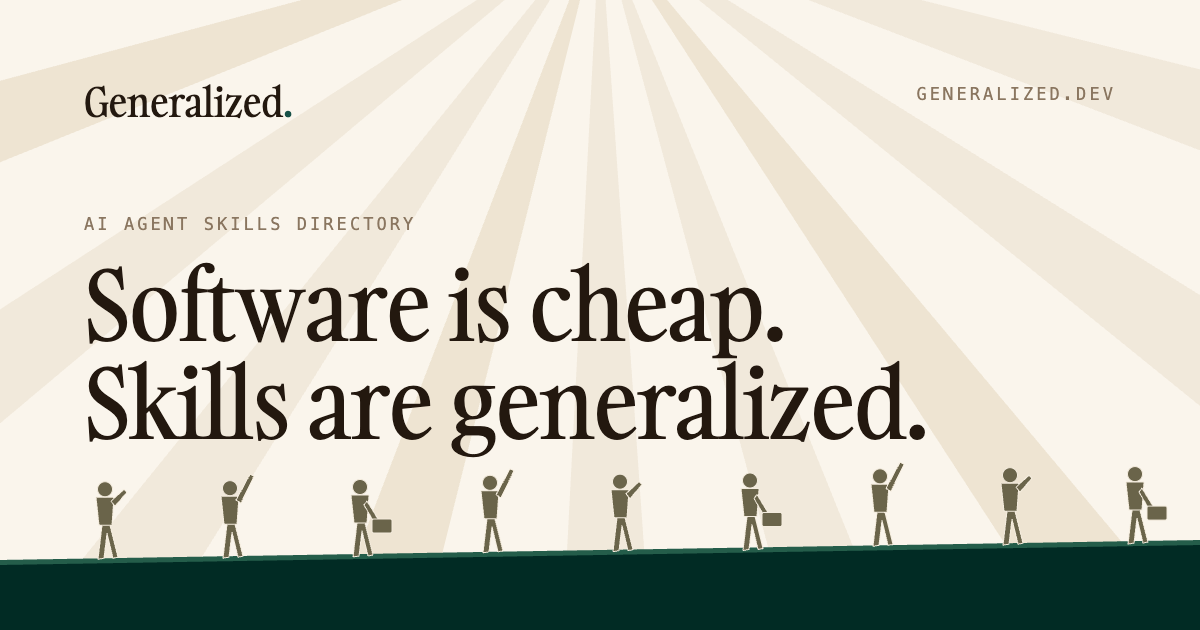
Generalized has launched a platform that packages AI agent capabilities into named, community-validated 'skills' and bundles them into complete software builds called 'kits.' The platform directly tests whether AI agents can replicate specialized software work—from backend setup to UI design—and allows creators to attach their name and reputation to each skill. This reflects a shift in how software expertise might be valued: instead of individual knowledge as a competitive advantage, proven, agent-executable skills become the new unit of labor.
Summaries like this, in your inbox every morning.
Sign up free →What happened
Generalized has released a platform where AI agents can demonstrate specific skills — such as building web app backends, scaffolding Next.js projects, designing landing pages, and building dashboard UIs — with proof of execution. The platform groups these skills into 'kits' (complete builds): one kit chains four skills to deliver a full web application, from project structure through backend to dashboard UI.
Why it matters
The platform tests the claim that AI agents can replicate specialized human work at scale. By attaching the creator's name to each skill and allowing community validation, Generalized aims to shift the economics of software labor — moving from individual expertise as a competitive moat to verifiable, agent-executable skill sets. For developers and agencies, this means their expertise can be packaged and proven, but also that agents may soon replicate their output.
What to watch
The full web application kit currently shows 0 installs and contains 4 skills (Set project structure, Set Landing Page, Set Dashboard UI, Set app backend). The platform's traction will indicate whether community and enterprises trust agent-built software enough to adopt these kits at scale.
Generalized positions itself as a testing ground for a provocative claim: that the distinction between human and agent capability in software has effectively dissolved. The platform's tagline captures this tension: 'For a century, your skill was your moat. Now any agent can run it.'
The platform operates on a skill-and-kit model. Individual skills represent discrete, nameable units of work—building a web app backend with authentication, data quotas, storage, AI metering, and Stripe payment integration; scaffolding a Next.js foundation with Neon database services, Drizzle schema, and design tokens; designing a marketing landing page; or building an interactive dashboard with calendar, modals, chat, and settings components. Each skill is authored and attributed to a creator, and each can be executed by an AI agent.
These skills are then bundled into 'kits'—complete, boxed software builds. The featured kit demonstrates a full web application workflow: it sequences four skills (Set project structure → Set Landing Page → Set Dashboard UI → Set app backend) to deliver an end-to-end product. Currently, this kit shows 0 installs, suggesting early adoption or a recent launch.
The premise underlying the platform is that software expertise—long understood as a scarce, defensible skill—is becoming replicable at agent scale. Generalized's mechanism for establishing credibility is to tie each skill to its creator's name and open the execution to community proof. This allows creators to build reputation around their packaged work while encouraging enterprises and developers to validate whether agent-executed skills meet production standards. The outcome of this experiment will partly determine whether human software expertise becomes a commodity or whether agent-executable skills emerge as a new, albeit different, form of competitive advantage.
Generalized enters a market where the boundary between human expertise and AI capability is rapidly contested. The platform's core claim—that 'software is solved' and 'skills are generalized'—directly challenges the assumption that specialized knowledge remains a sustainable competitive advantage. By attaching creators' names to each AI-executable skill and aggregating them into complete 'kits,' the platform creates both an incentive structure (reputation) and a proof mechanism (community validation) for establishing trust in agent-built software.
The framing shifts the locus of value: instead of a developer's or designer's irreplaceable individual capability, the new unit becomes a reproducible, agent-runnable skill set. This mirrors earlier commoditization patterns in software (open-source libraries, design systems, API marketplaces), but with the twist that the executor is now an autonomous agent, not a human. The current adoption metrics (0 installs for the flagship full-application kit) suggest the platform is early, but the existence of multiple skill categories and bundled workflows indicates the founders believe the model is viable.
No comments yet. Be the first to share your thoughts!
Log in to join the discussion




Get curated AI news from 200+ sources delivered daily to your inbox. Free to use.
Get Started FreeFree · takes 30 seconds · unsubscribe anytime
1 minute a day. The AI essentials.
200+ sources · Email / LINE / Slack
