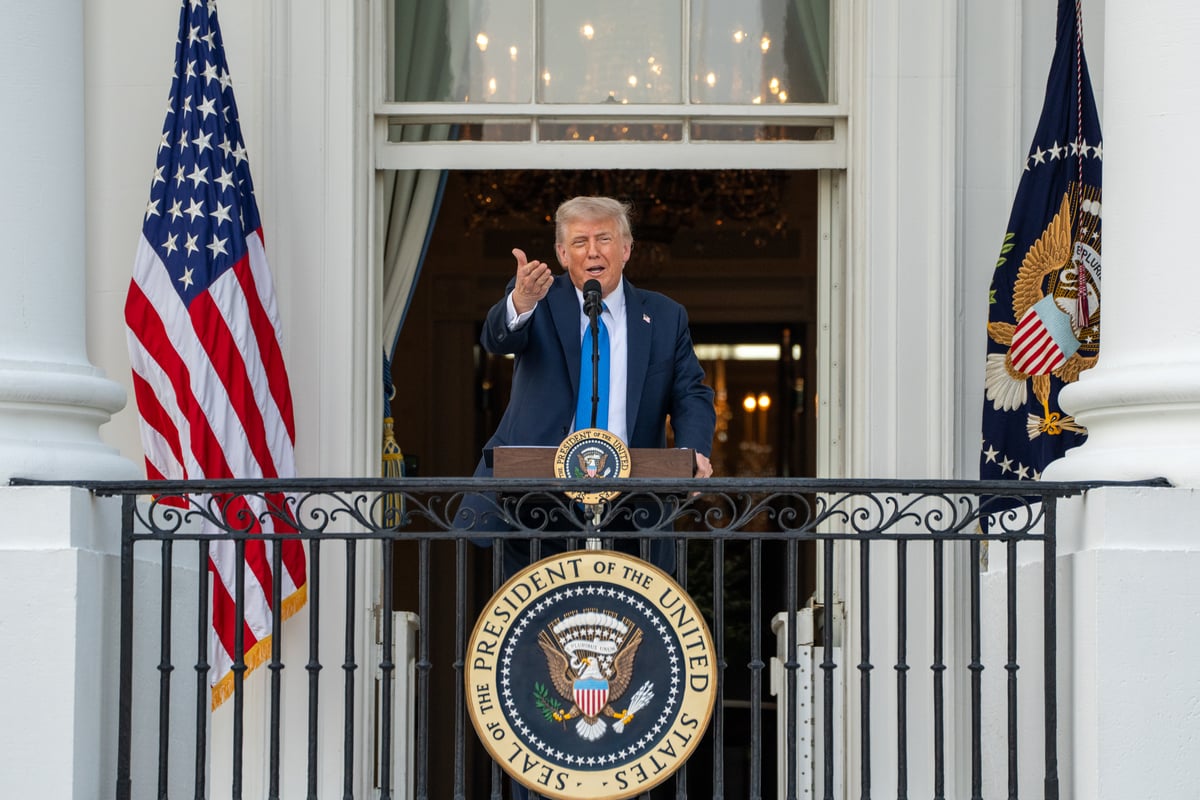
President Trump's investment accounts have been selling Micron Technology stock while buying Nvidia shares as both AI-related chip stocks have surged over 1,340% since early 2023.
Micron, a memory-chip supplier, has locked in long-term customer contracts but faces potential price declines by 2028 as supply normalizes.
Nvidia, which dominates AI infrastructure with over 80% accelerator market share, is launching new platforms and entering the personal computer market later this year, positioning it for continued growth.
What happened
President Trump's investment accounts, managed by third parties, sold $90,000 to $116,000 of Micron stock year-to-date through May while buying $246,000 to $3.7 million(約5.9億円) of Nvidia stock. Both companies' shares have surged more than 1,340% since January 2023.
Why it matters
Micron, a memory-chip maker for AI systems, signed 16 multiyear contracts locking in pricing over three to five years—a shift from the industry's traditional short-term deals. However, Wall Street expects memory prices to drop once supply meets demand, possibly by 2028, which may have prompted the selling. Nvidia, dominant in AI infrastructure with over 80% market share in accelerators, is expanding into PCs and launching new cost-saving chips, suggesting different growth trajectories.
What to watch
Nvidia's Vera Rubin platform enters volume production in the second half of 2026, delivering 10 times the inference throughput per watt at one-tenth the cost per token compared to its predecessor. The company will also launch RTX Spark superchips for Windows PCs this fall, marking its entry into a market historically controlled by Intel and AMD.
Ask the AI about this article →
The divergence in Trump's accounts' trading activity reflects a broader shift in the semiconductor industry's dynamics. Micron, while benefiting from an unprecedented memory chip shortage that drove revenue up 345% in its most recent quarter, faces a structural headwind: the memory chip industry historically runs on cyclical supply-demand swings. By signing 16 multiyear contracts locking in minimum pricing over three to five years, Micron has made a strategic move to reduce cyclicality, yet Wall Street still anticipates price compression by 2028. This forward-looking concern likely explains why the president's accounts have been reducing exposure, despite the stock's stunning 1,860% gain since January 2023.
Nvidia, by contrast, operates in a different part of the AI supply chain and faces less cyclical pressure. With over 80% market share in AI accelerators and revenue growing 85% in its most recent quarter, Nvidia is positioned to benefit from multiple growth catalysts. The upcoming Vera Rubin platform and RTX Spark personal computer launch represent not just incremental improvements but expansions into new markets and use cases. The company's ability to optimize its entire computing stack, combined with its lowest-cost-per-token advantage, creates a structural moat that extends beyond memory chips. Wall Street's 56% estimated earnings growth through fiscal 2028 and the median analyst target price of $300 (implying 42% upside) reflect confidence in Nvidia's durability, even as its valuation has expanded significantly.
For example, today's edition would include:
AI-summarized, only the topics you pick — one digest a day via Email, Slack, or Discord.
Free · takes 30 seconds · unsubscribe anytimeWhat is AIToday? →
Ask AI anything about this article. Q&As are published on this page for other readers too.
Visko raised $10 million in pre-seed funding from Llama Ventures and opened public access to its first foundat…

U.S. markets ended August higher, with the S&P 500 up 2.6% and the Nasdaq up 3.9%

Neurovia AI, an Abu Dhabi-based company, is pitching Saudi security agencies software that it says can compres…

AI company Runway has unveiled Solaris, the first model in a new category it calls "Interface World Models." I…

John Deere introduced JD, a conversational AI tool that lets farmers ask open-ended questions about their hist…

Nvidia CEO Jensen Huang said on Fox Business that AI is creating 'hundreds of thousands' of jobs, including in…