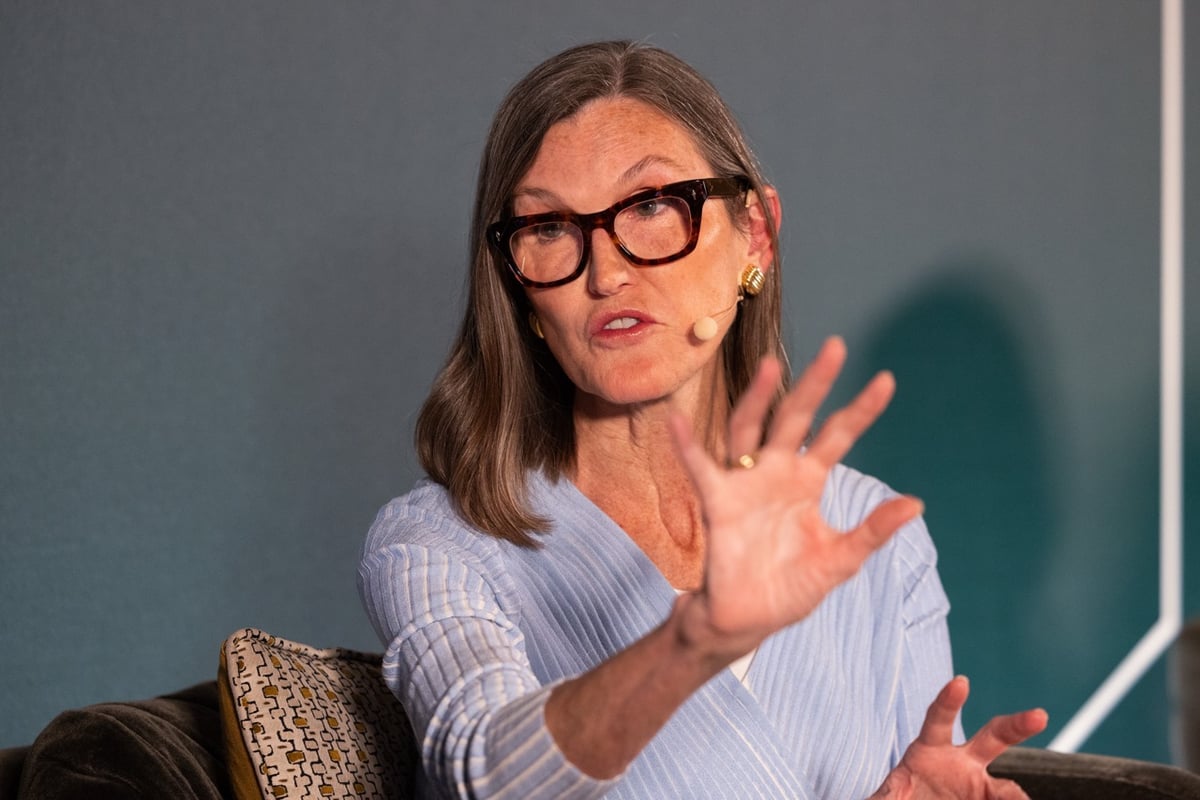
Cathie Wood's Ark Investment Management has concentrated about 30% of its combined ETF portfolio into five artificial intelligence–focused stocks: Tesla, SpaceX, Alphabet, Amazon, and AMD. Each company is positioned to capitalize on different AI opportunities—from Tesla's robotaxis and humanoid robots to Alphabet and Amazon's cloud AI services to AMD's potential dominance in the emerging agentic AI CPU market. The concentration reflects Wood's bullish view that these firms will lead the AI industry, though some valuations already price in significant future growth.
Summaries like this, in your inbox every morning.
Sign up free →What happened
Five companies make up 30.4% of Ark Investment Management's combined portfolio across its ETF family: Tesla (9.73%), SpaceX (4.28%), Alphabet (4.71%), Amazon (3.6%), and AMD (8.10%). All are positioned to benefit from artificial intelligence.
Why it matters
Ark's CEO Cathie Wood is betting heavily that these firms will lead in AI—from Tesla's robotaxis and humanoid robots, to Alphabet and Amazon's cloud-based AI tools and services, to AMD's opportunity in the emerging agentic AI market (where AI agents autonomously plan and execute tasks, potentially running on CPUs). For investors, it signals where a prominent tech-focused fund manager sees the most promise in the AI industry.
What to watch
Alphabet plans to spend between $180 billion(約29兆円) and $190 billion(約30兆円) on capex this year largely for AI-related ambitions. SpaceX, valued at $1.8 trillion(約290兆円), is not yet profitable. AMD's fortunes may shift if agentic AI demand increases significantly over the next few years.
Cathie Wood, CEO of Ark Investment Management, has built a portfolio heavily tilted toward artificial intelligence, with five stocks accounting for about 30.4% of the firm's combined holdings across its ETF family. These five holdings are Tesla (9.73%), SpaceX (4.28%), Alphabet (4.71%), Amazon (3.6%), and AMD (8.10%).
Two of the five are companies led by Elon Musk. Tesla, Ark's largest holding, is no longer valued primarily as an electric vehicle maker; instead, its biggest opportunities—robotaxis and humanoid robots—depend critically on AI to function. SpaceX similarly is positioned for AI-driven growth: though the company pioneered reusable rockets and currently generates most operating profits from its satellite internet business, SpaceX's own regulatory filings argue that AI represents the vast majority of its total addressable market. However, valuations are a concern. SpaceX is worth $1.8 trillion(約290兆円) despite not being profitable, and the article notes that much of both companies' upside is already reflected in their stock prices, though Tesla is described as more attractive than SpaceX for risk-tolerant investors.
Alphabet and Amazon are major cloud and AI service providers. Alphabet has incorporated AI overviews and AI mode into its search engine and offers cloud-based AI tools driving strong sales growth. The company plans to spend between $180 billion(約29兆円) and $190 billion(約30兆円) on capex this year, largely for AI-related investments. Beyond AI, Alphabet maintains a large core digital advertising business, has a footprint in streaming, and is building a robotaxi service through its subsidiary Waymo. Amazon's cloud business is seeing accelerating sales growth partly due to AI, and the company is deploying AI-powered initiatives across its business to cut costs and boost profits. Amazon also has diversified revenue streams in healthcare, streaming, and digital advertising, backed by switching costs, network effects, and a strong brand.
AMD rounds out the five. The company is a leading CPU (Central Processing Unit) player, historically playing second fiddle to Nvidia in GPUs, which have been the primary compute engines for AI training. However, agentic AI—where AI agents autonomously plan and execute tasks to automate work and reduce expenses—could shift the equation: agents run on CPUs, giving AMD a large growth opportunity. AMD has been a CPU leader for decades with a switching-cost moat and has outperformed its main competitor Intel in recent years.
Cathie Wood's heavy concentration in AI stocks reflects a deliberate bet on which technologies and business models will dominate the next phase of the AI industry. The portfolio spans multiple angles: autonomous robotics and transportation (Tesla's robotaxis and humanoid robots, Alphabet's Waymo), cloud infrastructure and services (Alphabet and Amazon's AI tools driving sales growth), and semiconductor leadership (AMD's potential advantage in the agentic AI market, which relies on CPUs rather than GPUs). Wood's thesis appears to rest on the idea that the AI boom will extend beyond large language models into embodied AI and agent-based automation, where companies like Tesla, SpaceX, and AMD can leverage their existing platforms and competitive moats.
That said, the article flags a valuation risk: both Tesla and SpaceX command stock prices that already reflect significant future success. SpaceX's $1.8 trillion(約290兆円) valuation despite current unprofitability is noted as particularly expensive. Alphabet and Amazon, by contrast, are framed as having lower execution risk because they are already generating strong returns from their AI initiatives (Alphabet's cloud AI tools, Amazon's cloud momentum) while holding multiple non-AI revenue streams (advertising, Waymo, Amazon's diverse business lines). AMD's position is positioned as an upside opportunity if agentic AI demand materializes—a bet on a technological shift that could reshape CPU demand.
AI-summarized, only the topics you pick — one digest a day via Email, Slack, or Discord.
Free · takes 30 seconds · unsubscribe anytime
No discussion yet for this article
Get curated AI news from 200+ sources delivered daily to your inbox. Free to use.
Get Started FreeFree · takes 30 seconds · unsubscribe anytime
1 minute a day. The AI essentials.
200+ sources · Email / LINE / Slack
