What happened
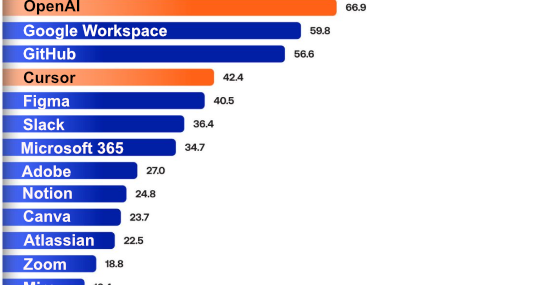
Okta's analysis of enterprise AI tool usage—tracked across over 2 million accounts from June 2022 to June 2026—shows Anthropic ranked #1 in growth rate (indexed at 100), followed by OpenAI (66.9), Google Workspace (59.8), GitHub (56.6), and Cursor (42.4). For the largest account counts, Microsoft 365 ranked #1, with Google Workspace in second place.
Why it matters
More than half (57%) of companies now use two or more AI platforms simultaneously, signaling a shift toward a "mix-and-match" approach rather than reliance on a single vendor. This fragmentation means enterprises are actively building portfolios of AI tools tailored to specific workloads, a pattern that could reshape how software budgets are allocated across different AI providers.
What to watch
Anthropic's growth has accelerated notably since January 2026, when it began adding enterprise accounts. Over the same period, OpenAI and Cursor growth has slowed, suggesting a shift in which vendors enterprises are adopting for new deployments.
Summaries like this, in your inbox every morning.
Okta's analysis reveals a fundamental shift in how enterprises adopt AI tools. Rather than consolidating around a single vendor, companies are now mixing multiple platforms—a behavior that has emerged in just four years of widespread enterprise AI availability. Anthropic's exceptionally strong growth rate (indexed at 100 versus OpenAI's 66.9) reflects both the vendor's recent acceleration in enterprise account acquisition starting in January 2026 and the broader diversification trend. The plateauing of growth among earlier entrants like OpenAI and Cursor over the same recent period suggests that enterprises have moved past the "evaluate the leader" phase into active portfolio building. This multi-platform approach (adopted by over 57% of companies) reflects a pragmatic enterprise posture: rather than assuming one AI tool solves all use cases, companies are selecting specialized tools for narrow workloads—code generation, writing, security, cloud infrastructure, and creative tasks—and managing them as a unified ecosystem.
For example, today's edition would include:
AI-summarized, only the topics you pick — one digest a day via Email, Slack, or Discord.
Free · 30 seconds with Google · unsubscribe anytimeWhat is AIToday? →
Ask AI anything about this article. Q&As are published on this page for other readers too.
Sam Altman and Elon Musk backed Dario Amodei's call for a slowdown in model releases, while Marc Benioff at Dr…
Eva Brucherseifer and Jan Muehlig will present 'What would it take?

Meta Platforms shares are up 24.34% over the past month, as Muse became the #1 app in the App Store one week a…

Broadcom, Meta Platforms, and Microsoft are all trading around breakeven for the year

In the first posts from the new DeepMind Institute, researchers Rohin Shah and Anca Dragan argue visible chain…
Anthropic published an index scoring its own development work, and says 26 percent of it now sits at AL4 — Epo…