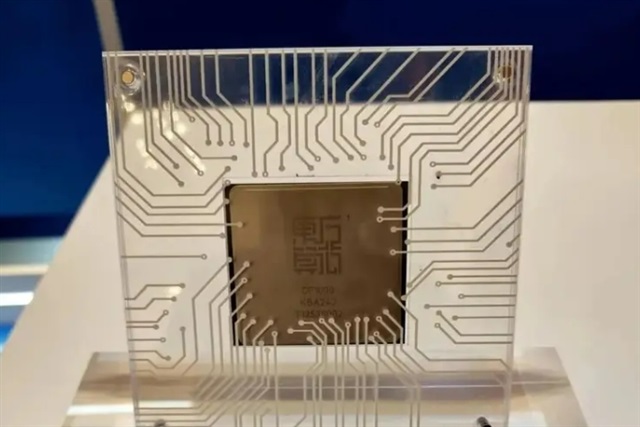
Shanghai Orient Computing Core Technology has unveiled the DF1000, a 14-nanometre AI accelerator designed to reduce reliance on advanced process nodes and high-bandwidth memory through software-defined computing and 3D-stacked near-memory architecture. This addresses a critical challenge for Chinese AI developers operating under semiconductor export restrictions, potentially offering a path to greater technological independence in AI infrastructure.
Summaries like this, in your inbox every morning.
Sign up free →What happened
Shanghai Orient Computing Core Technology unveiled the DF1000, a 14-nanometre AI accelerator that uses software-defined computing and 3D-stacked near-memory architecture to reduce reliance on advanced process nodes and high-bandwidth memory.
Why it matters
The chip addresses a key bottleneck for Chinese AI developers—access to cutting-edge semiconductors and high-bandwidth memory (HBM), which are subject to export controls. By achieving AI performance without dependence on the latest process technology or premium memory, domestic companies may gain greater autonomy in building AI systems.
What to watch
The DF1000's real-world performance and adoption rate among Chinese AI companies will indicate whether the design strategy successfully offsets the constraints of older manufacturing nodes.
Shanghai Orient Computing Core Technology has launched the DF1000, a 14-nanometre AI accelerator designed to sidestep some of the most acute constraints facing Chinese AI companies. The chip employs two key architectural strategies: software-defined computing, which shifts computational flexibility from hardware specialization to programmable logic, and 3D-stacked near-memory architecture, which places memory closer to compute units to reduce the distance data must travel. Together, these approaches are intended to reduce reliance on both advanced process nodes—the cutting-edge manufacturing techniques that China is restricted from accessing—and high-bandwidth memory (HBM), a critical bottleneck also controlled through export regulations. By demonstrating that meaningful AI performance is possible without the newest silicon-manufacturing processes or premium memory components, the DF1000 offers Chinese developers an alternative path that does not depend on circumventing international controls. The chip reflects a broader strategy of substituting clever architecture and software optimization for raw technological advantage, addressing the practical reality that Chinese companies cannot easily obtain the most advanced semiconductors and memory available to competitors in the United States and allied nations.
China's semiconductor industry operates under significant export restrictions on advanced chips and memory components, creating a structural constraint for AI development. Shanghai Orient Computing Core Technology's DF1000 represents an attempt to work within these constraints by shifting the architectural burden from cutting-edge manufacturing and memory to software-defined computing strategies and near-memory 3D stacking. Rather than competing on process node maturity or memory bandwidth—where Western and allied suppliers maintain advantages—this design prioritizes efficiency and local supply chain viability. The success of this approach will depend on whether the performance trade-offs are acceptable to Chinese AI developers and whether the near-memory architecture can deliver sufficient throughput for large-scale inference and training workloads.
No discussion yet for this article
Get curated AI news from 200+ sources delivered daily to your inbox. Free to use.
Get Started FreeFree · takes 30 seconds · unsubscribe anytime
1 minute a day. The AI essentials.
200+ sources · Email / LINE / Slack
