What happened
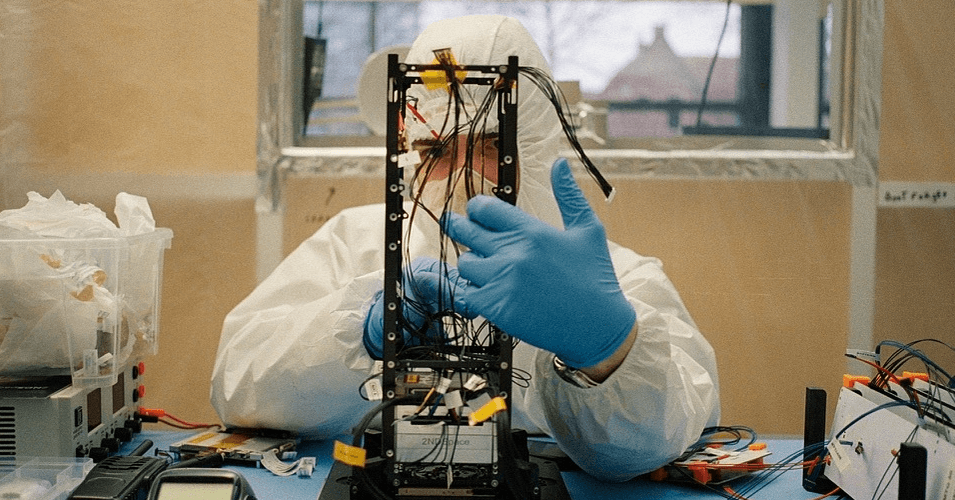
Mass Balance, a British biotech startup, launched a grapefruit-sized autonomous laboratory into orbit aboard a SpaceX transporter on Tuesday morning. The experiment, contained in a 10 centimeter pod built by Austrian company Tumbleweed, will orbit Earth for a couple of months, automatically measuring and transmitting data about how live cells grow and function under weak gravity.
Why it matters
Disease-causing disordered proteins responsible for age-related diseases including Alzheimer's, Parkinson's, and certain cancers are difficult to study on Earth because gravity causes convection and sedimentation that muddy data collection. By studying these proteins in microgravity, Mass Balance aims to generate training data that could fill gaps in AI models like Google's AlphaFold, which currently struggle to predict how disordered proteins behave and respond to medicines.
What to watch
This is the first test of Mass Balance's system; the company is not attempting to return the apparatus to Earth, which avoids the engineering challenges other space biotech firms like BioOrbit and Varda Space Industries face. Mass Balance plans to eventually generate data by running tests on disordered proteins under micro-gravity and use it to train an AI model adapter, with the model, data licensing, and data access driving revenue for the firm.
Summaries like this, in your inbox every morning.
Space-based research for disease study is emerging as a new frontier in biotech. Mass Balance co-founder and CEO Toby Call states that the goal is to make space a reliable, routine research environment. The core insight is that disordered proteins—which drive aging diseases—behave differently in microgravity: without gravity's effects, they may become easier to image and analyze. This matters because current AI models trained on Earth-based data cannot accurately predict how these proteins will respond to drugs, leaving a gap in pharmaceutical development.
The company's revenue model hinges on monetizing the data and AI insights generated from space experiments rather than on manufacturing physical products in orbit. By avoiding the need to return hardware to Earth, Mass Balance reduces engineering complexity compared to competitors. The first mission is modest in scope—testing the autonomous laboratory's operating system and data capture capabilities with a simple chemical breakdown reaction. Success here could validate the platform for future runs targeting disordered proteins directly, positioning the startup to license data and trained models to life sciences and pharma organizations.
Pick your industry and the AI tools you use, and get news related to your work every day.
Free · 30 seconds with Google · unsubscribe anytimeWhat is AIToday? →
Ask AI anything about this article. The AI reads this article, earlier AIToday articles, and Wikipedia, and cites its sources. Q&As are published on this page for other readers too.

