What happened
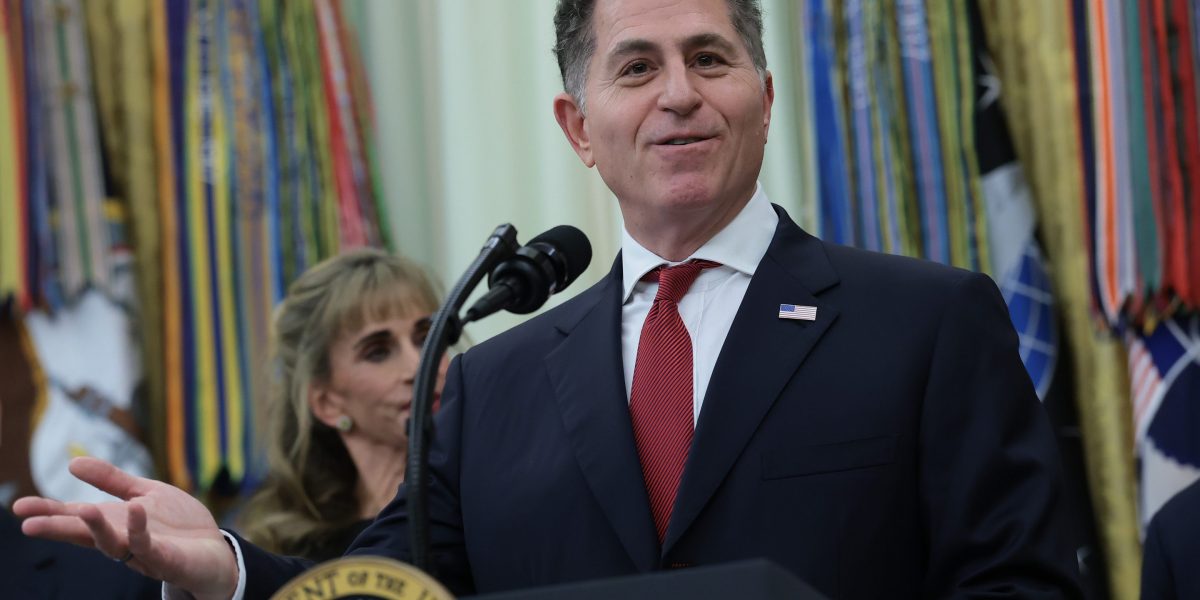
President Trump has publicly praised Dell and its founder Michael Dell on three occasions since February—at a campaign event, a White House luncheon, and the stock market opening bell—each time coinciding with same-day stock gains of 4.4% to 32.8%. Trump also bought between $1 million(約1.6億円) and $5 million(約8億円) of Dell stock before his first endorsement, and the Department of Defense awarded Dell a five-year contract worth up to $9.7 billion(約1.6兆円) in May.
Why it matters
Richard Painter, former White House ethics lawyer under George W. Bush, says the endorsements violate federal standards that have barred officials from praising private companies for decades across both administrations. Even if Trump had not traded the stock himself, publicly telling people to "go out and buy a Dell computer" is an improper endorsement; investors may assume Trump knows of upcoming federal contracts and trade on that assumption. However, analyst Patrick Moorhead argues Dell's stock surge reflects strong business fundamentals—hyperscalers (large cloud providers) buying AI servers—not Trump's praise.
What to watch
Dell reported record quarterly revenue with $24.4 billion(約3.9兆円) in AI orders and $16.1 billion(約2.6兆円) in AI server revenue on May 29, raising full-year AI server revenue expectations to roughly $60 billion(約9.6兆円). Michael Dell's net worth reached $217 billion(約35兆円), making him the world's fifth-richest man; his paper wealth rose by an estimated $606 million(約970億円), $8.0 billion(約1.3兆円), and $4.6 billion(約7400億円) on the three trading days Trump endorsed him.
Summaries like this, in your inbox every morning.
Michael Dell has cultivated relationships with sitting presidents for years, serving on advisory councils under George W. Bush and meeting with Barack Obama on trade and technology policy. His recent proximity to Trump, however, has taken a more explicit and public form. Beyond Dell's $6.25 billion(約1兆円) pledge to Trump Accounts (a philanthropic investment described as bipartisan), Trump has begun endorsing Dell directly from positions of presidential authority—the Oval Office, White House events, and the stock market opening. Analyst Patrick Moorhead contends this is noise: Dell's business case stands on its own, driven by hyperscalers (large cloud providers) purchasing AI servers at scale. Dell's May 29 earnings—reporting $24.4 billion(約3.9兆円) in AI orders and raising full-year AI server revenue guidance to roughly $60 billion(約9.6兆円)—support that view. Yet Richard Painter's concern is structural, not about Dell's fundamentals. He argues that when a sitting president publicly endorses a company, investors may reasonably infer inside knowledge of federal contracts or government favor, creating a market-moving signal that presidents are forbidden from sending under long-standing ethics rules. The three same-day stock moves following Trump's statements suggest such inference may already be occurring, regardless of whether Trump's praise caused the moves or merely coincided with them.
Pick your industry and the AI tools you use, and get news related to your work every day.
Free · 30 seconds with Google · unsubscribe anytimeWhat is AIToday? →
Ask AI anything about this article. The AI reads this article, earlier AIToday articles, and Wikipedia, and cites its sources. Q&As are published on this page for other readers too.

