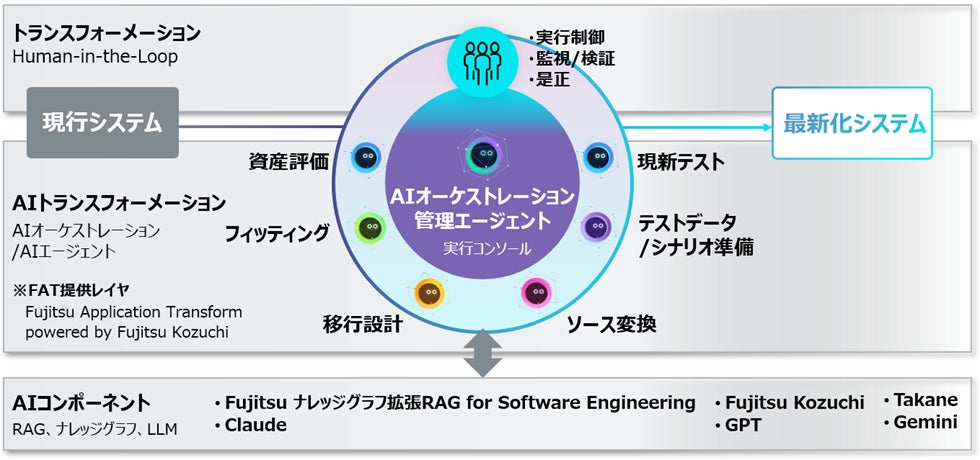
Fujitsu is launching an AI-driven modernization service on July 14, 2026, that combines generative AI technologies—including its own Kozuchi platform and Takane language model, along with Claude (Anthropic) and GPT (OpenAI)—with expert engineer knowledge to automate legacy system updates. The service can reduce modernization timelines by approximately 40% while preserving asset value and improving code quality by migrating to object-oriented Java applications, addressing a critical need for financial, public, healthcare, manufacturing, and distribution sectors.
Summaries like this, in your inbox every morning.
Sign up free →何が起きたか
富士通が生成AIを活用した「Fujitsu AIドリブンモダナイゼーションサービス」を2026年7月14日から日本国内で提供開始します。Fujitsu Kozuchiや大規模言語モデルTakaneに加え、AnthropicのClaudeやOpenAIのGPTなど複数のAI技術と、同社の専門エンジニアの知見を組み合わせたサービスです。
なぜ重要か
レガシーシステムのモダナイゼーションは企業のDXとAX推進の基盤となるものの、特に金融・公共・医療分野や製造・流通業では長年の業務ノウハウが蓄積されており、手作業での対応は時間と人員を要します。本サービスにより、モダナイゼーションの自動化・最適化が進むことで、企業の迅速なビジネス変革を支援することになります。
注目点
本サービスの利用により、モダナイゼーションの工程期間を約40%短縮することが可能とされています。複数のAIを柔軟に組み合わせることで、セキュリティ水準や業務特性に応じた最適なソリューションの選択が可能になります。
Fujitsu announced its new AI-driven Modernization Service, effective July 14, 2026, designed to accelerate legacy system updates by fusing generative AI with decades of systems integration expertise. The service combines Fujitsu's proprietary AI platform Kozuchi and large language model Takane (co-developed with Cohere) with cutting-edge models from Anthropic (Claude) and OpenAI (GPT), overseen by Fujitsu's modernization specialists—engineers termed "modernization masters" who possess deep legacy technology knowledge.
The core innovation lies in AI-driven automation tailored to modernization workflows. Rather than simple mechanical code translation, the service deploys custom AI agents that orchestrate complex transformation tasks in parallel, unifying decision criteria across project phases to eliminate rework and quality variance. The system analyzes legacy assets holistically, structuring them as AI-ready data, then automates language conversion, testing, and validation through what Fujitsu calls "harness engineering" and "loop engineering"—continuous refinement of transformation results. Critically, the service maintains existing system value and allows future extensibility while migrating code to maintainable, object-oriented Java applications. A human-in-the-loop mechanism ensures final judgment and quality consistency, balancing automation with risk control. The result: modernization timelines can shrink by approximately 40%.
The multi-AI architecture reflects customer diversity. Fujitsu allows flexible pairing of multiple AI models matched to each customer's business domain, program characteristics, and security requirements, freeing customers from the operational burden of tracking AI evolution and letting them focus on business transformation and ROI. The service draws on Fujitsu's accumulated knowledge base—thousands of project records, case studies, successes, and failures—which has been codified and fed to specialized AI agents, ensuring high reproducibility and reliability regardless of engineer availability or location.
This service is the second pillar of Fujitsu's AI-driven modernization platform. The first, Fujitsu Application Transform (powered by Kozuchi), launched in March 2026 and automatically generates design documents from source code analysis. Fujitsu plans to progressively offer customers AI service platforms to execute modernization independently, leveraging lessons learned from the managed service.
Fujitsu's move reflects a broader industry shift toward automating legacy system transformation as enterprises accelerate both digital transformation (DX) and AI transformation (AX) initiatives. The company is addressing a real bottleneck: modernizing complex systems where decades of business logic and regulatory compliance (particularly acute in finance, public administration, and healthcare) are embedded in aging code. By codifying its own institutional knowledge—thousands of project cases, successes, and failures—into a specialized AI agent, Fujitsu is attempting to scale expertise that typically depends on scarce senior engineers.
The multi-AI approach is strategic. Rather than betting on a single model, the service lets customers mix Fujitsu's proprietary tools (Kozuchi, Takane, developed with Cohere) with best-in-class external models from Anthropic and OpenAI based on workload requirements and security posture. This flexibility matters because legacy modernization involves both semantic understanding (where large language models excel) and domain-specific task orchestration (where specialized agents add value). The 40% timeline reduction is backed by concrete mechanisms: AI-driven cross-asset analysis, automated code transformation with continuous validation, and human-in-the-loop oversight to catch risks and ensure quality consistency.
The service sits within a broader Fujitsu roadmap: an earlier design-document auto-generation service (Fujitsu Application Transform, launched March 2026) handled upstream asset analysis, and this new offering targets the core modernization work itself. Fujitsu signals that customer self-service AI tools will follow, gradually shifting from managed service to platform.
No comments yet. Be the first to share your thoughts!
Log in to join the discussion

Get curated AI news from 200+ sources delivered daily to your inbox. Free to use.
Get Started FreeFree · takes 30 seconds · unsubscribe anytime
1 minute a day. The AI essentials.
200+ sources · Email / LINE / Slack
