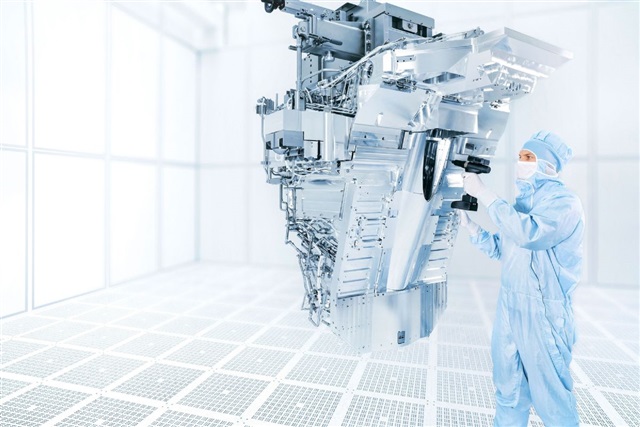
Zeiss and ASML, two European companies that work as an integrated unit, are dominating the market for extreme ultraviolet (EUV) lithography equipment—the technology essential for manufacturing the most advanced AI chips. ASML's second-quarter 2026 results exceeded expectations, reflecting strong demand as semiconductor manufacturers race to build capacity for AI workloads.
Summaries like this, in your inbox every morning.
Sign up free →What happened
Zeiss, which exclusively supplies ASML's extreme ultraviolet (EUV) optical systems, says the two companies operate as though they were one business. This comes as ASML posted second-quarter 2026 results that beat expectations.
Why it matters
EUV lithography is the core technology that makes the most advanced AI chips—the semiconductors powering large language models and data centers. The deep integration between Zeiss and ASML means they function as a single chokepoint in the global supply chain for cutting-edge chip manufacturing, giving them leverage as demand from AI companies drives semiconductor investment.
What to watch
The body does not specify forward milestones, pricing, or future capacity commitments, so concrete next steps are not available from this reporting.
Zeiss and ASML have long operated in tandem, with Zeiss holding the exclusive contract to supply the extreme ultraviolet (EUV) optical systems that ASML's lithography tools depend on. EUV technology is the breakthrough that enables manufacturers to etch transistors at the smallest scales—a prerequisite for building the most powerful AI chips. In recent remarks, Zeiss emphasized that the two companies function as an integrated unit rather than as separate vendor and customer, underscoring how tightly their engineering, supply, and strategic roadmaps are aligned. This level of integration means that advances in one company directly unlock capabilities in the other, creating a self-reinforcing cycle of innovation and capacity expansion. ASML's second-quarter 2026 financial results, announced in the reporting period, exceeded investor expectations, a sign that the semiconductor industry's investment cycle—driven by the urgent need for AI chip manufacturing capacity—remains in strong demand. As data centers worldwide expand their server deployments and AI chip designers push the limits of what is technologically possible, orders for ASML's most advanced lithography systems, which depend entirely on Zeiss's optical precision, have remained robust. This duopoly, spanning two European equipment leaders, now sits at the center of the global race to build AI infrastructure.
The pairing of Zeiss and ASML represents one of the most strategically important collaborations in semiconductor equipment manufacturing. Zeiss's exclusive role as supplier of EUV optical systems—the most technically demanding component in ASML's lithography tools—creates an inseparable dependency between the two firms. Their claim to operate as a single business reflects not merely a supplier-customer relationship but a vertically integrated engineering partnership where innovation and production capacity in one directly enables the other. This structural integration has become a decisive advantage as the AI industry's ravenous demand for advanced chips translates into sustained orders for the most cutting-edge lithography equipment. ASML's second-quarter 2026 results beating expectations signals that this demand environment remains robust.
AI-summarized, only the topics you pick — one digest a day via Email, Slack, or Discord.
Free · takes 30 seconds · unsubscribe anytime
No discussion yet for this article
Get curated AI news from 200+ sources delivered daily to your inbox. Free to use.
Get Started FreeFree · takes 30 seconds · unsubscribe anytime
1 minute a day. The AI essentials.
200+ sources · Email / LINE / Slack
