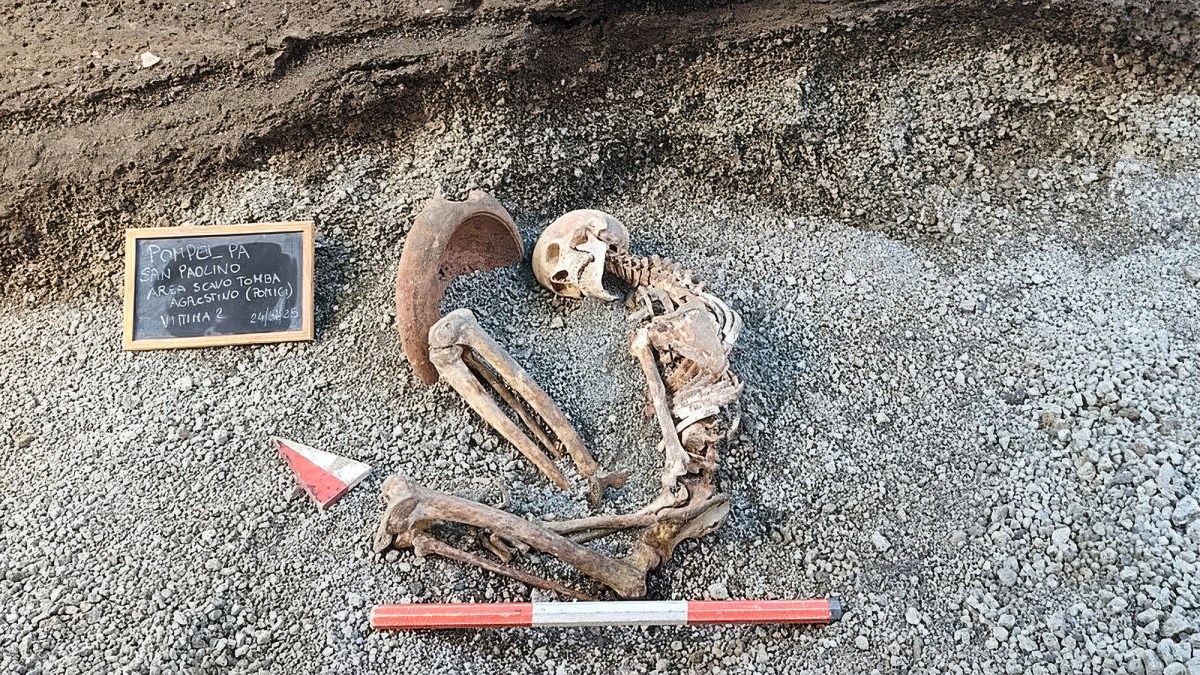
Archaeologists at Pompeii used artificial intelligence to recreate a video of a man's final moments during Mount Vesuvius's eruption in 79 CE, based on physical evidence from his remains. The experimental reconstruction aims to make archaeological discoveries more engaging to general audiences, while the archaeological park's leadership argues that qualified researchers must lead such efforts to ensure accuracy and responsible use of the technology.
Summaries like this, in your inbox every morning.
Sign up free →What happened
The Archaeological Park of Pompeii and University of Padua used artificial intelligence to reconstruct the last moments of a man who died outside Porta Stabia during Mount Vesuvius's eruption in 79 CE. The man, likely in his 20s or 30s, died when the volcano pummeled the area with rock fragments called lapilli; archaeologists found him carrying a terracotta mortar that bore evidence of fracture, suggesting he used it to shield his head as he fled.
Why it matters
The video reconstruction aims to make archaeological findings more accessible to non-experts, according to the Archaeological Park's social media statement. The AI approach allowed the team to process excavation data, generate the video, and incorporate feedback quickly—and to create higher-quality emotional, photograph-like content compared to traditional computer graphics. However, archaeologists also acknowledge downsides: the same ease of use that makes AI convenient for qualified researchers is available to those lacking scientific grounding, raising concerns about accuracy in public-facing reconstructions.
What to watch
The Archaeological Park's director general stated that the scale of Pompeii's data means AI assistance will be necessary to adequately protect and showcase it—and emphasized the importance of archaeologists doing this work themselves rather than leaving it to those without humanities and scientific training. The video is described as an experimental prototype intended to capture public interest through realistic animation.
The Pompeii reconstruction represents a deliberate effort by qualified archaeologists to harness AI's efficiency and visual power for public engagement. The discovery of the two men outside Porta Stabia—one killed by lapilli from the eruption and the other likely killed by a pyroclastic flow hours later—connects logically to historical accounts: Pliny the Younger wrote that people tried to protect themselves with objects or pillows during the eruption, and the fractured mortar found with the older man suggests he adopted exactly this survival strategy. The Archaeological Park's choice to reconstruct the older man's final moments reflects both the emotional resonance of the physical evidence and the practical appeal of AI as a tool: the technology processes excavation data, generates video, and accepts revisions far faster than traditional computer graphics while producing more realistic emotional content.
However, the archaeologists' own caution signals an important tension. The speed and ease that make AI attractive to a responsible research institution are equally available to those without scientific or humanities training. Gabriel Zuchtriegel, the park's director general, frames archaeologist-led AI work as necessary defensive action—a way to ensure that public-facing reconstructions of ancient lives are grounded in actual evidence and scholarly expertise. The vastness of Pompeii's archaeological data makes AI assistance nearly unavoidable for adequate preservation and presentation, yet that scale also creates a risk: if archaeologists do not lead these efforts, others will, potentially spreading inaccurate representations of the past and its people.
No discussion yet for this article
Get curated AI news from 200+ sources delivered daily to your inbox. Free to use.
Get Started FreeFree · takes 30 seconds · unsubscribe anytime
1 minute a day. The AI essentials.
200+ sources · Email / LINE / Slack
