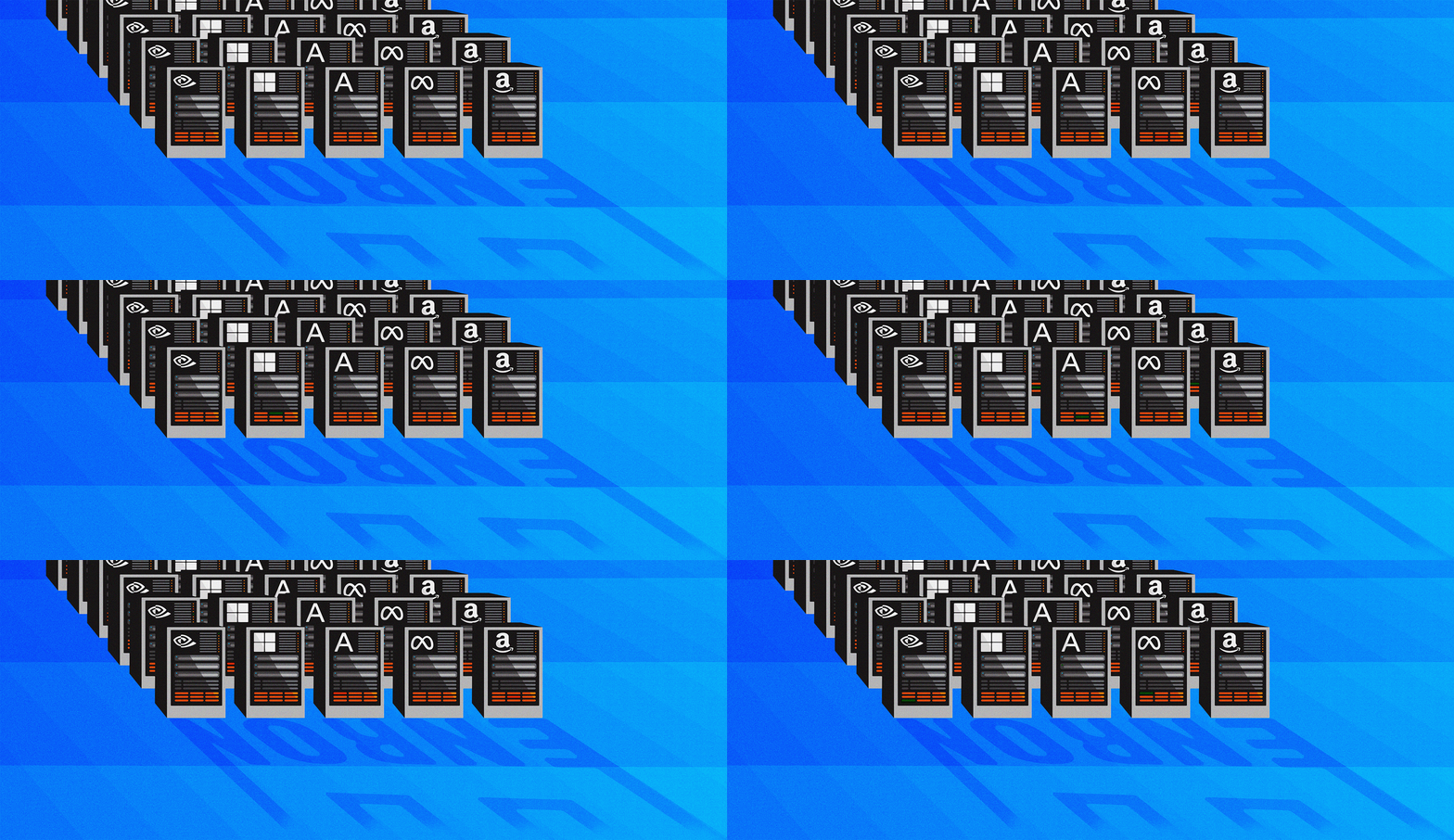
Major technology companies including Meta, Alphabet, and Microsoft are using variable interest entities (VIEs) — special-purpose financing vehicles that keep billions in debt off their main balance sheets — to fund their massive investments in AI infrastructure. This practice echoes the accounting tactics that Enron exploited before its collapse in 2001, though modern rules now require greater disclosure. While auditors and investment analysts say the accounting treatment itself is now legal and more transparent than in Enron's era, they warn that these arrangements can obscure a company's true leverage and obligations from investors, and some argue that major projects like Meta's $27 billion(約4.3兆円) Louisiana data center should be consolidated onto Meta's balance sheet rather than kept separate.
Summaries like this, in your inbox every morning.
Sign up free →What happened
Alphabet, Meta, and Microsoft are using variable interest entities (VIEs) — special financing vehicles that keep debt off their main balance sheets — to fund the trillions in spending needed to build AI data centers and energy infrastructure. Meta's Louisiana data center project (dubbed Hyperion) involves $27 billion(約4.3兆円) in debt held by a separate entity in which Meta and Blue Owl Capital each invested equity; Alphabet maintains VIE arrangements for data center leases and power infrastructure; and Oracle has agreed to backstop another entity's lease for up to $3.3 billion(約5300億円).
Why it matters
These arrangements can mask how much debt and obligation tech companies are actually carrying, giving investors an incomplete picture of financial health — the same tactic Enron used before its collapse 25 years ago. Unlike Enron's era, modern accounting rules now require more disclosure in footnotes, but auditors and analysts say the judgment calls around whether to consolidate these entities remain difficult to contest and often depend on specific contract details. Ratings agencies and some investment analysts, including those at Veritas Investment Research, argue that companies like Meta should be consolidating these projects onto their balance sheets, and that reliance on such structures to improve metrics like EBITDA and free cash flow may signal financial strain.
What to watch
The SEC's chief accountant stated last week that regulators are watching closely to ensure companies describe their relationships with these entities and the accounting they apply. Investors must dig through financial statement footnotes to find the details; Moody's and S&P Global are assessing future lease commitments and infrastructure obligations as they evaluate companies' debt loads. Oracle received a credit downgrade from S&P Global earlier this month due in part to its "stretched leverage," linked to its substantial lease commitments for data centers.
Twenty-five years after Enron Corp. used off-balance-sheet entities to hide hundreds of millions in debt and trigger one of the largest US corporate collapses, a similar financing strategy is now emerging across the technology industry's massive buildout of AI infrastructure. Alphabet Inc., Meta Platforms Inc., Microsoft Corp., Oracle Corp., and Nvidia are all relying on variable interest entities (VIEs) and other special-purpose vehicles to package and finance the trillions in spending required to construct data centers and energy equipment — shifting risks among developers, vendors, and lenders while keeping substantial infrastructure costs out of their main financial statements.
Meta's Louisiana data center project, code-named Hyperion, offers a detailed case study. Last year, Meta and Blue Owl Capital — a major investment firm — each invested equity into a separate legal entity that subsequently took on $27 billion(約4.3兆円) in debt. Another related entity serves as the landlord, while a Meta subsidiary is the sole tenant of the nearly 4,000-acre campus. According to Meta's SEC filings, the social media company determined it should not consolidate this debt onto its own balance sheet because it isn't responsible for finding replacement tenants or attracting additional occupants — a role Meta characterizes as critical to the venture's economic performance. Instead, Meta said its involvement is limited to construction management, administrative services, and property management. Meta's maximum exposure to the venture is $46 billion(約7.4兆円). Last week, Meta announced plans to expand the Hyperion campus; Bloomberg News reported the company expects to spend as much as $250 billion(約40兆円) on the overall project.
Alphabet keeps VIE arrangements for data center leases and credit backstops for power infrastructure off its balance sheet, arguing that it neither directs the structures nor qualifies as the "primary beneficiary" under current consolidation guidance. Microsoft provides minimal detail, only stating that it doesn't consolidate its VIEs. Accounting experts and auditors disagree about whether these determinations are sound. Ben Butler, an investment analyst for Veritas Investment Research Corp., contends that Meta should consolidate Hyperion onto its balance sheet: as the sole tenant, an equity investor, and property manager, Meta appears to have the power to direct the venture's activities. He notes that Meta has disclosed billions in obligations tied to the project. Ernst & Young, Meta's auditors, flagged that evaluating Meta's power to direct the Blue Owl joint venture was "challenging" — a signal of the significant judgment involved in these decisions.
Other major tech companies face similar scrutiny. Oracle has agreed to backstop another entity's lease for up to $3.3 billion(約5300億円) and carries $260 billion(約42兆円) in future lease commitments, mostly for data centers, that will eventually flow onto its balance sheet. S&P Global downgraded Oracle's credit earlier this month, citing in part the company's "stretched leverage." Nvidia has inked $119 billion(約19兆円) in future purchase obligations with vendors to advance AI infrastructure, including a multibillion-dollar purchase commitment for optics technology announced in March. Alphabet, Meta, and Microsoft declined to elaborate beyond their SEC filings or to respond to questions about how the Enron scandal influences their modern accounting approaches.
The risks and opacity mirror Enron's playbook. Enron exploited Financial Accounting Standards Board guidance that permitted companies to keep side arrangements off the balance sheet if they involved a small equity stake from a third party. Modern rules have since tightened: consolidation guidance now requires companies to report VIE assets and liabilities if they have both the power to direct the entity's significant activities and face exposure to significant gains or losses. Companies must also provide more detailed disclosures in footnotes about the nature of these entities and their exposure. Yet David Gonzales, a senior accounting analyst at Moody's, emphasizes that corporate managers' assessments of control depend on specific contract details and are difficult to challenge. He argues that companies should more clearly explain why they do or don't control an entity.
The accounting treatment masks real economic obligations. By not showing interest payments on credit funding AI infrastructure projects, companies can artificially boost profit metrics like EBITDA. Jennifer Law, chief financial and operating officer at K2 Integrity, noted that off-balance-sheet structures allow firms to make return on capital, free cash flow, and leverage appear more attractive than underlying economics warrant. Ben Butler warned: "It can speak levels about what stage we're at if companies are having to rely on SPVs to make their return on capital look good, to make their free cash flow look good, to make leverage look more attractive." Moody's assesses future lease commitments when evaluating companies' debt loads, since those future payments will drain cash and hit free cash flow metrics. Gonzales remarked: "If we just looked at the financial statements, we would be more or less short sighted: missing liabilities, missing obligations, missing key elements of these structures that really truly represent the economics."
Regulators are taking notice. Kurt Hohl, the SEC's chief accountant, stated last week during an audit industry webinar that the agency is watching closely to ensure companies describe their relationships with other entities and the accounting they apply. The challenge for investors is clear: they must dig through footnotes and disclosures to understand the true scope of these arrangements. As Gil Luria, head of technology research for D.A. Davidson & Co., observed: "Enron's crime wasn't having special purpose vehicles. Enron's crime was hiding them." Modern disclosure rules make hiding harder, but investors still face more work than if companies simply borrowed directly — and the underlying question of control, and the risks buried in these structures, remains contested.
The resurgence of off-balance-sheet financing vehicles in big tech mirrors a critical moment in corporate accounting history. Twenty-five years after Enron's collapse — which exploited lax guidance that allowed companies to avoid booking side arrangements if a third party held a small equity stake — technology companies are now using updated versions of the same mechanism to fund their unprecedented AI buildout. The scale is vast: tech companies are looking to spend more than $3 trillion(約480兆円) on AI systems, and the debt and asset commitments related to data centers, chips, servers, and energy equipment are increasingly being tucked into VIEs and other special-purpose vehicles.
Modern accounting rules have tightened since Enron's era, imposing constraints and requiring companies to disclose more details about these entities in financial statement footnotes. Yet auditors and analysts contend that the core judgment call — whether a company truly "controls" an entity and should consolidate it — remains difficult to challenge and heavily dependent on contract specifics. Meta's auditors at Ernst & Young noted it was "challenging" to evaluate whether Meta has the power to direct activities at its Blue Owl joint venture. Meanwhile, investment analysts at Veritas Investment Research argue that Meta should consolidate its Hyperion project onto its balance sheet, given that Meta is the sole tenant, an equity investor, and property manager — a position that appears to give Meta de facto control, despite Meta's own accounting determination to the contrary.
The stakes for investors are material. By keeping these obligations off the balance sheet, companies can present healthier-looking metrics like EBITDA and free cash flow, potentially masking stretched leverage. The SEC's chief accountant flagged last week that regulators are watching closely, and ratings agencies like Moody's and S&P Global are now assessing future lease commitments to see through the accounting treatment. S&P Global downgraded Oracle's credit earlier this month citing "stretched leverage," driven in part by Oracle's enormous future data-center lease commitments. The tension is clear: the accounting is legal and more transparent than it was under Enron-era rules, but investors must still dig through footnotes to grasp the true economic picture.
AI-summarized, only the topics you pick — one digest a day via Email, Slack, or Discord.
Free · takes 30 seconds · unsubscribe anytime
No discussion yet for this article
Get curated AI news from 200+ sources delivered daily to your inbox. Free to use.
Get Started FreeFree · takes 30 seconds · unsubscribe anytime
1 minute a day. The AI essentials.
200+ sources · Email / LINE / Slack
