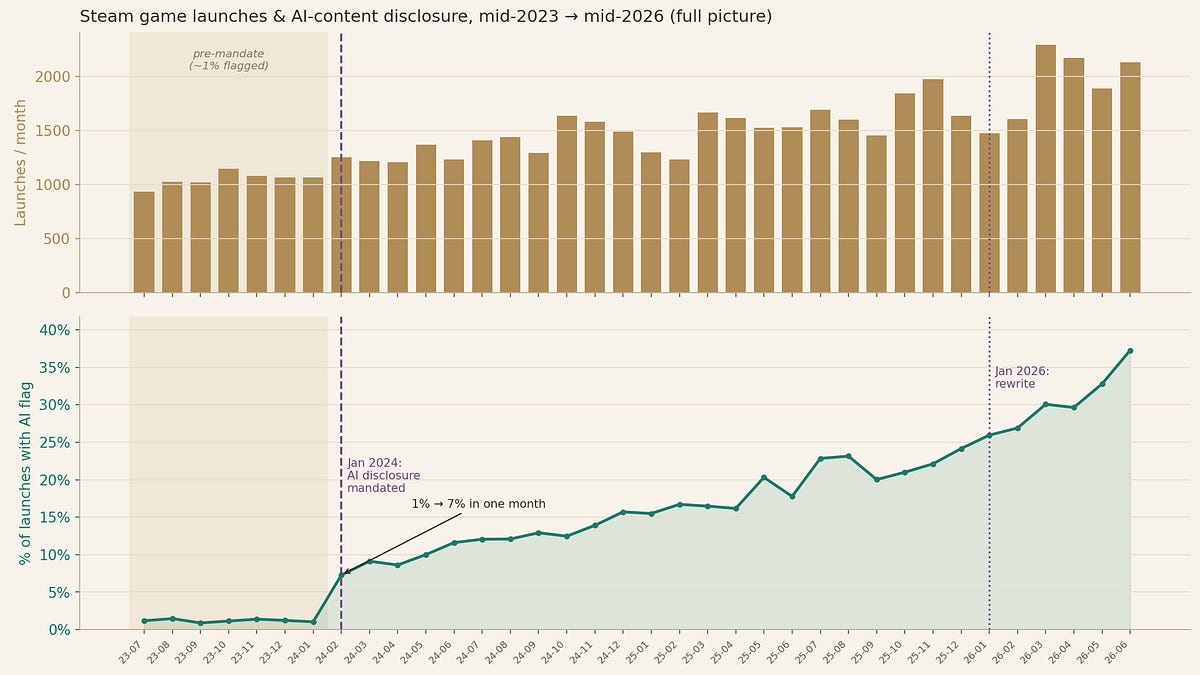
Steam's required AI-content disclosure mechanism, live since January 2024, reveals that AI-flagged games now comprise roughly one in three new releases—but they underperform on a per-game basis, converting at only 55% the rate of non-AI titles. The surge in AI game volume is real: flagged launches jumped from ~13 to ~530 per month, now accounting for 60–90% of platform growth. However, AI's rising share of total revenue (10–27% by late 2025–2026) is a volume story, not quality; successful AI games tend to use AI across multiple modalities (voice, localization, text) and frame their disclosures carefully, while the mass of failed AI games are single-modality art-generation plays with minimal disclosure effort.
Summaries like this, in your inbox every morning.
Sign up free →What happened
A census of 53,597 Steam games released between July 2023 and July 2026 shows that AI-disclosed titles rose from ~1% (retroactive flags) in 2023 to roughly one in three new releases by mid-2026, with AI-flagged launches growing from ~13 per month pre-mandate to ~530 per month.
Why it matters
AI games now account for ~10–27% of sales (measured by review counts) across late 2025 and 2026, but only because volume is high—individual AI games convert at just 55% of the non-AI rate, suggesting developers are shipping more AI titles as low-effort bets rather than building genuinely better products. The median failed AI game is a single-modality art-asset play with a throwaway one-line disclosure, while successful ones use AI for voice, localization, and text and hedge their language carefully.
What to watch
If the trajectory holds, AI-disclosed games may cross 50% of all Steam releases in 2027–2028. Notably, 22% of significant-revenue AI games added their disclosure flag after release—some years later—clustering around Valve's January 2026 policy rewrite, meaning part of the recent uptick reflects back-catalog relabeling, not purely new releases.
Between July 2023 and July 2026, a census of 53,597 Steam game releases captured the full wave of AI disclosure. Before January 2024, Valve had no AI-disclosure mechanism; developers could not flag AI use because no field existed. The ~1% of games appearing with disclosure in 2023 are retroactive relabelings—games that added the flag years later when Valve's system went live. The real adoption curve begins in February 2024, when the first cohorts submitted under the new rule surface and the flagged share jumps to ~7%. From there, it climbs steadily: by mid-2026, roughly one in three new Steam releases carries a genuine, at-submission AI disclosure.
The platform's growth is almost entirely AI-driven. Non-AI game releases rose from ~1,030 to ~1,320 per month, a modest increase. AI-flagged launches, by contrast, exploded from ~13 per month (pre-mandate) to ~530 per month by 2026. Depending on the measurement window, 60–90% of the growth in monthly Steam releases is AI-flagged games. If the trajectory holds, AI-disclosed games will cross 50% of all releases sometime in 2027–2028, though this is a scenario, not a forecast.
Yet AI games underperform economically on a per-title basis. Using review counts as a proxy for units sold, AI games grew from ~3–6% of sales in 2024 to ~10–27% in late 2025 and 2026—real growth, but still well below their ~33% share of launches. Crucially, when you control for time-on-market by comparing AI to non-AI games within the same launch month, the picture is flat: an AI-flagged game reaches modest success (≥100 reviews, roughly ~3,000 sales) at only about 55% of the non-AI rate, and this ratio has not improved over two years. AI's rising sales share is a volume story, not a quality story: more shots on goal, not better conversion. The platform is brutally hit-driven—the top 1% of all titles capture ~94% of revenue, and the top two AI games per quarter routinely represent 45–79% of all AI revenue—so the presence of one or two successful AI hits can swing the quarterly numbers dramatically.
The disclosure text reveals the gap between success and failure. Among 138 successful AI games (≥1,000 reviews) and a random sample of 400 failed ones (<50 reviews, on market ≥9 months), a stark pattern emerges. Flopped AI games are overwhelmingly visual: 72% mention AI art, images, or textures, compared to 57% of successful ones. Successful games are more multimodal and market-oriented—3× more likely to disclose AI voice (24% vs 8%) and localization (18% vs 6%), and more likely to use AI for text and music. In framing, failed disclosures are bare (median 13 words vs 22 for successes; 35% of flops are a single ≤10-word line like "There are some AI generated paintings…"), while successful games hedge and reassure more—59% use minimizing language ("assist / auxiliary / supplementary") vs 41% of flops, and 21% add human-oversight reassurance ("reviewed and manually refined") vs 12%. The pattern is clear: the mass of AI games that go nowhere skew toward low-effort, single-modality art generation with throwaway disclosure, while the rare commercial successes treat AI as a broad toolkit and the disclosure as something to word carefully.
A secondary finding: 22% of significant-revenue AI games added their disclosure flag after release, sometimes years later—Crime Scene Cleaner added it 20 months after launch. These retroactive additions cluster tightly around Valve's January 2026 policy rewrite, the signature of a compliance sweep. This means part of the 2026 uptick in current flag counts reflects back-catalog relabeling, not purely new AI games shipping.
The Steam data captures a pivotal moment in game development: the industry's first year of mandatory AI-content transparency. Because Valve's disclosure mechanism did not exist before January 2024, the dataset cleanly isolates the real adoption wave—retroactive relabeling of older titles is noise, but the February 2024 jump from ~1% to ~7% flagged releases marks the point where new submissions began disclosing AI use at scale. The three-year growth to ~33% of releases by mid-2026 is not a gradual trend but a structural shift in how developers approach shipping: Steam's release volume grew modestly (from ~1,030 to ~1,320 non-AI launches per month), while AI-flagged launches exploded (from a rounding error to ~530 per month). This means 60–90% of the platform's growth is now AI-driven.
However, the economic picture reveals a fundamental quality gap. AI games capture only ~10–27% of sales despite representing ~33% of releases, and crucially, this gap persists when you control for time-on-market—AI games do not catch up to non-AI performance over time. Individual AI titles convert at 55% of the non-AI rate, a ratio unchanged over two years. The revenue data is volatile and hit-driven (the top 1% of all Steam games capture ~94% of revenue; the top two AI games per quarter often represent 45–79% of all AI revenue), but the per-game underperformance is consistent. This pattern is reinforced by the developer-disclosure text: failed AI games (87% of the population) cluster toward single-modality art generation with minimal disclosure effort, while the rare commercial successes use AI more broadly—voice, localization, text—and treat the disclosure as a carefully-worded compliance exercise. The data thus suggests developers are treating AI as a volume lever (shipping more titles with less effort) rather than as a tool to build better games.
AI-summarized, only the topics you pick — one digest a day via Email, Slack, or Discord.
Free · takes 30 seconds · unsubscribe anytime
No discussion yet for this article
Get curated AI news from 200+ sources delivered daily to your inbox. Free to use.
Get Started FreeFree · takes 30 seconds · unsubscribe anytime
1 minute a day. The AI essentials.
200+ sources · Email / LINE / Slack
