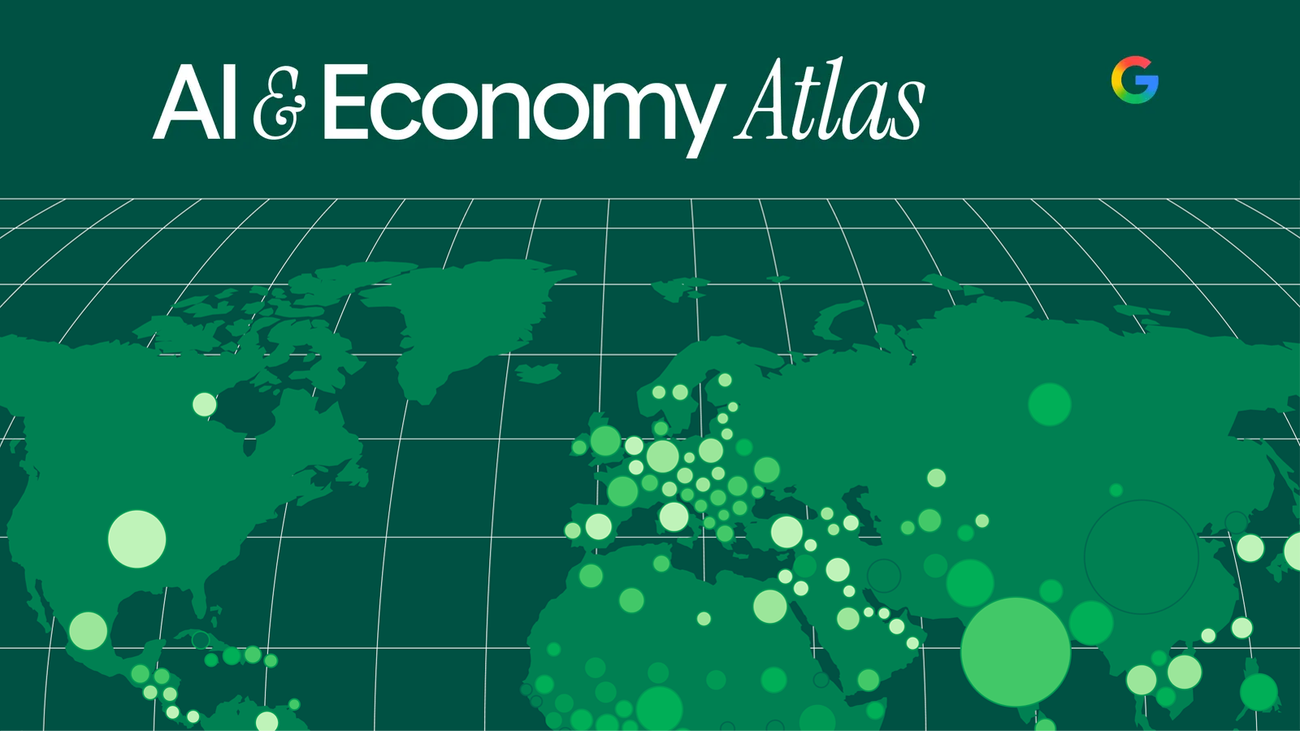
Google has released ATLAS v1.0, a comprehensive study of how over 1 billion monthly users employ AI tools across work and daily life, drawing from 15 million human-AI interactions. The research reveals that while AI adoption spans most occupations and industries, actual use within jobs remains selective—averaging only 21% of tasks—and the majority of AI interactions occur outside work on administrative and household tasks. The findings underscore both the breadth of AI's reach globally and the persistence of a digital divide linked to GDP per capita, with notable adoption exceptions in some middle-income countries.
Summaries like this, in your inbox every morning.
Sign up free →What happened
Google released ATLAS v1.0 (AI & Economy ATLAS), a large-scale study of how people use AI tools built from 15 million aggregated, de-identified human-AI interactions across Gemini App, AI Mode, and the Gemini API. The dataset spans more than 150 countries, 140 languages, 800 occupations, and 4,000 tasks.
Why it matters
ATLAS reveals how AI adoption is actually unfolding in practice rather than in theory. Key findings show AI use at work is broad but shallow—spanning 68% of occupations representing 90% of U.S. employment, yet within jobs people use AI for only ~21% of tasks. Over 86% of AI interactions happen outside work, addressing administrative friction and household tasks often invisible to standard economic metrics. This empirical evidence is critical for policymakers, businesses, and researchers trying to understand AI's true economic impact.
What to watch
Google plans to expand ATLAS over time as a long-term project. The company notes that ATLAS currently covers only Gemini products; a much wider range of AI usage exists in Google Workspace, Google Translate, AI Overviews, Gemini for Google Cloud, and Gemini Enterprise, but these are not yet reflected in the dataset.
Google announced ATLAS v1.0 (AI & Economy ATLAS—Activity, Task, Landscape, and Adoption Study), an ongoing, large-scale study designed to provide empirical evidence on how AI is being adopted and used across the global economy. The launch reflects Google's recognition that while the potential for AI to transform work and economic life is widely acknowledged, the actual outcomes depend on concrete adoption patterns that remain poorly understood. To address this, Google is making public the first iteration of ATLAS, built from 15 million aggregated and de-identified human-AI interactions spanning Gemini App, AI Mode, and the Gemini API, which together serve more than 1 billion people monthly.
The dataset is geographically and linguistically diverse: ATLAS v1.0 insights span more than 150 countries, 140 languages, 800 occupations, and 4,000 tasks, making it, according to Google, "the most comprehensive look to date at how real people are using AI at scale." The study employs strict privacy protections, built atop Google DeepMind's OCTO (Observation Clustering and Taxonomy Organisation), a tool for transforming unstructured LLM conversation data into organized entities. Beyond removing personally identifiable information, ATLAS adds multiple protective layers that automatically strip sensitive references, sever linkages between de-identified data and user logs, summarize text, and aggregate summaries across multiple users.
Key findings reveal both the breadth and limits of AI adoption. Workplace adoption is broad but shallow: AI use spans 68% of occupations representing 90% of U.S. employment, yet within jobs people use AI for only ~21% of tasks. At work, the vast majority of AI interactions focus on collaborative uses such as ideation, strategy, information retrieval, and learning. Creative design and hypothesis testing (termed "non-routine cognitive" tasks) appear in AI work interactions at a much higher rate than in the overall economy—65% versus 35%. Critically, less than 10% of work interactions fully automate tasks, indicating that current AI use is primarily assistive rather than replacement-focused. AI adoption extends beyond knowledge work: workers in manual and technical trades—auto technicians, industrial mechanics—use conversational AI for real-time diagnostics, troubleshooting, and on-the-fly learning, and when they do, they are 2× more likely to use multimodal AI for creating images or video.
Outside work, AI's impact may be underestimated by traditional economic metrics. Over 86% of ATLAS interactions occur outside work, with people using AI for productive household activities like researching purchases and help with appliances, as well as high-friction administrative tasks such as navigating government services for taxes, licensing, and fines. Globally, AI adoption correlates with GDP per capita, though with exceptions: English represents only about a third of global AI conversations, and users do not abandon native languages for complex tasks. Some middle-income countries in South America and the Middle East are adopting AI at rates comparable to higher-income nations, suggesting the digital divide is not monolithic. Google acknowledges that ATLAS v1.0 represents just the beginning and notes that a much wider range of economically-relevant AI usage remains unmeasured, including AI-enabled products with billions of users and interactions like Google Workspace, Google Translate, and AI Overviews, as well as enterprise platforms such as Gemini for Google Cloud and Gemini Enterprise. The company plans to expand ATLAS scope and capabilities in collaboration with academic and other researchers, with contributions acknowledged from Dame Diane Coyle (Cambridge) and Dr. David Autor (MIT).
Google's ATLAS project addresses a critical gap in understanding AI's real-world economic impact. While broad consensus exists that AI has significant potential to transform work and the economy, evidence-based data on actual adoption patterns has been scarce. ATLAS aims to fill this void by offering empirical insights rather than speculation. The study is built on Google DeepMind's OCTO tool, which transforms unstructured LLM conversation data into organized entities while maintaining strict privacy protections—personally identifiable information is scrubbed, and multiple additional layers automatically remove sensitive references and sever linkages to underlying user logs.
The findings paint a nuanced picture: AI adoption is geographically broad and occupationally diverse, yet economically shallow in practice. Workers across all sectors are experimenting with AI, including those in manual trades like automotive technicians and industrial mechanics, who use it for real-time diagnostics and on-the-fly learning. However, this experimentation is selective rather than transformative. The fact that within a typical job AI is used for only ~21% of tasks, and less than 10% of interactions fully automate work, suggests that current AI use is primarily augmentative—assisting and collaborating with workers rather than replacing them wholesale. The finding that over 86% of AI interactions happen outside work is particularly significant because it points to value creation and friction reduction in areas—tax filing, appliance troubleshooting, purchase research—that conventional economic metrics may not capture.
Globally, ATLAS shows that AI adoption tracks GDP per capita, with English representing only about a third of conversations and users retaining their native languages for complex tasks. Notably, some middle-income countries in South America and the Middle East are adopting AI at rates comparable to higher-income countries, suggesting the digital divide is not absolute. Google frames ATLAS as the first iteration of a long-term project; the company acknowledges that the dataset currently covers only Gemini products, while other AI-enabled services with billions of users—Google Workspace, Google Translate, AI Overviews—and enterprise platforms remain unmeasured.
AI-summarized, only the topics you pick — one digest a day via Email, Slack, or Discord.
Free · takes 30 seconds · unsubscribe anytime
No comments yet. Be the first to share your thoughts!
Log in to join the discussion


Get curated AI news from 200+ sources delivered daily to your inbox. Free to use.
Get Started FreeFree · takes 30 seconds · unsubscribe anytime
1 minute a day. The AI essentials.
200+ sources · Email / LINE / Slack
