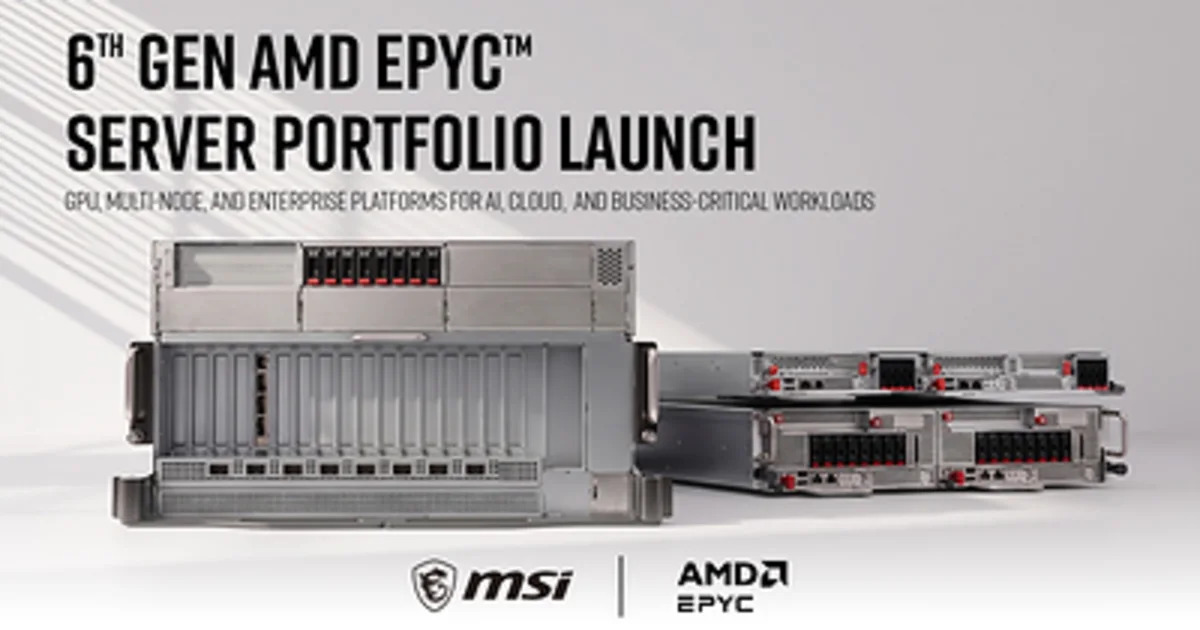
MSI launched a new server portfolio powered by 6th Gen AMD EPYC Server CPUs on July 23, 2026, designed to modernize data centers for AI, cloud, and other intensive workloads. The platforms come in two configurations: SP7 with up to 256 cores and 512 threads per processor for high-performance deployments, and SP8 with up to 128 cores and 256 threads per processor for balanced mainstream use. The lineup includes liquid-cooled GPU servers and multi-node platforms that allow organizations to match infrastructure to their specific workload needs.
Summaries like this, in your inbox every morning.
Sign up free →What happened
MSI introduced a new server portfolio powered by 6th Gen AMD EPYC Server CPUs on July 23, 2026, spanning liquid-cooled GPU servers, multi-node platforms, and enterprise servers across SP7 and SP8 designs. SP7 platforms deliver up to 256 cores and 512 threads per processor, while SP8 platforms offer up to 128 cores and 256 threads per processor.
Why it matters
The portfolio addresses growing demand for workload-specific data center architecture. Organizations can now select systems designed with purpose around performance, density, efficiency, and serviceability as infrastructure evolves to handle AI, cloud, HPC, virtualization, and business-critical workloads.
What to watch
MSI showcased the CD270-S4091-X2 multi-node server at AMD Advancing AI 2026. The CG681-S6093 Liquid-Cooled 6U GPU Server supports dual 6th Gen AMD EPYC Server CPUs, 400G networking, and E1.S NVMe storage for accelerated AI deployments.
MSI announced its 6th Gen AMD EPYC Server portfolio on July 23, 2026, introducing a broad range of server platforms designed to serve the evolving needs of enterprise data centers. The announcement came during the AMD Advancing AI 2026 event, where MSI showcased the CD270-S4091-X2 multi-node server as a flagship example of the new lineup.
The portfolio is built on two processor configurations. SP7 platforms feature up to 256 cores and 512 threads per processor and are optimized for performance-driven deployments requiring maximum density. SP8 platforms offer up to 128 cores and 256 threads per processor, positioned for mainstream deployments where balance between performance, efficiency, and cost is critical. This dual-track strategy reflects market demand for workload-specific architecture, as Danny Hsu, General Manager of MSI's Enterprise Platform Solutions, explained: "Data center architecture is becoming more workload-specific, and customers need systems that can be selected with purpose. MSI's latest server portfolio powered by 6th Gen AMD EPYC Server CPUs gives organizations the platform range to build around performance, density, efficiency, and serviceability as their infrastructure evolves."
The product lineup encompasses three main form factors. The CG681-S6093 Liquid-Cooled 6U GPU Server represents MSI's offering for dense AI deployments, built on SP7 architecture with dual 6th Gen AMD EPYC Server CPUs, 400G networking, and E1.S NVMe storage to handle accelerated workloads with liquid-cooling efficiency. Multi-node platforms are available in both 19-inch and 21-inch DC-MHS designs across SP7 and SP8 configurations, optimized for cloud, virtualization, containerized workloads, and scale-out enterprise applications. These air-cooled platforms allow customers to balance compute density, performance, and power efficiency in modern data centers. Enterprise servers complete the portfolio to address traditional business-critical applications.
AMD's Dan McNamara, senior vice president and general manager of Compute and Enterprise AI, positioned the 6th Gen EPYC lineup as a trusted foundation for modern infrastructure: "AMD enterprise AI technologies have become the trusted foundation for the modern data center, and 6th Gen AMD EPYC Server CPUs extend that leadership with a new level of performance, efficiency and scalability. As enterprises scale cloud, HPC, virtualization and AI workloads, EPYC CPUs provide a trusted foundation for AI performance, infrastructure consolidation and innovation, while continuing to deliver leadership general-purpose compute for the business-critical applications and workloads that keep organizations running every day."
MSI's launch on July 23, 2026 reflects a shift in enterprise data center strategy toward purpose-built infrastructure. Rather than deploying generic compute platforms, organizations increasingly need systems tailored to specific workload profiles—whether optimizing for raw performance density, balanced efficiency, or specialized AI acceleration. The dual-configuration approach (SP7 and SP8) enables customers to right-size investment based on use case, avoiding overcapacity in mainstream deployments while supporting extreme-scale AI and HPC work where needed.
The product lineup spans multiple deployment styles: liquid-cooled GPU servers for dense accelerated inference and training, multi-node architectures for cloud and containerized scale-out, and enterprise platforms for traditional business workloads. This breadth suggests MSI is positioning itself as an infrastructure partner for the modern data center's heterogeneous demands. AMD's role as the underlying CPU vendor reinforces the continued dominance of EPYC in the enterprise segment, where the combination of core density, efficiency, and memory bandwidth supports both conventional virtualization and emerging AI workloads on a single platform.
AI-summarized, only the topics you pick — one digest a day via Email, Slack, or Discord.
Free · takes 30 seconds · unsubscribe anytime
No discussion yet for this article
Get curated AI news from 200+ sources delivered daily to your inbox. Free to use.
Get Started FreeFree · takes 30 seconds · unsubscribe anytime
1 minute a day. The AI essentials.
200+ sources · Email / LINE / Slack
