What happened
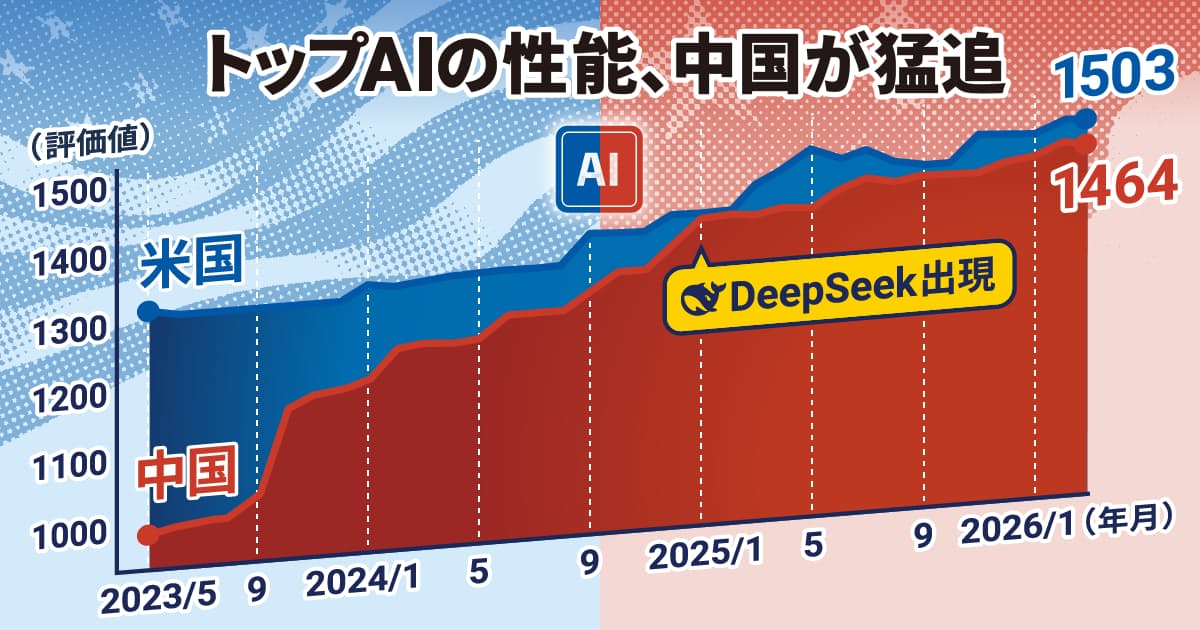
Stanford University reports that the performance gap between top US and Chinese AI models has narrowed sharply, with Chinese firms now competing closely on capability.
Why it matters
The race now hinges on money versus cost-efficiency, as US tech giants lead in funding while Chinese rivals offer comparable performance at lower prices, potentially reshaping global AI adoption.
What to watch
Whether cost advantage will let Chinese models gain market share in developer and enterprise use, and how US firms respond on pricing.
Summaries like this, every morning.
The article highlights a shift in the US-China AI rivalry: while the US has dominated cutting-edge model development, Chinese companies are now catching up, with Stanford University noting a rapidly closing performance gap. This suggests that capability alone is no longer the deciding factor.
The competition now centers on economics. US firms have greater financial resources, but Chinese models are often cheaper, with Alibaba reportedly offering performance close to US standards at less than half the price. This cost efficiency could make Chinese AI attractive to developers and businesses, potentially shifting market dynamics.
The stakes are high, as AI leadership may influence economic growth and global order. The test is whether China's cost advantage can translate into broader adoption, and whether US firms will respond with pricing or innovation. The article's mention of US companies switching to cheaper Chinese AI suggests this is already happening, but the long-term winner remains uncertain.
Pick your industry and the AI tools you use, and get news related to your work every day.
Free · 30 seconds with Google · unsubscribe anytimeWhat is AIToday? →
Ask AI anything about this article. The AI reads this article, earlier AIToday articles, and Wikipedia, and cites its sources. Q&As are published on this page for other readers too.
In a Google blog post summarizing the video "The Agent Factory" on Sept 25, 2026, Ryan Lopopolo defined an age…

Nvidia and TCV invested in AI video startup Higgsfield Inc

Meta reported Q3 2026 revenue of US$64.6b, up 26%, but a US$9.9b legal charge tied to teen safety settlements…

Yayoi started the open beta of Yayoi no Kicho Daiko AI on October 23, free for all Yayoi PAP members, after a…

ModelCompare asked 12 AI models three times each for their most controversial view of humans; all 12 gave the…
The explainer cites Anthropic's definition of an agent as an LLM that dynamically decides its own process flow…