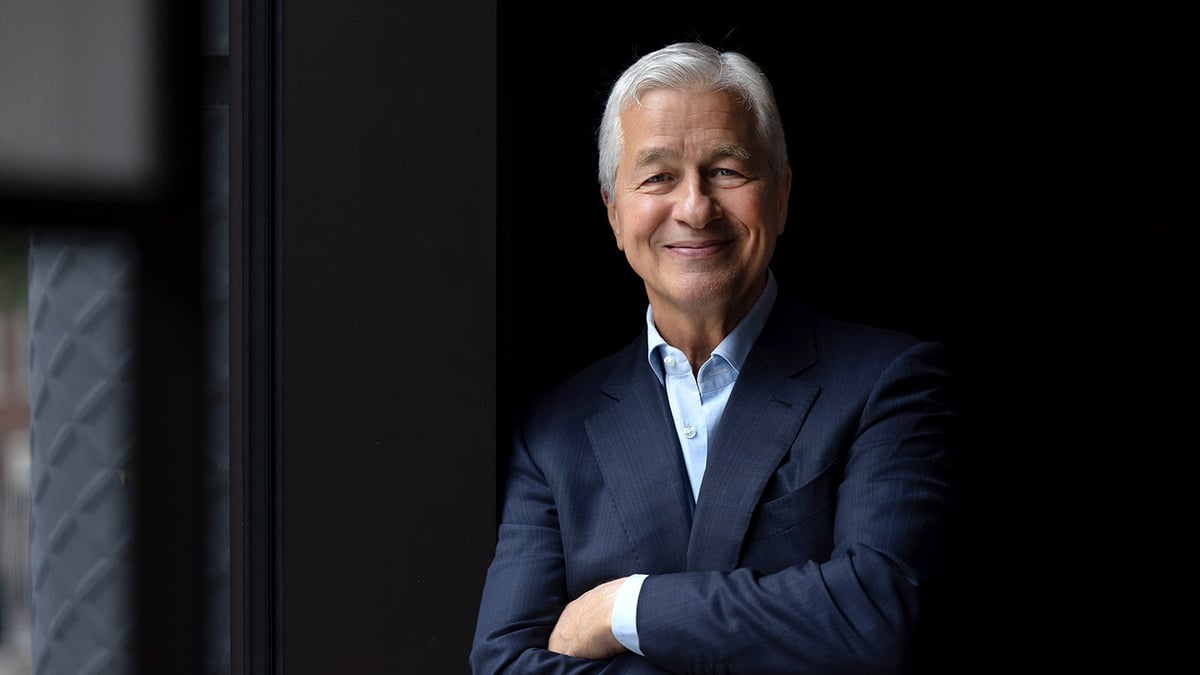
JPMorgan Chase CEO Jamie Dimon said on the bank's latest earnings call that AI capital expenditure is projected to exceed $1 trillion(約160兆円) next year, up from $700 billion(約110兆円) this year. He noted this would mean AI spending accounts for more than a quarter of all company capital expenditure in 2027, though he cautioned that the current market momentum may not be permanent.
Summaries like this, in your inbox every morning.
Sign up free →What happened
JPMorgan Chase CEO Jamie Dimon said on the bank's second-quarter earnings call that AI capital expenditure is projected to reach a little over $1 trillion(約160兆円) next year, up from $700 billion(約110兆円) this year and $400 billion(約64兆円) last year.
Why it matters
Dimon's projection means AI spending will account for more than a quarter of all company capital expenditure in 2027, signaling that businesses view AI investment as central to future operations. JPMorgan Chase and Goldman Sachs both reported strong second-quarter earnings driven by investment banking activity, with investment banking revenue up 45% year-over-year at JPMorgan Chase and 55% at Goldman Sachs.
What to watch
Dimon cautioned that although the current market is "getting close to as good as it gets," investors should remember "we just don't know how long it's going to last"—a reminder that the AI spending surge may not continue indefinitely.
All five of the largest U.S. banks reported second-quarter earnings on Tuesday, with results described as "almost uniformly outstanding." JPMorgan Chase and Goldman Sachs led the earnings announcements as the two top investment banks in the country. Investment banking revenue was a particular bright spot, rising 45% year-over-year at JPMorgan Chase and 55% at Goldman Sachs, driven largely by market-related activity such as initial public offerings.
On JPMorgan Chase's earnings call, CEO Jamie Dimon addressed the role of artificial intelligence in the bank's outlook and the broader economy. He stated that total capital expenditure across companies is approximately $4 trillion(約640兆円), with AI representing a substantial and growing portion of that spending. "AI went from $400 billion(約64兆円) last year to $700 billion(約110兆円) this year," Dimon said. "People project, which so do our people, it will be like a little over a trillion next year and maybe a little reduction in the non-AI capex." This projection implies that AI spending will account for more than a quarter of all company capital expenditure in 2027.
Dimon also offered a note of caution for investors. Although he acknowledged that the current market is "getting close to as good as it gets," he stressed the importance of remembering a fundamental uncertainty: "We just don't know how long it's going to last." Despite this caveat, he indicated that in the near term, the AI investment cycle is likely to continue driving growth and supporting stock valuations for companies involved in the sector.
JPMorgan Chase and Goldman Sachs reported exceptionally strong second-quarter earnings this week, with investment banking divisions leading the performance—investment banking revenue jumped 45% year-over-year at JPMorgan Chase and 55% at Goldman Sachs. This strength reflects robust market activity, particularly in initial public offerings. Against this backdrop, Dimon's comments about AI spending carry weight: he framed the AI investment surge as both a major driver of near-term opportunity and a structural shift in how companies allocate capital.
Dimon's numbers tell a steep growth story. AI spending tripled from $400 billion(約64兆円) two years ago to $700 billion(約110兆円) this year, and is now projected to reach a little over $1 trillion(約160兆円) next year. Because total capital expenditure stands at about $4 trillion(約640兆円), this trajectory means AI will consume more than one-quarter of all corporate spending by 2027—a remarkable concentration of investment in a single technology area. At the same time, Dimon signaled caution: he noted that while the current market is "getting close to as good as it gets," the duration of the AI spending cycle remains uncertain, implying that executives and investors should not assume the current momentum will extend indefinitely.
AI-summarized, only the topics you pick — one digest a day via Email, Slack, or Discord.
Free · takes 30 seconds · unsubscribe anytime
No discussion yet for this article
Get curated AI news from 200+ sources delivered daily to your inbox. Free to use.
Get Started FreeFree · takes 30 seconds · unsubscribe anytime
1 minute a day. The AI essentials.
200+ sources · Email / LINE / Slack
