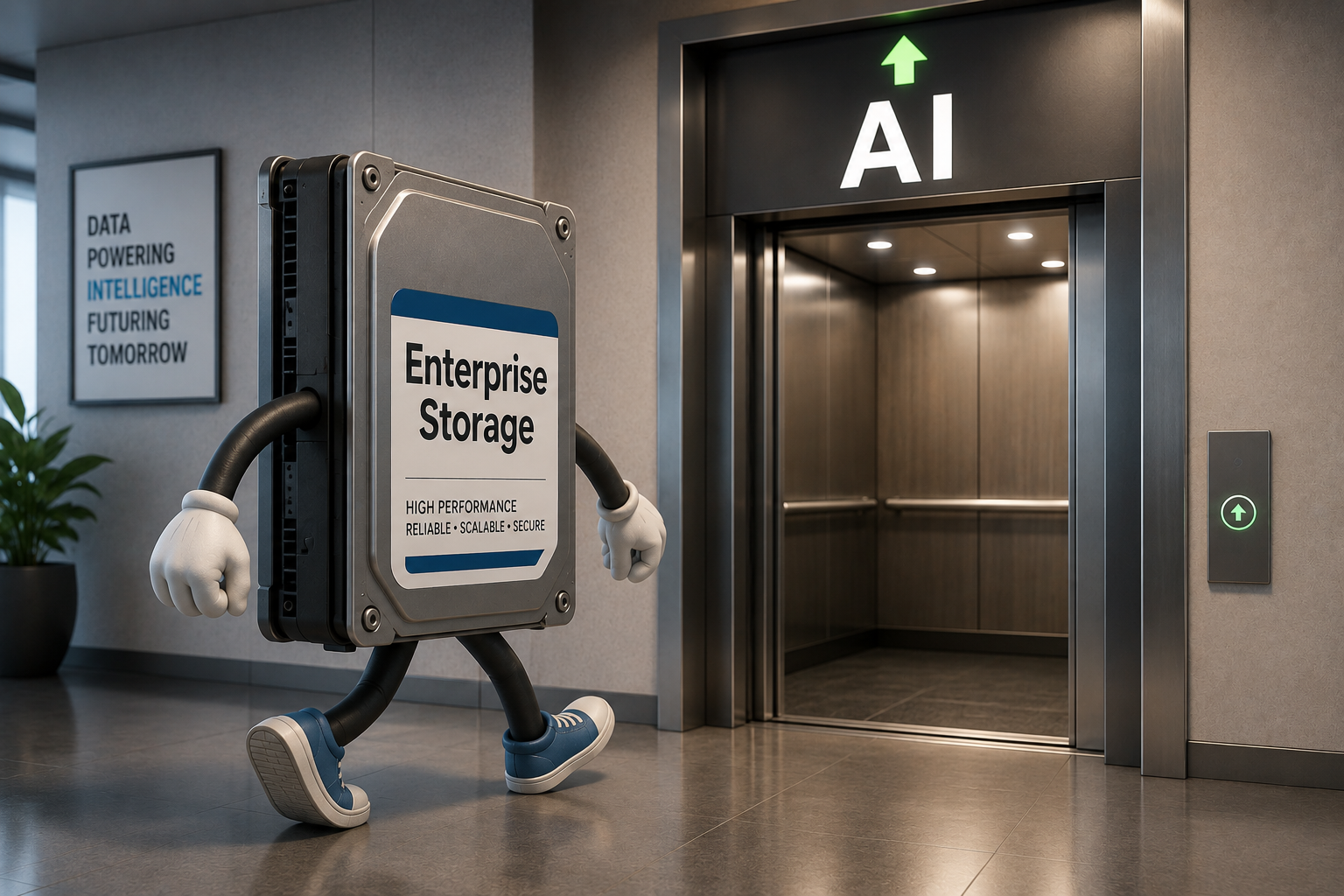
Storage technology has moved from a supporting role to a core component of AI infrastructure, tasked with managing massive amounts of context memory and KV cache that agentic AI systems now require. This shift reflects the transition from simple chatbots to autonomous AI agents that need to process and retain far larger amounts of contextual data across longer, iterative workflows. Storage's new dedicated tier within AI clusters marks a fundamental architectural change that vendors and enterprises are racing to address.
Summaries like this, in your inbox every morning.
Sign up free →What happened
Storage has taken on a new dedicated function in AI clusters—storing context memory and KV cache for agentic AI systems. Nvidia's BlueField-4 STX architecture, announced in March, introduced Context Memory Storage (CMX) to expand GPU memory across the rack and enable large language models to handle million-token context windows.
Why it matters
As AI workloads shift from single prompts to extended agentic sessions, the volume of data to store is growing into petabytes—far exceeding what standard GPU and DRAM can handle. Storage is now a strategic differentiator rather than a supporting component. For enterprises, this means the ability to feed models with high-quality data and sustain throughput across distributed environments has become equally important to GPU performance alone.
What to watch
A Deloitte forecast notes that inference will account for approximately two-thirds of AI compute in 2026. The emerging context graph tool—an accumulated structure of decision traces woven among entities and time—is being positioned as critical infrastructure for agentic AI to access the right context across fragmented data sources.
The article frames 2026 as a pivotal moment when storage technology has undergone a functional promotion within AI infrastructure. Historically, storage supported GPU servers or functioned in shared network environments, but the shift to agentic AI systems—which operate autonomously over extended sessions and require substantial contextual working memory—has created a third dedicated role: context memory storage. This transition reflects a broader architectural change in how enterprises build production-grade AI systems. The body describes how large language models and agentic AI inference generate massive key-value (KV) caches that grow beyond what expensive GPU memory or inefficient CPU movement can accommodate, pushing storage itself into the inference engine.
Two infrastructure trends are converging here. First, Nvidia's announcement of BlueField-4 STX in March with its Context Memory Storage capability provided a market catalyst and concrete technical blueprint for disaggregated storage architecture. Second, the focus on inference—expected to account for approximately two-thirds of AI compute in 2026 according to Deloitte—means that sustained data throughput and efficient cache management have become competitive imperatives. Companies like Neo4j are simultaneously investing in context graph technology—an accumulated structure of decision traces across entities and time—to help agentic AI systems access the right information across fragmented data sources. For businesses and developers, this implies that storage efficiency and architectural awareness are no longer afterthoughts but core design considerations in enterprise AI deployment.
No comments yet. Be the first to share your thoughts!
Log in to join the discussion



Get curated AI news from 200+ sources delivered daily to your inbox. Free to use.
Get Started FreeFree · takes 30 seconds · unsubscribe anytime
1 minute a day. The AI essentials.
200+ sources · Email / LINE / Slack
