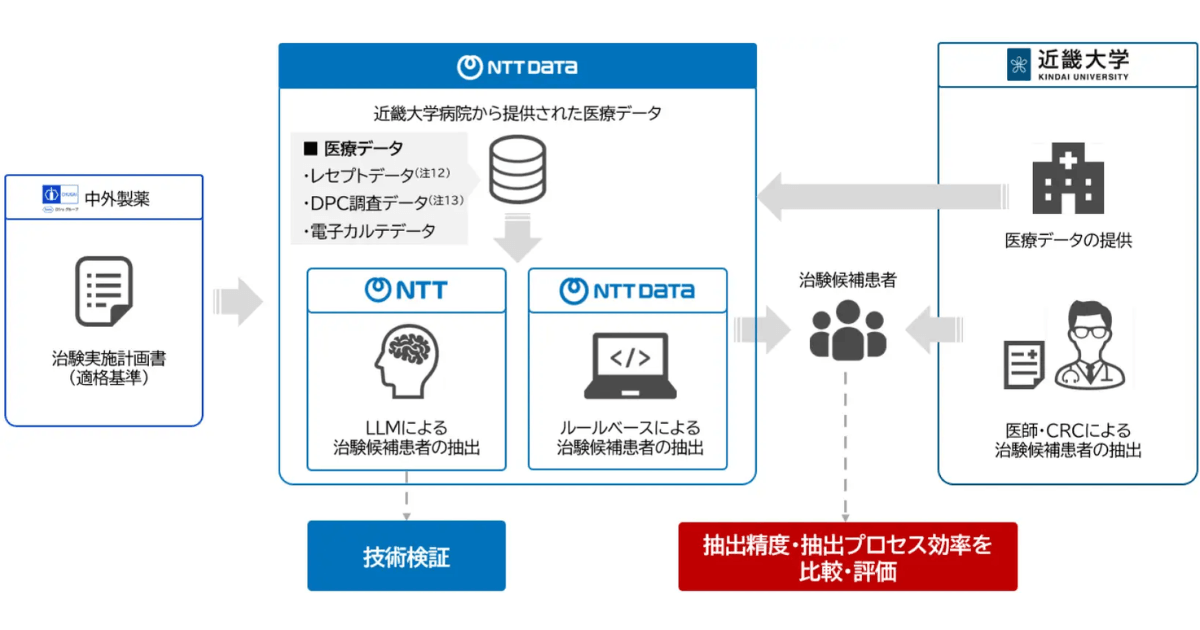
Four Japanese organizations—Kindai University Hospital, Chugai Pharmaceutical, NTT, and NTT Data—have launched a joint research project using real-world clinical data and large language models (LLMs) to improve the accuracy and efficiency of identifying candidate patients for clinical trials. The study, which will run through March 2027, aims to compare rule-based methods with LLM-based approaches to speed up trial enrollment, reduce overall trial duration, and help patients access new treatment options faster.
Summaries like this, in your inbox every morning.
Sign up free →何が起きたか
近畿大学病院、中外製薬、NTT、NTTデータの4者が、リアルワールドデータとLLM(大規模言語モデル)を用いて、治験候補患者の抽出精度と業務効率を検証する共同研究を開始しました。2027年3月まで実施予定です。
なぜ重要か
従来、治験候補患者の抽出には医師や治験コーディネーター(CRC)が診療情報を個別に確認する必要があり、多くの時間と労力がかかっていました。この研究により治験の参加者組み入れが円滑になれば、治験全体の期間短縮や製薬企業の開発スピード向上につながる可能性があります。
注目点
技術検証ではNTT独自開発の純国産LLM「tsuzumi 2」を使用し、ルールベース手法とLLMの3通りの抽出方法(①ルールベース手法②LLM活用③両者の組み合わせ)を比較します。医師やCRCによる判定結果と照らし合わせて精度を評価します。
Kindai University Hospital, Chugai Pharmaceutical, NTT, and NTT Data have initiated a collaborative research program to evaluate how artificial intelligence, specifically large language models (LLMs), can improve the identification of eligible candidates for clinical trials.
The motivation is clear: finding and enrolling patients who meet a trial's eligibility criteria is a labor-intensive manual process. Currently, physicians and clinical research coordinators (CRCs) must individually review each patient's medical information against the detailed eligibility criteria set out in the trial protocol. This approach demands significant time and effort, and delays in enrollment have been documented to disrupt trial schedules and slow the drug development pipeline overall.
In parallel, healthcare organizations have accumulated growing volumes of real-world clinical data—patient records, electronic health records, and other unstructured information from actual patient care. LLMs, which can interpret and extract meaning from large, mixed-format datasets, offer a potential way to automate and accelerate the candidate identification process. The research team will test this hypothesis by extracting candidate patients from Kindai University Hospital's electronic health record data according to eligibility criteria established by Chugai Pharmaceutical.
To ensure safe handling of sensitive patient information, NTT Data will contribute its operational expertise from running "Sennen Karute" (a medical data management platform), bringing established practices in data governance and secure information management. The technical validation will employ NTT's proprietary domestically developed LLM, "tsuzumi 2," which is specifically engineered to manage sensitive medical data. The team also plans to enhance the model through continued learning from published medical research, creating a healthcare-specialized version for the study.
The research will compare three extraction approaches: (1) rule-based methods using Python and SQL, where trial criteria are pre-programmed; (2) LLM-based extraction; and (3) a hybrid combining both methods. The accuracy of each approach will be benchmarked against the judgments of physicians and CRCs. Additionally, the team will measure the time required for candidate extraction and track the workload changes for clinical staff, directly assessing whether AI-assisted identification can shorten the time to recruit trial participants.
Importantly, the research explicitly states that AI output is intended as a decision-support tool for physicians; all final medical judgments remain the responsibility of doctors. The study has received approval from Kindai University Hospital's ethics committee and is planned to run through March 2027. The four organizations intend to use the findings to explore broader implementation of AI-assisted patient identification across hospitals and pharmaceutical companies in Japan.
Clinical trial patient recruitment has long been a bottleneck in drug development. Physicians and treatment coordinators (CRCs) must manually review patient medical records against eligibility criteria defined in the trial protocol—a process that is time-consuming and labor-intensive. The body notes that this manual approach has led to enrollment delays that impact the overall trial schedule, a problem that affects both pharmaceutical companies' development timelines and patients' access to new therapies.
The four-party collaboration addresses this challenge by leveraging two converging trends: the accumulation of real-world clinical data (electronic health records and patient information from actual care) and the maturation of LLM technology capable of interpreting unstructured medical data at scale. Rather than betting on a single approach, the research deliberately compares three methods—traditional rule-based programming, LLM-based extraction, and a hybrid approach—against physician and CRC judgments as the gold standard. This design allows the team to evaluate not only accuracy but also processing time and workload reduction, making the results actionable for hospitals and drug developers.
The choice of NTT's domestically developed "tsuzumi 2" reflects an emphasis on data governance and the handling of sensitive patient information, concerns that are critical in medical settings. The research team plans to extend the LLM's capabilities by continuing to train it on medical literature, positioning it as a healthcare-specialized tool. If successful, the results could establish a template for wider adoption of AI-assisted patient identification across the Japanese healthcare and pharmaceutical sectors.
No comments yet. Be the first to share your thoughts!
Log in to join the discussion


Get curated AI news from 200+ sources delivered daily to your inbox. Free to use.
Get Started FreeFree · takes 30 seconds · unsubscribe anytime
1 minute a day. The AI essentials.
200+ sources · Email / LINE / Slack
