
What happened
Starbucks is developing AI-powered tools to replace Microsoft inventory-tracking and IBM maintenance management systems, aiming to reduce its $400 million(約640億円) annual software spend. The news sent Microsoft down 2.4%, IBM down 5.2%, and Starbucks up over 3%; Toast shares spiked 2.3% at the same time.
Why it matters
Starbucks' move reflects a broader corporate trend toward building software in-house to cut costs—but the company's own recent failure (it abandoned an AI-powered inventory system and reverted to manual counting) signals the hidden maintenance burden. This dynamic may eventually push companies back to integrated third-party platforms like Toast, which combine point-of-sale, payments, and operations software.
What to watch
Toast ended Q1 2026 with 171,000 live locations (up 22% year over year) and is expanding into enterprise accounts. The company's AI-assisted engineering velocity is up 60%, its AI marketing agent achieved an 8% average sales increase in pilots, and it trades at roughly 45 times trailing earnings with 21% GAAP operating margins.
Summaries like this, in your inbox every morning.
Starbucks' decision to build software in-house reflects a common corporate pattern: as software expenses mount and AI development tools improve, leadership pursues proprietary solutions to cut costs. However, the article notes a critical flaw in this logic—Starbucks itself abandoned an AI-powered inventory system in favor of manual counting, illustrating that internal development carries hidden costs in security updates, integration work, and engineering headcount that often exceed the initial savings.
The significance for Toast, a cloud-based restaurant operations platform, lies in a longer-term bet. Toast operates as a vertically integrated specialist, combining point-of-sale hardware, payment processing, and operational software into a single system. While Starbucks is unlikely to become a Toast customer (the chain's established mobile app and loyalty program, plus global complexity, favor enterprise giants like IBM and Microsoft), the Starbucks news exemplifies two structural advantages for specialists: legacy vendors like Oracle's Simphony are vulnerable to replacement, and large enterprises spend heavily on operational tech ($400 million(約640億円) annually at Starbucks alone). As in-house AI experiments mature and maintenance burdens accumulate, the article suggests some of those companies may eventually seek out modern integrated platforms with built-in support and maintenance contracts. Toast has positioned itself in this space—the company ended Q1 2026 with 171,000 live locations (up 22% year over year), is expanding into enterprise accounts, and has embedded AI throughout its operations (engineering velocity up 60%, AI handling 40% of customer support). Whether that positioning translates to market share gains depends on how many companies abandon their homegrown experiments.
Pick your industry and the AI tools you use, and get news related to your work every day.
Free · 30 seconds with Google · unsubscribe anytimeWhat is AIToday? →
Ask AI anything about this article. The AI reads this article, earlier AIToday articles, and Wikipedia, and cites its sources. Q&As are published on this page for other readers too.
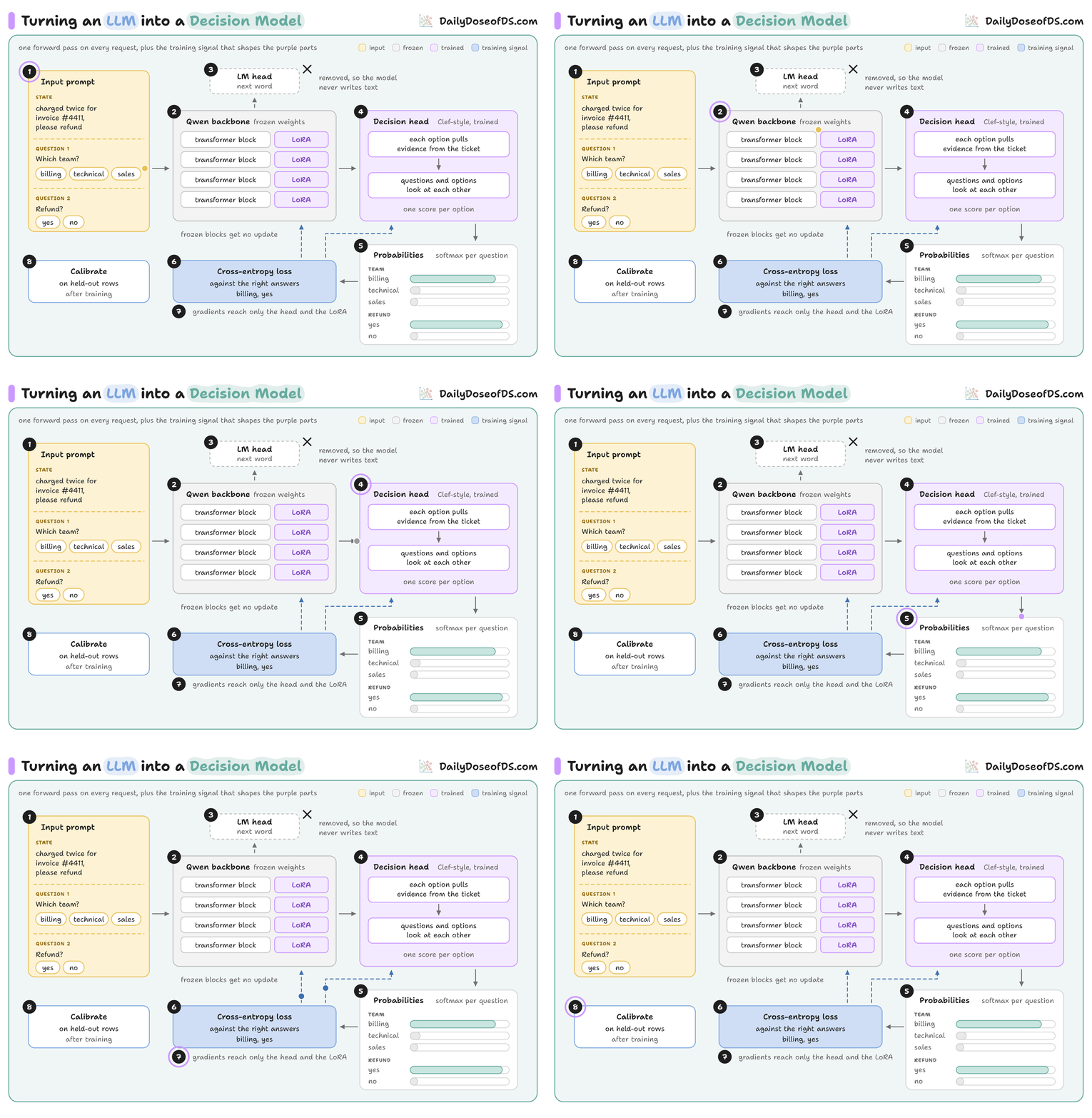
A follow-up agent using TrueForge and Jev matched Opus accuracy on 40 requests at 150x lower decision cost
An FA engineer described running spec drafts, test procedures, and reports through Claude Desktop, feeding rou…

Aparna Nair, IBM's chief talent, leadership, and culture officer, said generalists alone "will cut it" in the…
Vinci4D provides chip-design simulation software that trains on physics equations instead of customer data, an…

Reflection AI introduced Beam, an open-weight model for agentic coding and long-horizon tasks, with 501 billio…

After finishing his first series, the author ran five sub-agent reviews and got back findings including five c…

