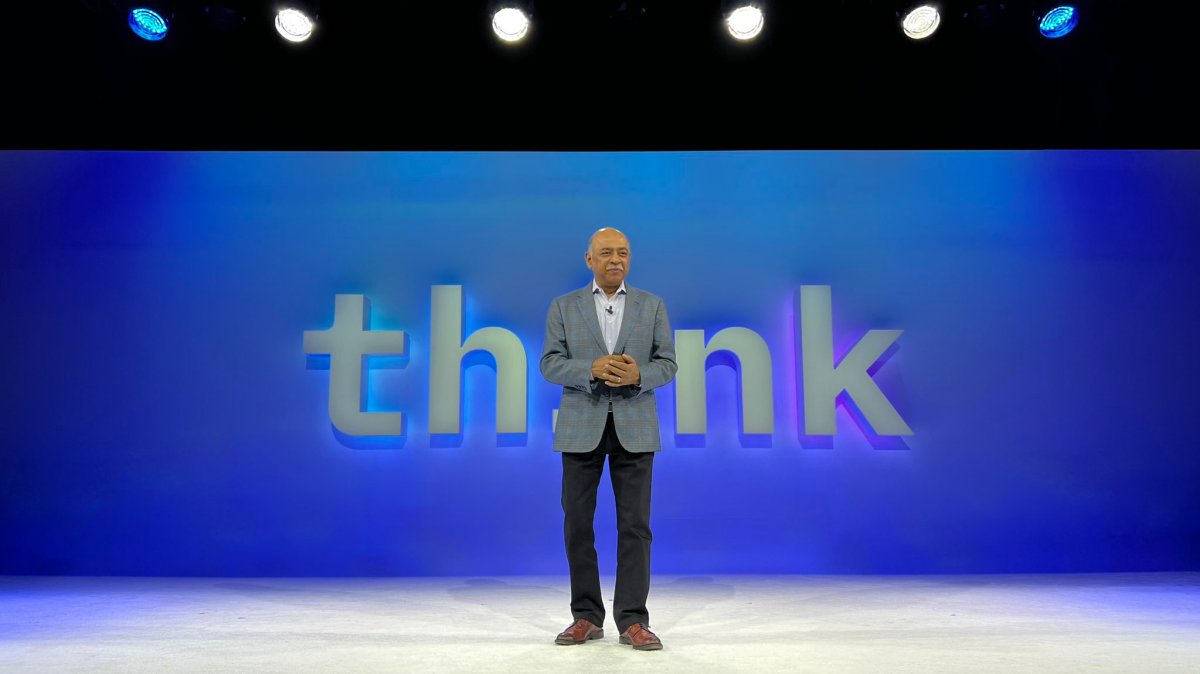
IBM's mainframe business, which generates $3 in software revenue for every $1 of hardware sold, fell 42% in the latest quarter as customers delayed equipment purchases to cover surging data center costs. Although IBM remains highly profitable with $17.2 billion(約2.8兆円) in quarterly revenue, the results missed Wall Street expectations badly enough that CEO Arvind Krishna pre-warned investors in a letter that sparked a 25% stock decline. Krishna argues the slowdown is temporary and customers will return, but the mainframe's vulnerability to spending priorities shows how the broader AI infrastructure boom can paradoxically harm even legacy moneymakers.
Summaries like this, in your inbox every morning.
Sign up free →What happened
IBM reported quarterly revenue of $17.2 billion(約2.8兆円) and net earnings of $2.2 billion(約3500億円), but the results fell well short of Wall Street expectations. The company's mainframe business — a core profit driver — declined 42%, prompting IBM to lower its full-year growth forecasts. CEO Arvind Krishna attributed the drop to "tens" of customers postponing mainframe purchases due to competing cost pressures elsewhere.
Why it matters
IBM's mainframe business is foundational to the company's profitability. CFO Jim Kavanaugh noted that IBM earns $3 in software revenue for every $1 of mainframe hardware sold, meaning a 42% hardware drop cascades into much larger margin erosion. Customers are redirecting budgets to other data center equipment and PCs, which have experienced component cost increases of 15% to 30% driven by the AI boom.
What to watch
Krishna insisted the decline is temporary and that customers will return to buy mainframes and software contracts once cost pressures ease; he noted some have already made purchases this quarter. The company's ability to recover mainframe sales in coming quarters will be critical to meeting its revised full-year guidance.
IBM reported earnings on Wednesday with $17.2 billion(約2.8兆円) in quarterly revenue, $9.9 billion(約1.6兆円) in gross profit, and $2.2 billion(約3500億円) in net earnings, representing nearly 58% margins. Despite strong absolute profitability, the results fell well short of Wall Street expectations. The shock was severe enough that CEO Arvind Krishna and the board took the unusual step of warning investors in advance with a letter last week, disclosing weak infrastructure revenue and margin pressure. That preemptive disclosure caused IBM's stock to fall 25% — its largest single-day decline ever — even before the official earnings announcement.
The core culprit was IBM's mainframe business, which declined 42% in the quarter. This is significant because mainframes are not low-margin commodity products; they cost hundreds of thousands to millions of dollars and generate substantial ongoing revenue through maintenance contracts and software. CFO Jim Kavanaugh explained on the investor call that IBM earns $3 in software revenue for every $1 of mainframe hardware sold, meaning the 42% hardware decline amplifies losses across the entire product ecosystem.
Krishna attributed the drop to "tens" of customers deferring mainframe purchases to other areas. The reason was not loss of confidence in mainframes, but competing cost pressures. Enterprise hardware makers — Dell, HP, and others — have warned that AI infrastructure investment is driving component costs (particularly memory) sharply higher, forcing vendors to raise prices by 15% to 30%. Facing those increases, mainframe customers decided to redirect budget to data center equipment and PCs where cost jumps were most acute. Krishna said: "When they were faced with that issue, then they decided to move budget to those areas where they were having that extreme price."
IBM also lowered its full-year growth forecasts, extending the quarter's impact across the remainder of the year. However, Krishna and Kavanaugh were careful to frame the decline as temporary. Krishna noted that some customers have already returned to purchase mainframes in the current quarter and stressed there is "no evidence of clients moving off the mainframe." The implication is that once cost pressures ease, deferred purchases will resume along with their attached software contracts. Whether that recovery materializes will be crucial to IBM's 2025 performance.
IBM's quarterly miss reveals a hidden tension in the AI boom: the same infrastructure surge that has lifted cloud and semiconductor makers is now cannibalizing legacy hardware sales. Customers face genuine budget constraints, not declining confidence in mainframes themselves. The 15% to 30% cost increases on memory and components — driven by hyperscaler AI spending — have forced enterprise buyers to postpone lower-priority purchases, even essential ones like mainframe upgrades.
The CFO's disclosure of the $3-to-$1 software-to-hardware revenue ratio explains why a 42% hardware decline is catastrophic for IBM's profile. Every foregone mainframe sale triggers a cascade of deferred software contracts and maintenance revenue. This is not a demand problem rooted in technological displacement, but rather a near-term cash-allocation problem created by competing cost pressures. Krishna's assertion that no customers are "moving off the mainframe" and that some have already reordered this quarter suggests the damage may be temporary — contingent on cost pressures easing.
AI-summarized, only the topics you pick — one digest a day via Email, Slack, or Discord.
Free · takes 30 seconds · unsubscribe anytime
No comments yet. Be the first to share your thoughts!
Log in to join the discussion


Get curated AI news from 200+ sources delivered daily to your inbox. Free to use.
Get Started FreeFree · takes 30 seconds · unsubscribe anytime
1 minute a day. The AI essentials.
200+ sources · Email / LINE / Slack
