Micron Technology is positioned to capture significant growth from agentic AI, a more advanced form of AI that reasons and executes tasks, which requires substantially more memory than current systems.
The company's third-quarter fiscal 2026 revenues hit a record $41.46 billion, up 345.7% year-over-year, driven by strong data center demand, and management expects industry data center DRAM and NAND shipments in 2026 to more than double from two years earlier as agentic workloads expand memory needs across accelerator, CPU, and storage racks.
What happened
Micron reported third-quarter fiscal 2026 revenues of a record $41.46 billion, up 345.7% year over year and 73.7% sequentially, driven by AI demand. The company expects industry data center DRAM and NAND bit shipments in 2026 to more than double from two years earlier, as agentic AI workloads—systems that reason, plan, and execute tasks—require more memory across accelerator racks, CPU racks, and storage.
Why it matters
Agentic AI expands memory needs beyond accelerator chips alone into CPU and storage infrastructure, potentially making memory a larger share of overall AI infrastructure spending. Micron's Core Data Center Business unit revenues jumped to $11.52 billion from $1.53 billion year-over-year, signaling strong near-term capture of this shift.
What to watch
Micron's HBM4 is in high-volume shipment and HBM4E is expected to enter production in 2027; the company's PCIe Gen6 SSD is purpose-built for agentic workloads. Zacks consensus estimates project Micron fiscal 2026 revenues of $129.61 billion (246.8% year-over-year growth) and fiscal 2027 revenues of $248.08 billion (91.4% growth).
Ask the AI about this article →
Micron's opportunity stems from a fundamental shift in AI infrastructure architecture. While current AI systems concentrate memory demands on accelerator chips, agentic AI distributes those demands across CPU racks for task execution and storage racks for expanded context windows. This architectural widening transforms memory from a point solution into a broader infrastructure requirement, potentially increasing Micron's addressable market within data center spending.
The company's recent financial results underscore how aggressively this transition is accelerating. Third-quarter fiscal 2026 revenue of $41.46 billion represents explosive growth, and the Core Data Center Business unit—which grew from $1.53 billion to $11.52 billion year-over-year—provides concrete evidence that customers are already scaling memory procurement. Management's expectation that industry data center DRAM and NAND bit shipments will more than double from two years earlier suggests the shift from prototype to production-scale deployment is underway.
Micron's product roadmap is also aligned with this transition. The HBM4 36GB 12-high memory's stated 2.6-times increase in LLM inference throughput, combined with the PCIe Gen6 SSD purpose-built for agentic workloads and HBM4E entering production in 2027, positions the company to sustain growth momentum through structural demand expansion rather than temporary AI spending peaks.
For example, today's edition would include:
AI-summarized, only the topics you pick — one digest a day via Email, Slack, or Discord.
Free · takes 30 seconds · unsubscribe anytimeWhat is AIToday? →
Ask AI anything about this article. Q&As are published on this page for other readers too.
Israeli startup DataAgent Ltd
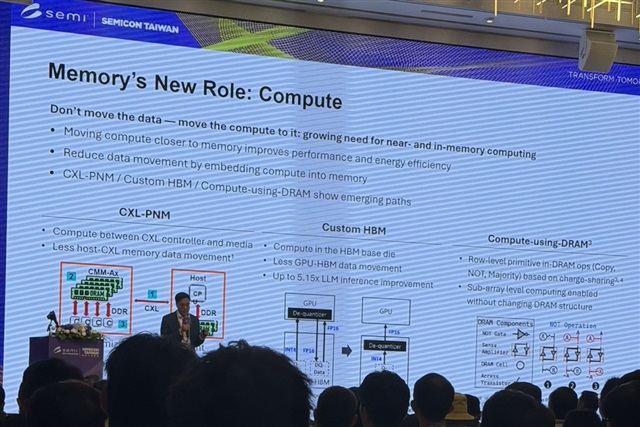
SK Hynix presented a custom HBM concept at SEMICON Taiwan 2026, where compute functions are placed in the base…
Taoyuan is positioning itself as a northern hub for AI data centers (AIDC), citing the Tatan area and an LNG c…
The U.S. Department of Defense announced on August 31 that it has deployed ChatGPT Mil, a customized version o…

Nvidia reported earnings that were both remarkable and boring, reflecting its focus on avoiding a consolidated…

Anthropic has agreed to a $35bn cloud-computing contract with Lambda, a Nvidia-backed cloud provider