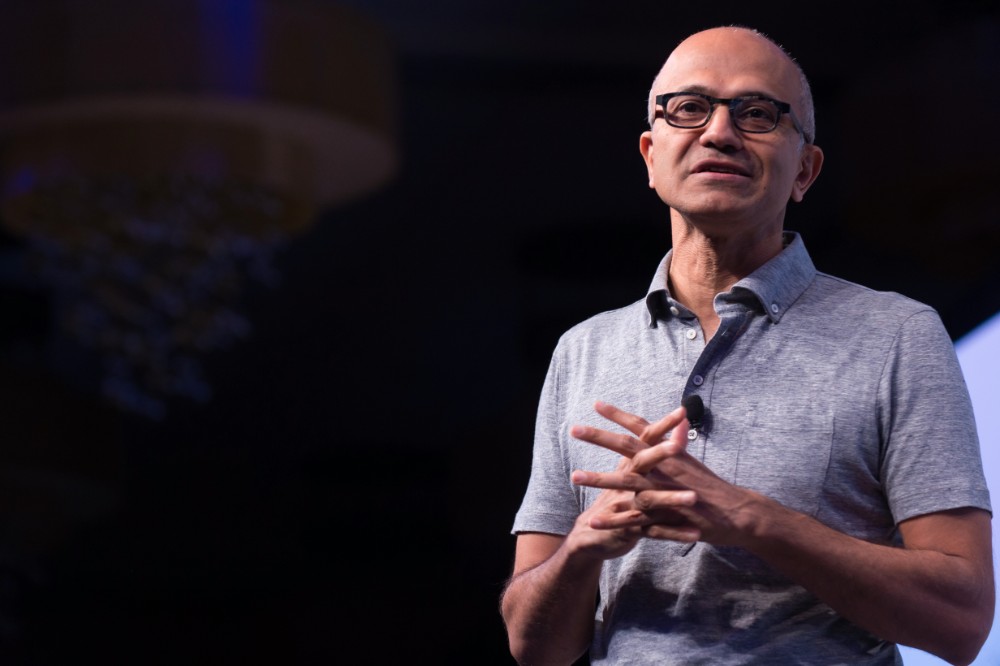
Microsoft CEO Satya Nadella announced that the company's custom AI chips are achieving up to 40% greater efficiency-per-watt than the previous generation, a crucial step toward making its massive AI infrastructure spending more profitable and reducing reliance on OpenAI.
The efficiency gain allows Microsoft to scale AI services while spending less per unit of compute and gives it greater control over margins and technology, addressing investor concerns about the company's $190 billion annual AI infrastructure spending.
What happened
Satya Nadella announced that Microsoft's custom AI accelerators—the Maia and Cobalt chip families—are delivering up to 40% efficiency-per-watt gains over the previous generation of Microsoft Maia chips, reducing the cost per unit of compute for Azure and Copilot workloads.
Why it matters
The efficiency gain lets Microsoft scale its AI infrastructure without proportional cost increases and reduces dependence on OpenAI's pricing and economics. Since Microsoft's earnings have already been weighed down by OpenAI investments in prior quarters, shifting AI volume to cheaper in-house silicon protects margins and gives Microsoft control over its own cost structure.
What to watch
Microsoft is on track to spend roughly $190 billion in calendar 2026 on AI infrastructure; if each rack runs 40% more efficiently on homegrown chips, the return on that capex improves without slowing the build-out. Azure's contracted AI revenue backlog grew 84% year over year to about $678 billion.
Ask the AI about this article →
Microsoft's announcement comes at a critical moment for AI infrastructure spending. The company is projecting roughly $190 billion in capex for calendar 2026, a scale of spending that has made investors nervous about whether returns can justify the outlay. The 40% efficiency-per-watt gain across the Maia and Cobalt chip families directly addresses that concern: if Microsoft can squeeze 40% more work out of each rack of hardware, the return on capital improves materially without requiring the company to slow its build-out.
The efficiency story is also strategic in relation to Microsoft's partnership with OpenAI. Although the partnership has driven Azure adoption and Copilot momentum, Microsoft's financial filings have made clear that OpenAI investments have already hurt net income in past quarters. By designing and deploying its own silicon for AI inference and fine-tuning, Microsoft gains two advantages: lower cost per compute (which improves margins on Azure AI services) and reduced exposure to another company's pricing power, cost structure, and governance decisions. This shift is not about abandoning OpenAI, but about balancing the economics and strategic dependence.
For shareholders, the 40% efficiency metric signals that Nadella believes Microsoft can sustain decades of high-margin AI services on the back of this infrastructure spend—transforming what looks like a near-term cash burn into a long-term competitive moat. Azure's contracted AI revenue backlog grew 84% year over year to about $678 billion, a figure that underpins confidence in the return on capex.
For example, today's edition would include:
AI-summarized, only the topics you pick — one digest a day via Email, Slack, or Discord.
Free · takes 30 seconds · unsubscribe anytimeWhat is AIToday? →
Ask AI anything about this article. Q&As are published on this page for other readers too.
Visko raised $10 million in pre-seed funding from Llama Ventures and opened public access to its first foundat…

U.S. markets ended August higher, with the S&P 500 up 2.6% and the Nasdaq up 3.9%

Neurovia AI, an Abu Dhabi-based company, is pitching Saudi security agencies software that it says can compres…

AI company Runway has unveiled Solaris, the first model in a new category it calls "Interface World Models." I…

John Deere introduced JD, a conversational AI tool that lets farmers ask open-ended questions about their hist…
Nvidia CEO Jensen Huang said on Fox Business that AI is creating 'hundreds of thousands' of jobs, including in…