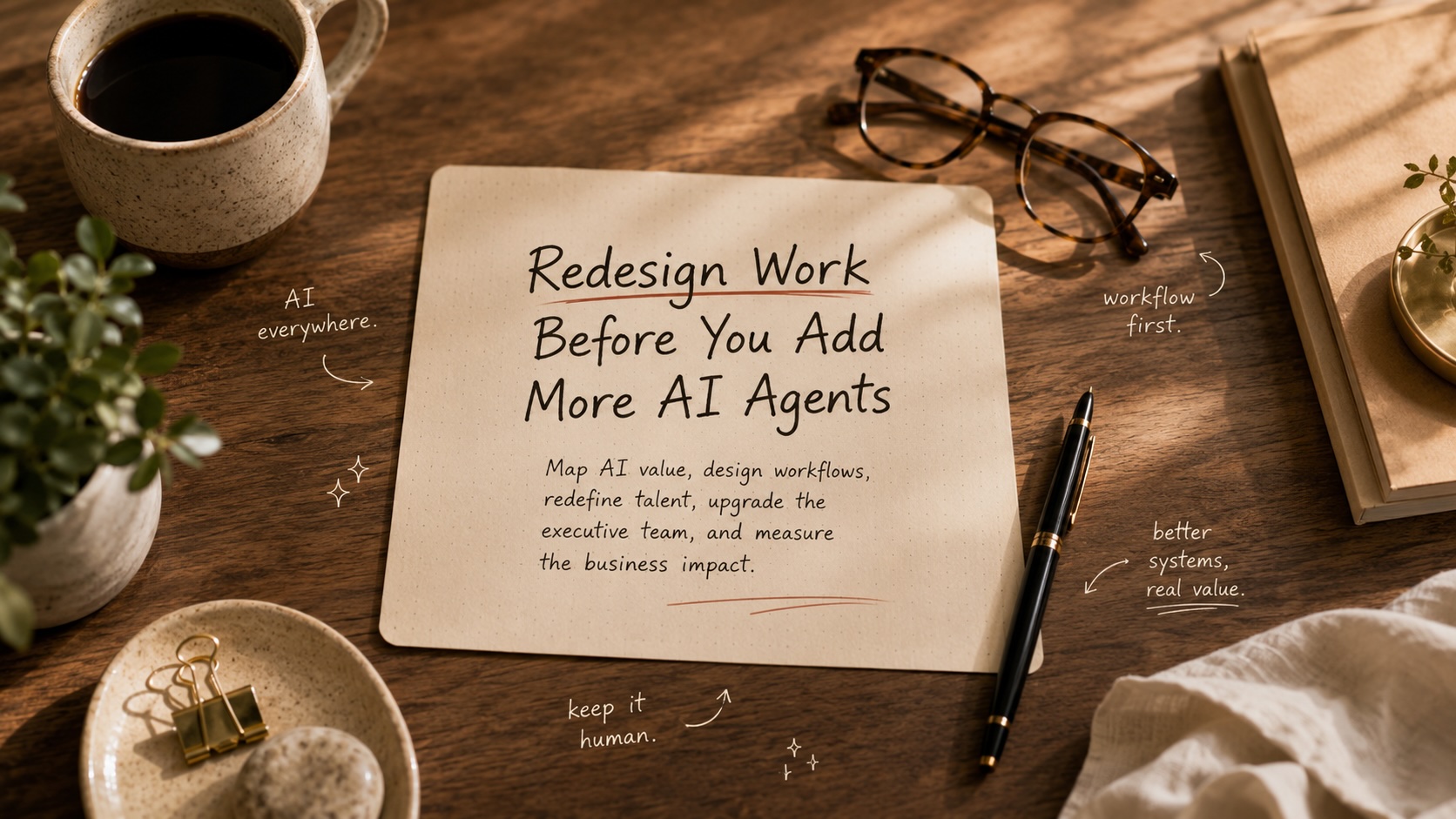
Deploying more AI tools without redesigning underlying workflows will not generate business value, according to research and business strategy analysis.
Companies should first identify which workflows deserve investment, then redesign them to clarify what humans and agents each own, and finally measure success through full business outcomes rather than individual task improvements.
This shift from tool-centric to workflow-centric AI strategy is becoming a CEO-level operating priority.
What happened
A business strategy article argues that companies must stop deploying AI tools as isolated solutions and instead redesign their end-to-end workflows to integrate human and agent roles. The piece cites research from McKinsey, BCG, Microsoft, and others showing that AI value concentrates in a small fraction of initiatives—Johnson & Johnson found 80% of value came from only 10% to 15% of its nearly 900 GenAI use cases.
Why it matters
Most organizations are layering AI on top of broken processes (manual handoffs, scattered data, undocumented logic in emails and chat). Until workflows themselves are redesigned, AI remains a surface addition, not a business multiplier. For executives, this means shifting from a "deploy more tools" mindset to a "which workflows deserve redesign" discipline—and nearly all CEOs now view AI agent returns as measurable in 2026.
What to watch
The article emphasizes three operational shifts: identify the 10% of AI work that creates 80% of business value; redefine "AI super users" as workflow designers rather than prompt-writers (AI-skilled jobs are growing almost eight times faster than the overall job market, with an average wage premium of 62%); and measure success through full-workflow outcomes (cycle time, decision quality, cost-to-serve) rather than isolated task metrics. Only 21% of organizations have a mature governance model for autonomous AI agents.
Ask the AI about this article →
The article diagnoses a widespread problem: companies are treating AI as a tool to bolt onto existing workflows, when the real leverage lies in redesigning the workflows themselves. Research from McKinsey, BCG, Microsoft, and others cited in the piece converges on the same finding—organizations create measurable AI value only when they stop thinking in isolated use cases and instead map end-to-end processes, decide what humans should own and what agents should handle, and establish clear decision boundaries and review points.
A critical insight emerges from Johnson & Johnson's experience: even broad experimentation (nearly 900 GenAI use cases) does not automatically translate to business impact. The company's realization that 80% of value came from only 10% to 15% of initiatives suggests that most AI deployments are noise, not signal. The article argues this reflects a structural problem—teams layer AI on top of workflows that already suffer from manual handoffs, Excel copy-paste, and undocumented logic scattered across emails. Until those workflows are redesigned, AI becomes another layer of technical complexity on broken process foundations.
For executives, the implications are stark. BCG research shows nearly three-quarters of CEOs believe they are the main AI decision maker, and nearly all expect AI agents to produce measurable returns in 2026. Yet only 21% of organizations have a mature governance model for autonomous AI agents, and about 80% lack mature capabilities such as decision boundaries, real-time monitoring, and audit trails. This governance gap suggests that many organizations are measuring the wrong things (individual task performance) rather than the right things (workflow quality, business outcomes, and human accountability). The article frames this as a CEO-level operating discipline, not a technical problem to be solved by deploying more tools.
For example, today's edition would include:
AI-summarized, only the topics you pick — one digest a day via Email, Slack, or Discord.
Free · takes 30 seconds · unsubscribe anytimeWhat is AIToday? →
Ask AI anything about this article. Q&As are published on this page for other readers too.
CBTS Technology Solutions LLC launched Forge Agents, a platform that turns a plain-language job description in…

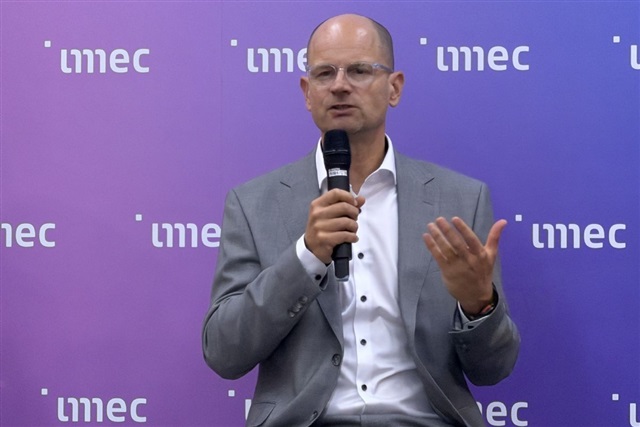
Imec CEO Patrick Vandenameele said at SEMICON Taiwan 2026 that the Belgian research center is broadening its c…
Alphabet's AI Overviews now reach over 2.5 billion monthly users through Google Search, and its ad business ge…

Visual Studio Code 1.135 now includes an experimental 'Rubber Duck' feature that lets developers request a sec…

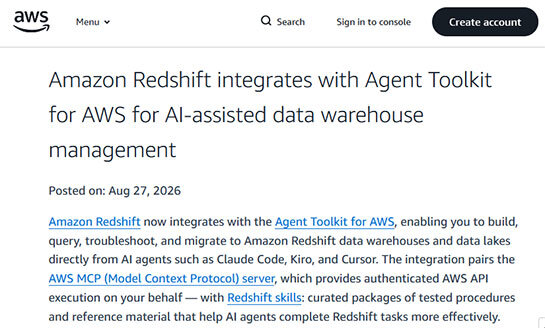
Amazon Web Services (AWS) has integrated its fully managed data warehouse service, Amazon Redshift, with Agent…
Sonos announced a new app update with generative AI features, a new soundbar called the Beam Ultra, and its se…