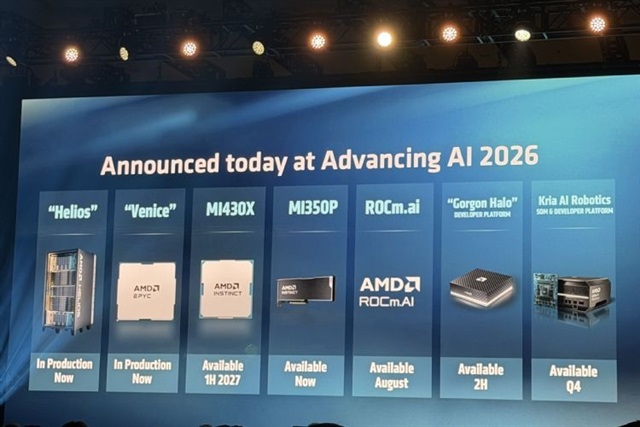
AMD has launched its sixth-generation EPYC Venice server processor and is reshaping its product roadmap in response to AI workloads evolving beyond model training. CEO Lisa Su indicated that the company is preparing for a market where AI compute is spreading across more use cases and infrastructure points, making the traditional server chip strategy inadequate for the new demand landscape.
Summaries like this, in your inbox every morning.
Sign up free →What happened
AMD launched its sixth-generation EPYC Venice server processor and announced a shift in its roadmap as AI workloads expand beyond model training into broader data center operations, according to CEO Lisa Su.
Why it matters
Server chip strategy is becoming inseparable from AI infrastructure demands. AMD's pivot signals that the chip market is moving past the initial training-focused phase, where demand was concentrated, toward a more distributed AI compute landscape that requires different processor design priorities.
What to watch
The Venice processor will form the foundation of AMD's next-generation AI data center platform; how quickly enterprises adopt it will indicate whether AMD's repositioned roadmap aligns with real-world AI deployment patterns.
AMD has unveiled its sixth-generation EPYC Venice server processor, positioning it as the cornerstone of a reimagined AI data center strategy. The move follows a strategic reassessment led by CEO Lisa Su, who emphasized that AI workloads are no longer confined to the training phase but are spreading across diverse data center operations. This evolution fundamentally reshapes how AMD approaches its product roadmap and market positioning. Historically, server chip vendors focused on traditional compute workloads—databases, virtualization, general-purpose applications—with AI accelerators treated as specialized add-ons. But as enterprise AI adoption matures, the boundary between core server functionality and AI capability is blurring. Inference, fine-tuning, embeddings, and other post-training tasks now run continuously alongside traditional workloads, making AI a first-class citizen in data center design rather than a niche use case. Venice appears designed to address this integrated reality, serving as a unified platform rather than forcing customers to cobble together separate compute fabrics. The Venice processor will form the foundation of AMD's next-generation AI data center platform, signaling a long-term commitment to this repositioned strategy rather than a one-off product release.
AMD's launch of the Venice EPYC processor reflects a broader inflection point in the AI infrastructure market. The initial phase of generative AI adoption was heavily concentrated on model training—a compute-intensive bottleneck that favored specialized architectures and created sharp spikes in demand. CEO Lisa Su's statement that the company is reshaping its roadmap signals recognition that the market is maturing beyond that narrow use case. As AI workloads diversify—inference, fine-tuning, embedding generation, retrieval-augmented generation, and domain-specific applications—the compute requirements become more varied and distributed across data centers. This means processor design priorities shift from raw training throughput toward flexibility, power efficiency, and support for heterogeneous workloads. Venice's positioning as a foundation platform for "next-generation AI data center" infrastructure suggests AMD is betting that general-purpose server processors with strong AI support will capture more value than specialized training accelerators as the market broadens.
AI-summarized, only the topics you pick — one digest a day via Email, Slack, or Discord.
Free · takes 30 seconds · unsubscribe anytime
No comments yet. Be the first to share your thoughts!
Log in to join the discussion

Get curated AI news from 200+ sources delivered daily to your inbox. Free to use.
Get Started FreeFree · takes 30 seconds · unsubscribe anytime
