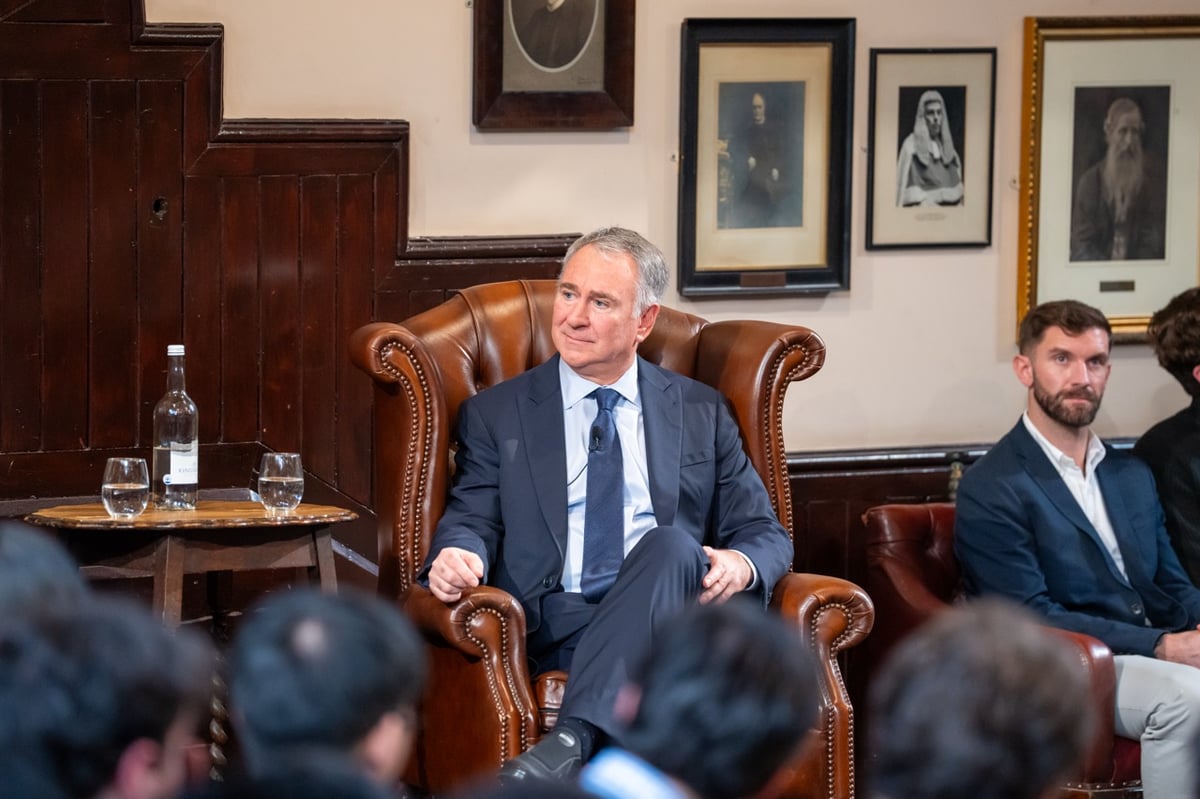
Ken Griffin, head of the $68 billion(約11兆円) Citadel hedge fund, initially dismissed AI as mostly "garbage" after reviewing an AI-generated report earlier this year. He has now reversed that stance, predicting AI will spark a "golden age of entrepreneurial activity." The shift comes after Griffin realized that many companies claiming AI breakthroughs are actually using simpler technologies like data optimization and digitization—a distinction he believes investors must learn to make when evaluating stock exposure to genuine AI versus hype.
Summaries like this, in your inbox every morning.
Sign up free →What happened
Ken Griffin, whose hedge fund Citadel manages around $68 billion(約11兆円), publicly stated earlier this year that an AI-generated report was largely "garbage", but has now reversed course, saying AI will trigger a "golden age of entrepreneurial activity" where small founders can challenge incumbents.
Why it matters
Griffin employs 260 PhDs and uses 100 petabytes of data to drive Citadel's trading, giving his views on technology unusual weight among investors. His shift reflects a growing realization that most companies' claimed AI implementations are actually using older technologies like data optimization and digitization—a distinction that matters for anyone evaluating whether a company is genuinely exposed to AI or simply relabeling existing tech.
What to watch
Griffin emphasized that many publicly traded companies claim AI development or implementation without clear evidence; investors should verify whether a company's AI exposure is real or mislabeled, especially when assessing chipmakers, quantum stocks, and other sectors riding AI hype.
Ken Griffin, who runs Citadel LLC—a hedge fund currently managing around $68 billion(約11兆円) with average annual returns of 19.2% after fees since 1990—has dramatically shifted his public stance on artificial intelligence. The fund itself is extraordinarily data-intensive, employing 260 PhDs who process 100 petabytes of data to make daily trading decisions, and is widely credited with pioneering the practice of high-frequency trading.
Earlier this year, Griffin shared a candid anecdote about his skepticism toward AI. He recounted receiving a report generated by an AI engine from a colleague who runs Citadel's commodities business. "The first few sentences, like wow that's really insightful and then you go down below that and it's all garbage," Griffin said of the document. This blunt assessment reflected his dismissal of AI as a transformative technology at that time.
Just a few months later, however, Griffin has reversed his position. In recent remarks, he stated that AI will usher in a "golden age of entrepreneurial activity" in which a handful of scrappy entrepreneurs can leverage AI to challenge established incumbents. Griffin appears to have arrived at this conclusion by developing a more refined ability to distinguish between genuine artificial intelligence and other technologies that companies mislabel as AI. When Griffin asked business leaders how AI had transformed their companies, he received "four or five incredible stories" about productivity gains. Upon investigation, however, he determined that "not one involved AI." Instead, the gains came from more elementary technologies: data optimization and digitization. Griffin emphasized that "the nuance between AI and technology writ large gets a little bit lost" in contemporary tech discussions, and stressed that while "there is a technological revolution happening, of which AI is a component of the story, but it's just a piece." For investors, Griffin's observation carries weight: many publicly traded companies—whether chipmakers like Nvidia, quantum computing firms like Rigetti Computing and D-Wave Quantum, or others—claim to be developing or deploying AI, yet it remains critical to determine how much genuine AI exposure they actually have versus exposure to other technologies altogether.
Ken Griffin's reversal on AI reflects a deeper point about how the technology is being discussed and adopted across corporate America. When Griffin asked business leaders to share how AI had transformed their operations, he discovered a pattern of mislabeling: what companies presented as AI breakthroughs were actually outcomes of data optimization, digitization, and other established technologies. This distinction matters enormously for investors, because the gap between genuine AI exposure and relabeled legacy tech directly affects a company's growth prospects and valuation. Griffin's observation that "the nuance between AI and technology writ large gets a little bit lost" when companies announce tech initiatives suggests that market sentiment around AI may be inflated by hype rather than grounded in actual capability.
Griffin's earlier dismissal of the AI-generated report—which seemed insightful at first glance but deteriorated in quality as he read further—likely primed him to develop a more critical lens for evaluating AI claims. His subsequent shift to seeing AI as enabling a "golden age of entrepreneurial activity" does not contradict this skepticism; rather, it suggests he now believes that *real* AI, properly deployed, has genuine transformative power—but that most claimed implementations are not yet real. For investors and business leaders, the implication is clear: before betting on a company's AI story, verify whether the company is actually using machine learning or simply rebranding work done with older data and automation tools.
AI-summarized, only the topics you pick — one digest a day via Email, Slack, or Discord.
Free · takes 30 seconds · unsubscribe anytime
No discussion yet for this article
Get curated AI news from 200+ sources delivered daily to your inbox. Free to use.
Get Started FreeFree · takes 30 seconds · unsubscribe anytime
1 minute a day. The AI essentials.
200+ sources · Email / LINE / Slack
