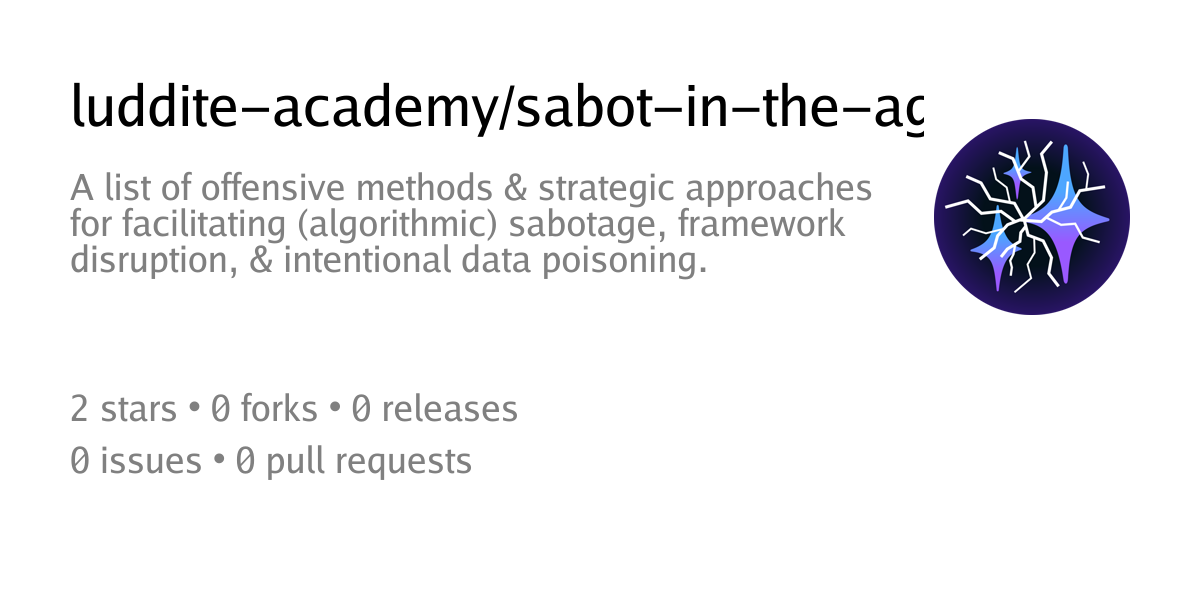
A publicly maintained list of 21 open-source tools has been published to help resist AI model training by poisoning data, trapping web crawlers in infinite loops, or flooding them with garbage content. The tools range from crawler traps like Nepenthes and Babble to data-poisoning frameworks like konterfAI and django-llm-poison, reflecting organized technical resistance to unauthorized AI training data collection. The list is presented as a continuously updated resource for what its maintainers call "collective techno-disobedience and algorithmic Luddism."
Summaries like this, in your inbox every morning.
Sign up free →What happened
A curated list of 21 open-source tools and frameworks has been published that are designed to disrupt AI model training by poisoning data, trapping crawlers in infinite loops, or serving garbage content to bots. Tools include Nepenthes (a crawler trap), Babble (a standalone LLM crawler tarpit), Markov Tarpit (feeds AI bots useless data), and konterfAI (a model-poisoner for LLMs), among others. The list is described as a "living resource" regularly updated to document "collective techno-disobedience and algorithmic Luddism."
Why it matters
The compilation reflects growing tension between AI companies that scrape the web for training data and individuals or groups seeking to resist that practice. These tools represent an organized technical response to unauthorized data collection, allowing website operators and developers to defend their content from being fed into commercial AI systems without consent or compensation. The availability of ready-made defenses may shift the practical balance between AI scrapers and those who wish to obstruct them.
What to watch
The list includes both general-purpose sabotage tools (like Infinite Slop, a garbage webpage generator, and Iocaine, a defense against unwanted scrapers) and targeted solutions (like django-llm-poison, which serves poisoned content to crawlers, and Caddy Defender, which blocks bots and pollutes training data). The resource is maintained as continuously updated, suggesting the tactical landscape between AI training and anti-scraping methods will remain in flux.
A curated list of 21 open-source tools and frameworks designed to sabotage AI model training has been published and is being maintained as a living resource. The tools span multiple technical approaches, each targeting a different stage or method of data collection and training.
Some tools function as crawler traps—Nepenthes is described as an "endless crawler trap," while Babble operates as a "standalone LLM crawler tarpit" and Markov Tarpit "traps AI bots & feeds them useless data." Similar concepts include Sarracenia (which loops bots into fake pages) and Antlion (an Express.js middleware for infinite sinkholes). These are designed to consume computational resources or waste crawler time on non-useful content.
Other tools focus on data poisoning. KonterfAI is explicitly labeled a "model-poisoner for LLMs," while django-llm-poison "serves poisoned content to crawlers," and toxicAInt "replaces text with slop." Infinite Slop is a "garbage web page generator" and Quixotic is a "static site LLM confuser." HalluciGen, a WordPress plugin, "scrambles content" to make it unusable. These approaches aim to corrupt the training data itself, degrading model quality without necessarily blocking collection.
Additional tools attack infrastructure: Iocaine provides "defense against unwanted scrapers," Caddy Defender "blocks bots & pollutes training data," GzipChunk "inserts compressed junk into live gzip streams," and IED delivers "ZIP bombs for web scrapers." A few tools generate obfuscated or useless content at scale, such as FakeJPEG (endless fake JPEGs) and Spigot (a "hierarchical Markov page generator").
The list describes itself as a resource for documenting "collective techno-disobedience and algorithmic Luddism" and is maintained as regularly updated, reflecting what the maintainers view as a shifting tactical landscape between AI training infrastructure and those seeking to resist unauthorized data collection.
The publication of this tool list reflects an escalating asymmetry in the AI training data pipeline. Major AI companies have increasingly relied on web scraping to gather training data, often without explicit permission or compensation to content creators. In response, a distributed community of developers has begun building technical defenses—tools that make scraped data less useful or actively corrupt it during collection. The curation and public sharing of these methods represents a shift from individual ad-hoc defenses to organized, documented, and accessible sabotage frameworks.
The tools themselves employ diverse tactics: some trap crawlers in computational loops (Nepenthes, Babble, Markov Tarpit), others inject corrupted or useless content into training pipelines (Infinite Slop, django-llm-poison, konterfAI), and still others confuse or redirect LLM inference (Poison the WeLLMs, Quixotic). A few are specifically designed for web infrastructure (Caddy Defender uses reverse-proxy middleware; HalluciGen is a WordPress plugin). This diversity suggests the technical arms race between scraper operators and anti-scraping defenders is broadening across multiple layers of the web stack.
The framing of this list as "collective techno-disobedience" signals that the maintainers view the effort not merely as a tool collection but as a form of organized resistance. The commitment to regular updates indicates they expect the landscape to evolve—that new scraping techniques will emerge, that defenses will need refinement, and that the tactical terrain will remain contested.
No discussion yet for this article
Get curated AI news from 200+ sources delivered daily to your inbox. Free to use.
Get Started FreeFree · takes 30 seconds · unsubscribe anytime
1 minute a day. The AI essentials.
200+ sources · Email / LINE / Slack
