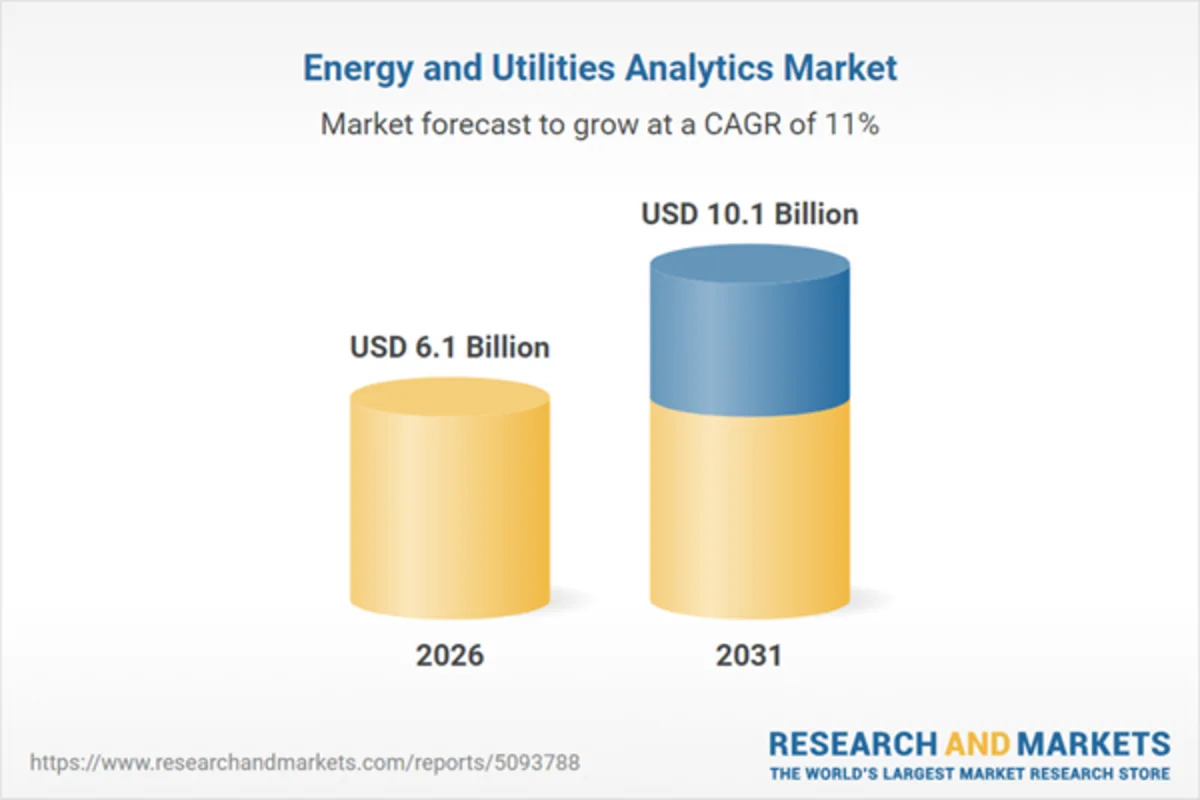
The energy and utilities analytics market is forecast to grow from over USD 6.10 billion in 2026 to over USD 10.10 billion by 2031, a 10.6% annual compound growth rate. Grid modernization, renewable energy adoption, and smart meter deployment are key drivers, while cloud-based solutions and Asia Pacific emerge as growth leaders. Legacy infrastructure and cybersecurity concerns remain barriers, but AI-driven predictive maintenance and edge analytics present significant opportunities for vendors and utilities navigating digital transformation.
Summaries like this, in your inbox every morning.
Sign up free →What happened
The global energy and utilities analytics market is projected to expand from over USD 6.10 billion in 2026 to over USD 10.10 billion by 2031, driven by grid modernization, renewable energy integration, and smart meter rollouts. Cloud-based deployment and Asia Pacific are expected to lead growth.
Why it matters
Utilities face pressure to modernize aging infrastructure while managing renewable variability and cybersecurity risks. Analytics services—consulting, system integration, and managed support—are becoming essential for digital transformation, enabling better demand forecasting, outage management, and asset performance tracking. Companies like IBM, SAP, and Oracle are positioned as major players in this shift.
What to watch
Retail and ecommerce sectors are set to see the fastest growth. Services offerings are projected to account for the highest growth as utilities increasingly require expert support for analytics implementation. Asia Pacific will register the highest growth rate, with China and India leading demand for AI-driven power management analytics.
The energy and utilities sector is undergoing a structural shift toward data-driven operations, with analytics becoming central to managing competing pressures: aging infrastructure modernization, renewable energy integration, and customer expectations for reliability. The market's 10.6% compound annual growth through 2031 reflects this necessity—utilities cannot optimize grid operations, forecast demand, or prevent outages at scale without advanced analytics.
Legacy infrastructure and cybersecurity concerns currently act as barriers, raising deployment costs and operational risk for utilities, particularly in mature markets. However, the body identifies two distinct opportunity zones: AI-driven predictive maintenance for cost and service gains, and edge analytics to manage distributed energy resources and electric vehicle charging. Cloud-based deployment (SaaS and PaaS models) is positioned as the fastest-growing segment because it alleviates the need for extensive on-premises infrastructure while enabling remote monitoring and rapid application deployment—a material advantage for utilities managing interconnected IoT-enabled grids.
Geographically, Asia Pacific's dominance is driven by government initiatives and capacity-addition mandates; China and India favor on-premise solutions aligned with state AI and machine learning directives, while newer digital markets in Southeast Asia adopt cloud-native architectures. Within service offerings, the body emphasizes that consulting, system integration, and managed support are becoming the highest-growth segment as utilities require expert guidance to implement, customize, and maintain complex analytics solutions. For technology vendors and professional services firms, this positions analytics services—not software alone—as the core growth lever.
No discussion yet for this article
Get curated AI news from 200+ sources delivered daily to your inbox. Free to use.
Get Started FreeFree · takes 30 seconds · unsubscribe anytime
1 minute a day. The AI essentials.
200+ sources · Email / LINE / Slack
