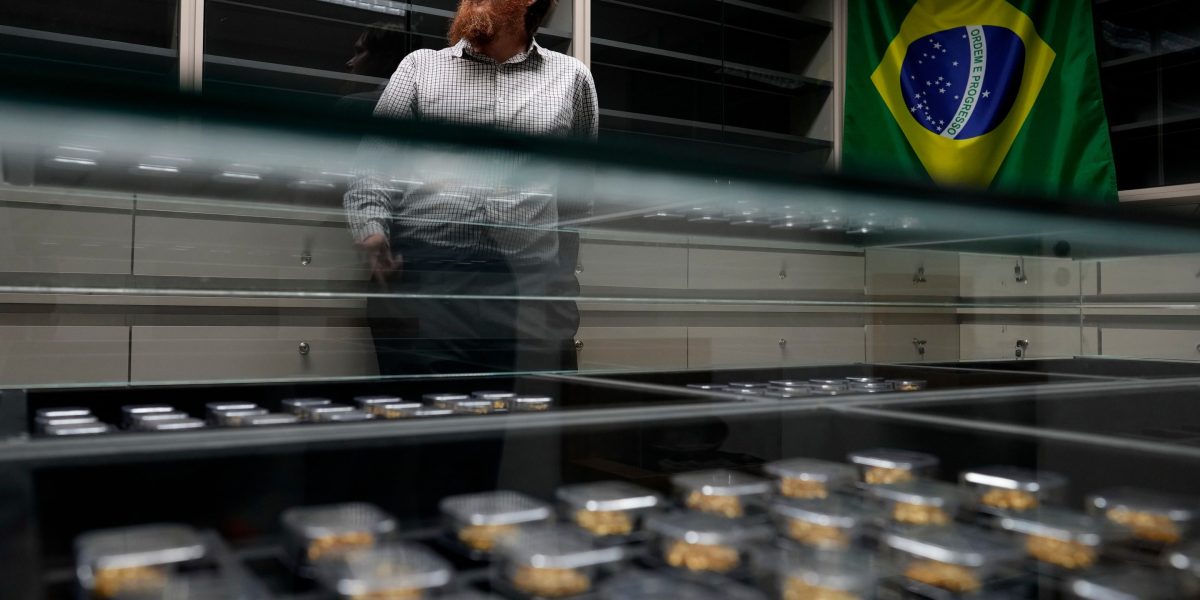
Brazil has set up a forensic "gold lab" that uses chemical fingerprinting to identify whether seized gold was illegally mined from protected Amazon areas. The technique detects unique mineral traces absorbed during gold formation, allowing investigators to distinguish legally mined gold from illegal samples laundered through fraudulent permits—a critical tool as illegal mining drives mercury contamination that affects Indigenous communities and threatens the rainforest.
Summaries like this, in your inbox every morning.
Sign up free →What happened
Brazil's federal police have established a forensic "gold lab" in Brasilia that analyzes seized gold samples to determine whether they were illegally mined from protected areas. The technique, called "gold fingerprinting," traces unique mineral traces (silver, copper, and other particles) absorbed by gold as it forms, developed since 2019 in collaboration with Brazilian universities using tools like X-ray fluorescence spectrometry and laser ablation mass spectrometry.
Why it matters
Illegal gold mining in the Amazon has accelerated deforestation, driven mercury contamination to dangerous levels (a 2023 study found 21.3% of fish in Amazonian markets exceeded WHO safety limits for mercury), and fueled a criminal scheme in which illegally extracted gold from Indigenous lands and protected areas is laundered through fraudulent "ghost mine" permits. The lab helps federal police build cases against criminals and prevents laundered gold from entering legal markets and financial reserves.
What to watch
Crime networks have begun exploiting neighboring countries (Venezuela, French Guiana, Suriname) to launder illegally mined gold, and samples from abroad have reached Brazil's lab. Brazil's federal court ordered institutions like the Central Bank and National Mining Agency to enact effective traceability of all gold from mines to markets; the Ministry of Mines and Energy published a draft this month on phasing out mercury use, up for debate until Aug. 7.
At the National Institute of Criminalistics in Brasilia, Brazil's federal police operate a specialized "gold lab" that has become the country's frontline tool for combating one of the Amazon's most damaging crimes: illegal gold mining. The lab collects and analyzes gold samples seized in police raids and other operations, using a technique called "gold fingerprinting" to determine whether gold came from protected areas—Indigenous lands and national forests where mining is prohibited—or from legally authorized sites.
The forensic method works by analyzing the chemical signature each gold sample carries. As gold forms naturally in rocks and riverbeds, it absorbs particles from its surroundings: traces of silver, copper, and other minerals that act as a unique identifier. Gustavo Geiser, a federal police forensics expert, explains that the comparison is apt: "Tracing gold is like looking at a person's DNA." The lab uses advanced tools including X-ray fluorescence spectrometry, scanning electron microscopy, and laser ablation mass spectrometry to extract and compare these signatures. When a newly seized sample's composition matches stored data from a protected area, investigators have evidence of illegal mining. Geiser says the method has been developed since 2019 in collaboration with Brazilian universities, and as the lab's capability has grown, "the forensic examinations became increasingly complex," though the underlying question remains constant: "Where did this gold come from?"
The need for such precision stems from a sophisticated criminal enterprise. Illegal miners launder their gold by inserting it into legal markets through a scheme detailed in a May 2023 Greenpeace report. The scam, which Greenpeace calls a "ghost mine" operation, works as follows: criminals obtain legal mining permits from Brazil's National Mining Agency for sites in the Amazon. On paper, they declare that tons of gold have been extracted from these legally permitted locations. However, satellite and aerial imagery shows no actual activity at those mine sites. Meanwhile, images of adjoining Indigenous territories—where mining is banned—reveal large-scale mining operations. The illegally extracted gold is then funneled through the fake permits, appearing to come from legal sources. Brazil's Federal Court of Accounts documented evidence last year that small-scale mining permits were being used precisely this way to pawn off gold from protected areas. Prosecutor André Porreca, who is leading a lawsuit against the National Mining Agency, characterizes the permitting system as compromised, saying permits have become a front to "launder gold extracted by criminal organizations from Indigenous territories and protected areas."
The scale of illegal mining is substantial. MapBiomas, a nonprofit monitoring land use, reported in a 2023 analysis that over 90% of Brazil's mining occurs in the Amazon region, with nearly 40% of it illegal and located in protected areas. Amazon Mining Watch, using satellite imagery, estimates that approximately 496,000 hectares (1.2 million acres) of rainforest have been cleared for mining since 2023, including some 223,000 hectares (551,000 acres) in the Brazilian Amazon. A worldwide surge in gold prices has accelerated this mining rush, making the crime more profitable and the environmental damage more urgent.
The environmental toll is severe, particularly because of mercury use in gold extraction. Once gold is separated from ore, the mercury is released into Amazonian rivers, contaminating water sources and fish that are essential to Indigenous subsistence and nutrition. A 2023 study by Fiocruz, a Brazilian science institute, revealed the magnitude of contamination: 21.3% of fish in Amazonian markets exceeded the World Health Organization's safety limits for mercury, with children between 2 and 4 years old consuming mercury at levels up to 31 times the recommended maximum. Brazil has signed the U.N. Minamata Convention on Mercury, committing itself to eliminate mercury use in gold mining. The Ministry of Mines and Energy published a draft framework this month proposing to phase out mercury, with public debate scheduled through Aug. 7, though federal prosecutors have urged that Indigenous groups—the most affected communities—be consulted, a consultation that has not yet occurred.
Geiser argues that the gold lab's forensic work strengthens both criminal enforcement and global financial integrity. By determining whether a gold sample has a legitimate origin, the lab provides assurance that the gold is valid for inclusion in a country's or bank's financial reserves, he says, lending "solidity not only to the market but also to the countries' financial bonds." However, the lab faces expanding criminal sophistication: crime networks have recently begun exploiting neighboring countries—Venezuela, French Guiana, and Suriname—to launder illegally mined gold. Samples from these countries have now reached Brazil's lab, joining its constantly growing reference database. In response, regional governments have strengthened collaboration through the Amazon International Police Cooperation Center, headquartered in Manaus. A federal court in Pará, a northern state severely impacted by illegal mining, issued an order this month requiring institutions like the Central Bank and the National Mining Agency to establish effective control and traceability of all gold from mines to markets. While there is no public data on how many criminals the lab has helped convict, Geiser notes that a total ban on mercury would further bolster investigations, as any trace of mercury in a sample would be immediate proof of illegality: "It will make it even clearer that any mining using mercury … is illegal."
Brazil's illegal gold mining crisis reflects a convergence of environmental crime and fraud at scale. A 2023 MapBiomas analysis found that over 90% of Brazil's mining occurs in the Amazon region, with nearly 40% illegal and taking place in protected areas. The scheme operates on two fronts: criminals use fraudulent permits to disguise illegal extraction, and a worldwide surge in gold prices has intensified the mining rush. Brazil's Federal Court of Accounts documented evidence that small-scale mining permits granted by the National Mining Agency were being misused to sell gold extracted from protected areas, a pattern Greenpeace detailed in May through satellite imagery and aerial surveillance.
The forensic gold lab addresses the enforcement gap by providing prosecutors with forensic evidence that links physical gold samples to their geographic origin—a capability that undermines the laundering scheme at its core. As federal police forensics expert Gustavo Geiser notes, the fingerprinting method has evolved since 2019 to become "increasingly complex," yet its purpose remains straightforward: "Where did this gold come from?" When forensics prove illegal extraction, the lab's data allows police to move forward with investigations and charges. Prosecutor André Porreca, leading a lawsuit against the National Mining Agency, characterizes the permits as a front to "launder gold extracted by criminal organizations from Indigenous territories and protected areas," signaling that the legal system recognizes the permitting system as compromised.
The environmental cost is severe and durable. Mercury released during gold extraction contaminates Amazonian water and fish—a harm Geiser notes is "nearly impossible to reverse." Brazil's signature of the U.N. Minamata Convention on Mercury commits it to eliminate mercury use in gold mining; a draft phased-out approach is under debate through Aug. 7. Geiser argues that a total mercury ban would not only curb environmental damage but also strengthen forensic investigations by making any trace of mercury in a sample proof of illegality. Meanwhile, transnational crime has begun routing illegally mined gold through neighboring countries, prompting regional collaboration through the Amazon International Police Cooperation Center in Manaus.
AI-summarized, only the topics you pick — one digest a day via Email, Slack, or Discord.
Free · takes 30 seconds · unsubscribe anytime
No discussion yet for this article
Get curated AI news from 200+ sources delivered daily to your inbox. Free to use.
Get Started FreeFree · takes 30 seconds · unsubscribe anytime
