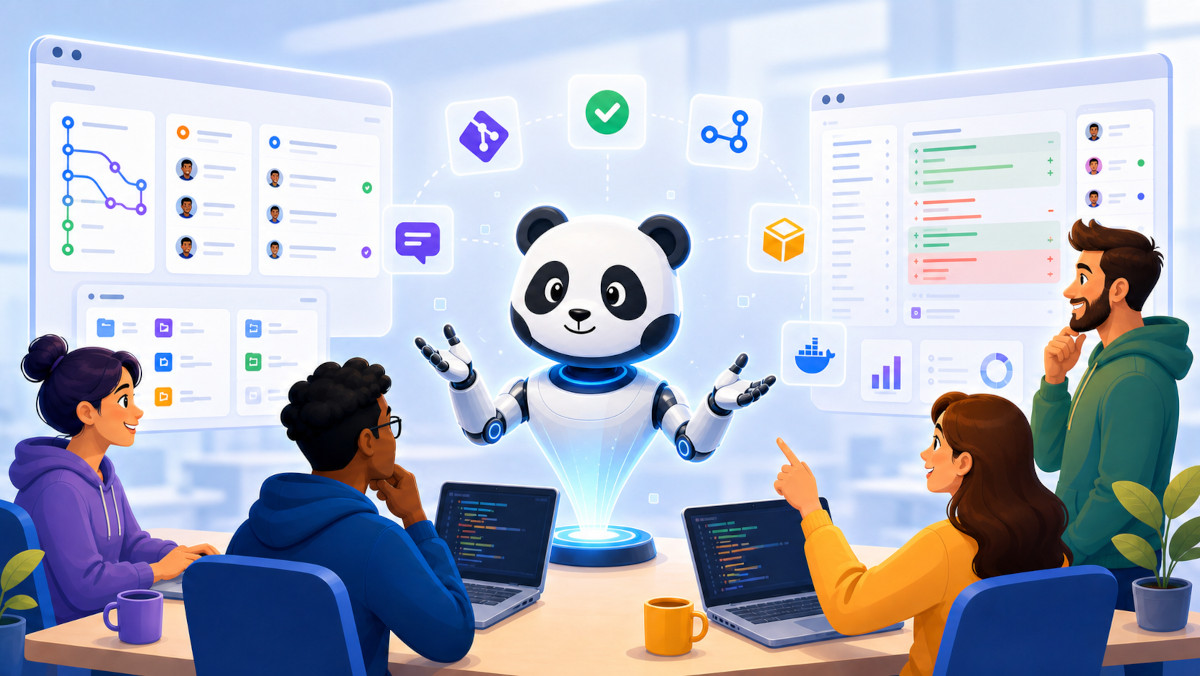
OneDev has positioned AI coding agents as integrated team members within its development platform, rather than separate assistants accessed via chat. AI agents now work directly from issues (capturing requirements), execute in isolated workspaces, submit pull requests linked to those issues, and participate in code review—ensuring implementation is judged against a shared source of truth and satisfies both human reviewers and CI/CD checks before merge.
Summaries like this, in your inbox every morning.
Sign up free →What happened
OneDev has introduced AI users as virtual teammates that work within the same development system teams use for requirements, implementation, review, and delivery. The AI agents can implement assigned issues, open pull requests, respond to review feedback, and follow up when CI/CD fails—all while keeping work visible in issues, pull requests, and CI/CD logs rather than in separate chat windows.
Why it matters
By anchoring AI work to issues as the source of truth and routing it through pull requests and code review, teams can hold AI agents accountable to the same specifications and validation processes humans use. This removes the friction of translating between a private AI chat and a project's actual development workflow, potentially making autonomous coding agents more practical for organizations that already use version control and issue tracking.
What to watch
OneDev can apply routing rules so certain issue types, priorities, or product areas automatically route to the best-suited AI user, and branch protection rules can assign AI reviewers to specific changes—turning AI participation into explicit project policy rather than ad hoc assistance. Teams can start using AI users by reading the documentation on working with AI users in issue and pull request contexts.
AI coding assistance has historically lived in separate chat interfaces or IDE plugins, forcing teams to translate requirements from tickets into prompts and then manually verify that results match the original specification. OneDev's approach inverts this: the platform treats AI agents as users within the existing development system, not external tools. By anchoring AI work to issues (which capture requirements, acceptance criteria, and team discussion), routing it through pull requests (the standard code review mechanism), and validating it against CI/CD checks (the same gates humans use), the platform creates a paper trail and a shared source of truth. This design choice appears aimed at addressing a core friction point: when AI coding is siloed in chat, teams lose visibility into what was asked and why, making it harder to hold results accountable and to transfer knowledge to the next person who touches the code.
The platform also enables automation through policy: teams can define rules so that certain issue types or pull requests automatically route to the right AI user, and branch protection rules can require specific AI reviewers for certain changes. This formalizes AI participation as part of the development process rather than treating it as a one-off assistant—a shift that could reduce coordination overhead if teams already manage their work through issues and pull requests. The practical implication for development teams is that AI agents become more auditable and integrated with existing tooling, though the body does not quantify how much faster or more accurate this workflow is compared to traditional prompt-and-response assistance.
No discussion yet for this article
Get curated AI news from 200+ sources delivered daily to your inbox. Free to use.
Get Started FreeFree · takes 30 seconds · unsubscribe anytime
1 minute a day. The AI essentials.
200+ sources · Email / LINE / Slack
