What happened
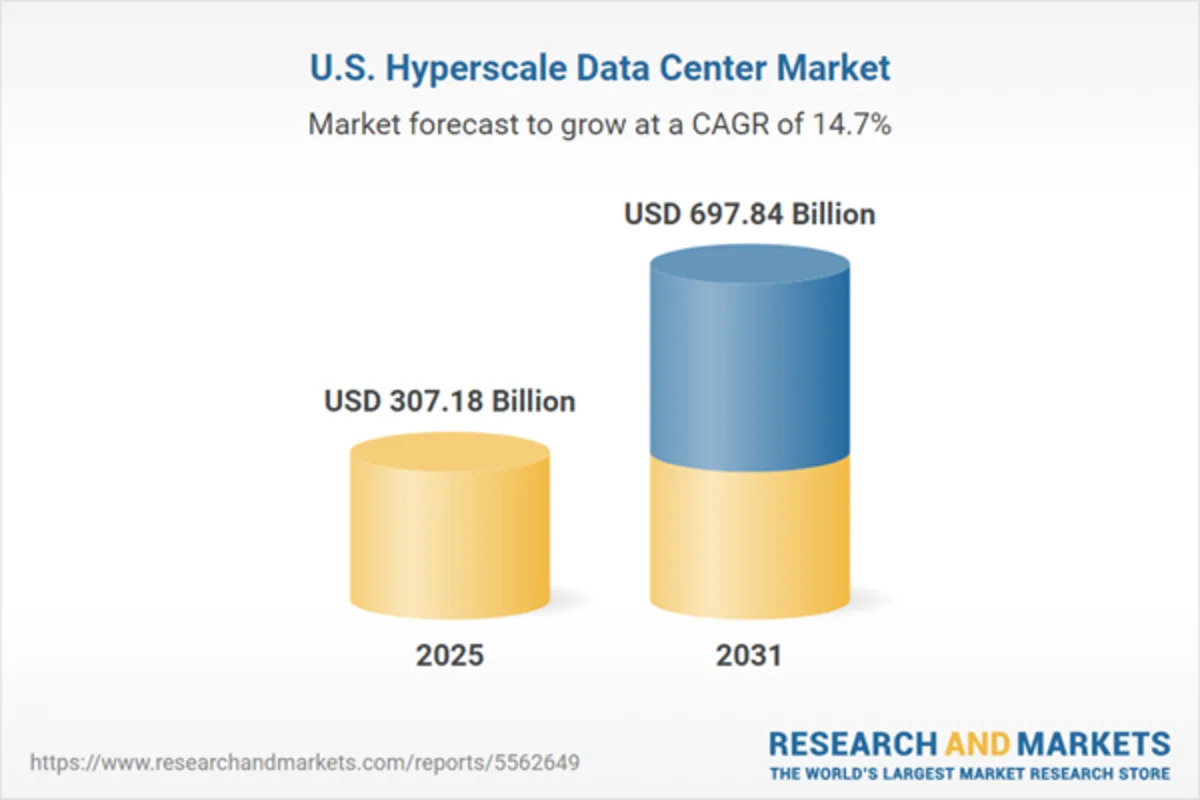
The U.S. hyperscale data center market is projected to expand at a CAGR of 14.66% from 2025 to 2031, driven by AI adoption, renewable energy, and advanced cooling and power technologies. Lambda opened an AI data center with 10,000 NVIDIA GPUs in Kansas City, Missouri in October 2025, and major operators like Amazon Web Services, Meta, Microsoft, and Google are investing heavily in sustainable infrastructure.
Why it matters
AI workloads are fundamentally reshaping data center design—traditional cooling methods cannot handle high-density GPU deployments, forcing operators to adopt liquid-cooling, hybrid systems, and microfluidic technologies to maintain efficiency. Businesses relying on cloud services may see cost and energy-efficiency improvements as these technologies mature, though the capital intensity of expansion could affect service pricing.
What to watch
The Southeast and Midwest are emerging as growth hotspots due to renewable resources and tax incentives, with Meta expanding in South Carolina and Louisiana and Google in Oklahoma. Nickel-zinc batteries and lithium-ion backup systems are competing to become the standard power solution for continuous AI operations.
Summaries like this, in your inbox every morning.
The U.S. hyperscale data center market is undergoing a structural transformation driven by AI's computational demands. The 14.66% compound annual growth rate through 2031 reflects the industry's recognition that GPU-heavy AI workloads require fundamentally different infrastructure than traditional cloud compute. Lambda's October 2025 deployment of 10,000 NVIDIA GPUs in Kansas City signals that operators are moving beyond incremental expansion into purpose-built AI facilities.
The convergence of three technology trends—GPU adoption, renewable energy, and advanced cooling—is reshaping competitive advantage. Major cloud providers (Amazon Web Services, Meta, Microsoft, Google) are investing in differentiated approaches: Meta and Microsoft are pioneering liquid cooling and microfluidic systems to handle density, while Google is standardizing lithium-ion backup power and exploring nickel-zinc batteries as alternatives. These investments suggest cooling and power efficiency will become key cost drivers for AI service pricing over the next five years.
Geographic distribution is shifting toward regions with dual advantages: renewable energy capacity and fiscal incentives. The Southeast's expansion (Meta in South Carolina and Louisiana) and Midwest's appeal (tax benefits, though hampered by Ohio regulatory bans) indicate that operators are decoupling from traditional coastal data center clusters to access cheaper power and land. Texas and Arizona's strength reflects connectivity infrastructure and tax benefits. This regional diversification may reduce concentration risk but also implies fragmentation of supply-chain logistics for data center components.
Pick your industry and the AI tools you use, and get news related to your work every day.
Free · 30 seconds with Google · unsubscribe anytimeWhat is AIToday? →
Ask AI anything about this article. The AI reads this article, earlier AIToday articles, and Wikipedia, and cites its sources. Q&As are published on this page for other readers too.

