AMD is forecast to outperform Nvidia in artificial intelligence semiconductors over three years.
The inference market—where AI generates responses—grows at 32% annually through 2032 and will nearly double AI training's size to $1.3 billion annually.
AMD leads in inference and server CPUs for autonomous AI agents, a market expected to reach $220 billion soon.
What happened
A Motley Fool analyst predicts Advanced Micro Devices (AMD) will outperform Nvidia over the next three years, citing AMD's strength in the faster-growing inference market and agentic AI, where it holds competitive advantages through software improvements, chiplet design, strategic acquisitions (MEXT and Taalas), and a partnership with Cerebras.
Why it matters
The inference market—where AI systems generate answers after processing prompts—is projected to grow at a 32% compound annual growth rate through 2032 and become nearly double the size of the AI model training market, hitting annual spending of $1.3 billion, according to Bloomberg Intelligence. While Nvidia dominates training, AMD is positioned as a serious competitor in this larger, faster-growing segment. Additionally, agentic AI (AI systems that act autonomously) is driving demand for server CPUs, a market AMD sees becoming $220 billion in the next few years—an area where AMD leads in server chips and has been gaining share from Intel.
What to watch
AMD's revenue growth is expected to accelerate as it executes on its inference and agentic AI strategies. The company's partnerships (particularly with Cerebras for disaggregated inference systems) and recent acquisitions will be critical to measuring whether it can translate its technical positioning into market share gains against Nvidia.
Ask the AI about this article →
The analyst's prediction hinges on a structural shift in AI spending: while Nvidia remains dominant in model training—the initial phase where large language models are created—the article emphasizes that inference (generating responses) is both technically less demanding and far larger in total market size. Bloomberg Intelligence projects inference will grow at 32% annually through 2032 and eventually represent nearly twice the spending of training, reaching $1.3 billion annually. This shift favors AMD because inference is memory-bound rather than compute-intensive, allowing AMD's chiplet architecture and software improvements to compete effectively where Nvidia's GPU dominance in training is less relevant.
AMD has also made targeted acquisitions and partnerships to close technical gaps. The purchase of MEXT (memory optimization) and Taalas (inference-specific chips) directly address inference workloads, while the Cerebras partnership creates a hybrid solution for the two phases of inference. Beyond inference, agentic AI—systems that autonomously execute tasks—demand far more CPUs relative to GPUs (a 1:1 ratio versus 8:1 for training), and AMD holds significant advantages here as the second-largest server CPU vendor with momentum against Intel. The analyst identifies this $220 billion opportunity as critical to AMD's growth trajectory.
For example, today's edition would include:
AI-summarized, only the topics you pick — one digest a day via Email, Slack, or Discord.
Free · takes 30 seconds · unsubscribe anytimeWhat is AIToday? →
Ask AI anything about this article. Q&As are published on this page for other readers too.
Israeli startup DataAgent Ltd

Taoyuan is positioning itself as a northern hub for AI data centers (AIDC), citing the Tatan area and an LNG c…

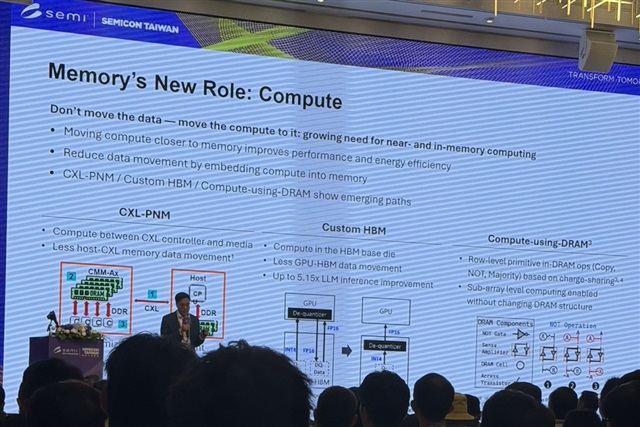
SK Hynix presented a custom HBM concept at SEMICON Taiwan 2026, where compute functions are placed in the base…
The U.S. Department of Defense announced on August 31 that it has deployed ChatGPT Mil, a customized version o…

Nvidia reported earnings that were both remarkable and boring, reflecting its focus on avoiding a consolidated…

Anthropic has agreed to a $35bn cloud-computing contract with Lambda, a Nvidia-backed cloud provider