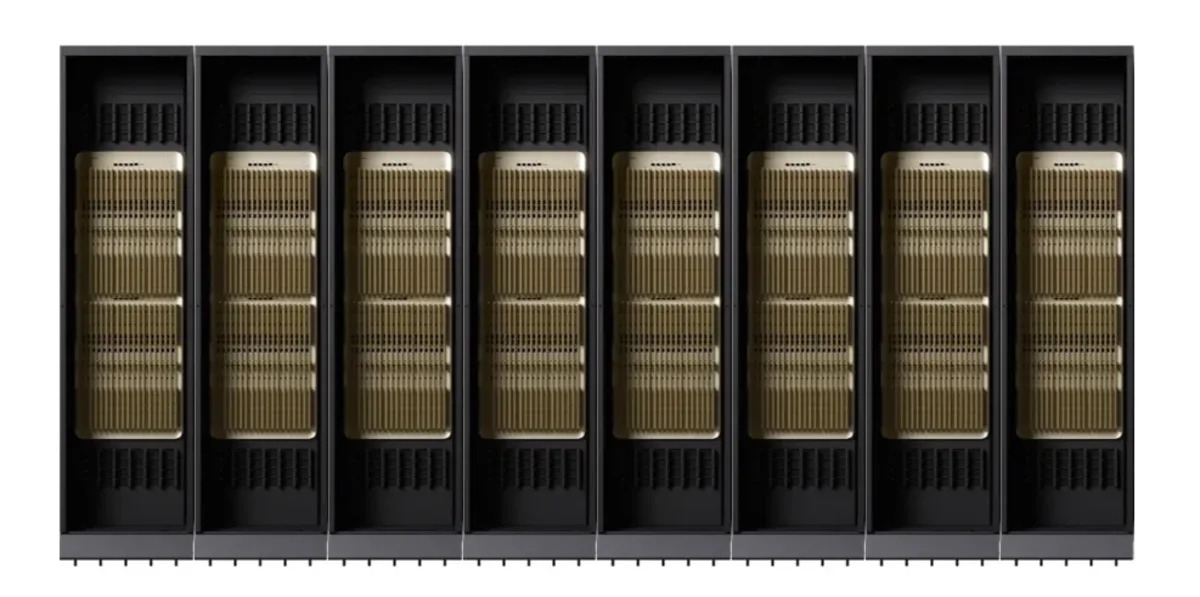
Nvidia denied a report that its Kyber AI server would be delayed by one year to 2028, asserting its product roadmap remains on track. The Kyber server, set to launch in the second half of 2027 alongside the Vera Rubin Ultra platform, would double GPU capacity per system to 144 chips through a redesigned vertical rack orientation, a key step as Nvidia faces competition from AMD and major cloud providers building their own chips.
Summaries like this, in your inbox every morning.
Sign up free →What happened
SemiAnalysis reported that Nvidia's next-generation Kyber AI server would face a one-year delay until 2028 due to design and manufacturing challenges. Nvidia denied the report, stating its roadmap remains intact and the Kyber server will launch with its Vera Rubin Ultra platform in the second half of 2027.
Why it matters
Nvidia's server roadmap is central to its dominance in data center AI chips. The Kyber server doubles GPU capacity per system from 72 to 144 chips through a vertical rack design. Any credible delay could signal manufacturing or design risks that competitors like AMD might exploit, and investors closely track execution on these timelines given Nvidia's $215.9 billion(約35兆円) fiscal 2026 revenue.
What to watch
Nvidia plans to launch its Vera Rubin platform in the second half of this year, ahead of the Kyber launch in the second half of 2027. The company releases new processor versions on a yearly cycle, so execution on these dates will be closely monitored.
Nvidia faces mounting pressure from multiple directions despite its commanding position in AI infrastructure. The company's fiscal 2026 revenue reached $215.9 billion(約35兆円), up from $26.9 billion(約4.3兆円) in fiscal 2023, and Wall Street analysts project fiscal 2027 revenue of $392.7 billion(約63兆円). However, competition is emerging from longtime rival AMD, which is launching its own 72-chip server rack, and from major customers including Google and Amazon that are increasingly offering their own chips to third parties.
The Kyber server represents a critical next step in Nvidia's roadmap—doubling GPU density per system through architectural redesign. A credible delay would undermine investor confidence in execution and could hand competitive advantage to rivals. SemiAnalysis's claim that design-related manufacturing challenges might push Kyber to 2028 triggered an immediate denial from Nvidia, signaling the reputational stakes. Nvidia's commitment to a yearly processor release cycle gives the market a clear cadence to monitor: Vera Rubin in H2 2025, then Vera Rubin Ultra with Kyber in H2 2027.
No discussion yet for this article
Get curated AI news from 200+ sources delivered daily to your inbox. Free to use.
Get Started FreeFree · takes 30 seconds · unsubscribe anytime
1 minute a day. The AI essentials.
200+ sources · Email / LINE / Slack
