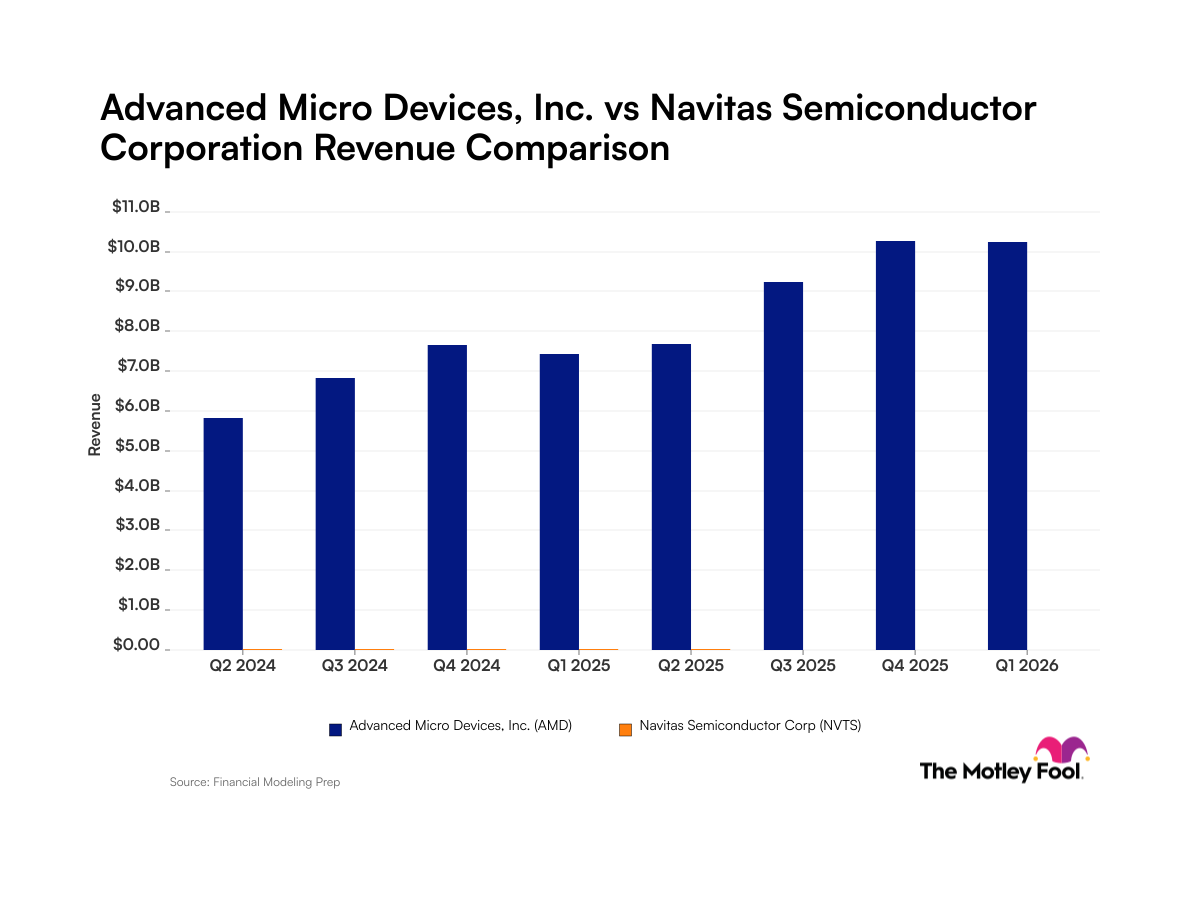
Advanced Micro Devices' quarterly revenue has more than doubled from $5.8 billion(約9300億円) in Q2 2024 to $10.3 billion(約1.6兆円) in Q1 2026, driven by strong demand for its AI infrastructure chips, while Navitas Semiconductor's revenue has declined sharply from $20.5 million(約33億円) to $8.6 million(約14億円) over the same period. Navitas' fall is partly intentional—the company exited its mobile and consumer businesses in China last year to refocus on AI—but the company's stock has also been hurt by a patent lawsuit and an equity-dilution announcement.
Summaries like this, in your inbox every morning.
Sign up free →What happened
Advanced Micro Devices generated $10.3 billion(約1.6兆円) in revenue for Q1 2026 (period ended March 28, 2026) with a 14% net income margin, while Navitas Semiconductor recorded $8.6 million(約14億円) in revenue for the same quarter with a -393% net income margin. AMD's revenue has risen from $5.8 billion(約9300億円) in Q2 2024 to $10.3 billion(約1.6兆円) in Q1 2026, whereas Navitas' revenue fell from $20.5 million(約33億円) in Q2 2024 to $8.6 million(約14億円) in Q1 2026.
Why it matters
AMD's upward revenue trend reflects strong demand for its microprocessors and graphics processing units from cloud providers building AI infrastructure, and the company has committed over $10 billion(約1.6兆円) to scale advanced packaging capabilities in Taiwan. Navitas' decline, though partly intentional after exiting its mobile and consumer businesses in China last year (which produced 60% of revenue in 2024), has pressured its stock price alongside a Wolfspeed patent infringement complaint and a $500 million(約800億円) at-the-market equity program that threatens shareholder dilution.
What to watch
Navitas management indicated sales would begin to recover this year, and Q1 2026 revenue did increase over Q4 2025, suggesting a potential turnaround may be underway. AMD's CPU chips are positioned to capture further demand as customers focus increasingly on AI inference capabilities.
Advanced Micro Devices and Navitas Semiconductor present contrasting stories in the AI-driven semiconductor market, with their revenue trajectories diverging sharply over the past two years. AMD, which develops and sells microprocessors, graphics processing units, and custom system-on-chip solutions to hardware manufacturers and public cloud providers, has grown its quarterly revenue consistently from $5.8 billion(約9300億円) in Q2 2024 (ended June 2024) through $10.3 billion(約1.6兆円) in Q1 2026 (ended March 28, 2026). For the quarter ended March 28, 2026, the company posted a 14% net income margin, underlining profitability alongside its scaling. The company has invested heavily to support this growth, committing over $10 billion(約1.6兆円) to expand advanced packaging capabilities in Taiwan.
Navitas Semiconductor, which designs and markets gallium nitride and silicon carbide power integrated circuits for automotive, mobile, and consumer electronics, has experienced a sustained revenue decline. Revenue fell from $20.5 million(約33億円) in Q2 2024 (ended June 2024) to just $8.6 million(約14億円) in Q1 2026 (ended March 31, 2026), a nearly 58% contraction over the period. More strikingly, the company recorded a -393% net income margin for the quarter ended March 31, 2026, indicating substantial operational losses. However, according to the Foolish Take analysis, much of this decline is intentional: Navitas decided to exit its mobile and consumer businesses in China last year to concentrate on the AI sector, and that China market had produced 60% of the company's 2024 revenue.
Navitas has also faced external pressures. The company recently responded to a patent infringement complaint filed by Wolfspeed, and it announced a $500 million(約800億円) at-the-market equity program, which threatens to dilute existing shareholder value. Despite these headwinds, management has signaled that sales would begin to recover this year. Q1 2026 revenue of $8.6 million(約14億円) did increase compared to Q4 2025's $7.3 million(約12億円), suggesting the anticipated turnaround may be beginning, though the stock price has fallen recently due to the Wolfspeed lawsuit and the equity dilution risk.
AMD's success reflects robust demand for its chips to power AI systems. As customers increasingly focus on AI inference capabilities, demand for CPUs is expected to rise further, positioning AMD's processor strength to capture additional growth. By contrast, Navitas' restructuring—while strategically sound in redirecting the company toward AI's higher-value power management segment—has created a near-term revenue trough that, combined with litigation and dilutive financing, has tested investor patience.
The revenue comparison between AMD and Navitas reveals two divergent trajectories within the artificial intelligence sector. AMD's steady scaling—from $5.8 billion(約9300億円) in Q2 2024 to $10.3 billion(約1.6兆円) in Q1 2026—reflects consistent demand for its processors and GPUs from cloud providers and hardware manufacturers investing in AI infrastructure. The company has backed this growth with a commitment of over $10 billion(約1.6兆円) to advance its packaging capabilities in Taiwan, signaling confidence in sustained demand.
Navitas' sharper decline, from $20.5 million(約33億円) to $8.6 million(約14億円) over the same span, appears driven by deliberate business restructuring rather than external market failure. By exiting its mobile and consumer operations in China—which accounted for 60% of 2024 revenue—the company narrowed its addressable market to focus on AI power management, a higher-value segment. However, the transition has compressed near-term revenue and coincided with external headwinds: a patent infringement complaint from Wolfspeed and the announcement of a $500 million(約800億円) at-the-market equity offering that risks diluting existing shareholders. The modest sequential improvement in Q1 2026 compared to Q4 2025 suggests management's recovery forecast may be materializing, though investor confidence remains fragile.
AI-summarized, only the topics you pick — one digest a day via Email, Slack, or Discord.
Free · takes 30 seconds · unsubscribe anytime
No discussion yet for this article
Get curated AI news from 200+ sources delivered daily to your inbox. Free to use.
Get Started FreeFree · takes 30 seconds · unsubscribe anytime
1 minute a day. The AI essentials.
200+ sources · Email / LINE / Slack
