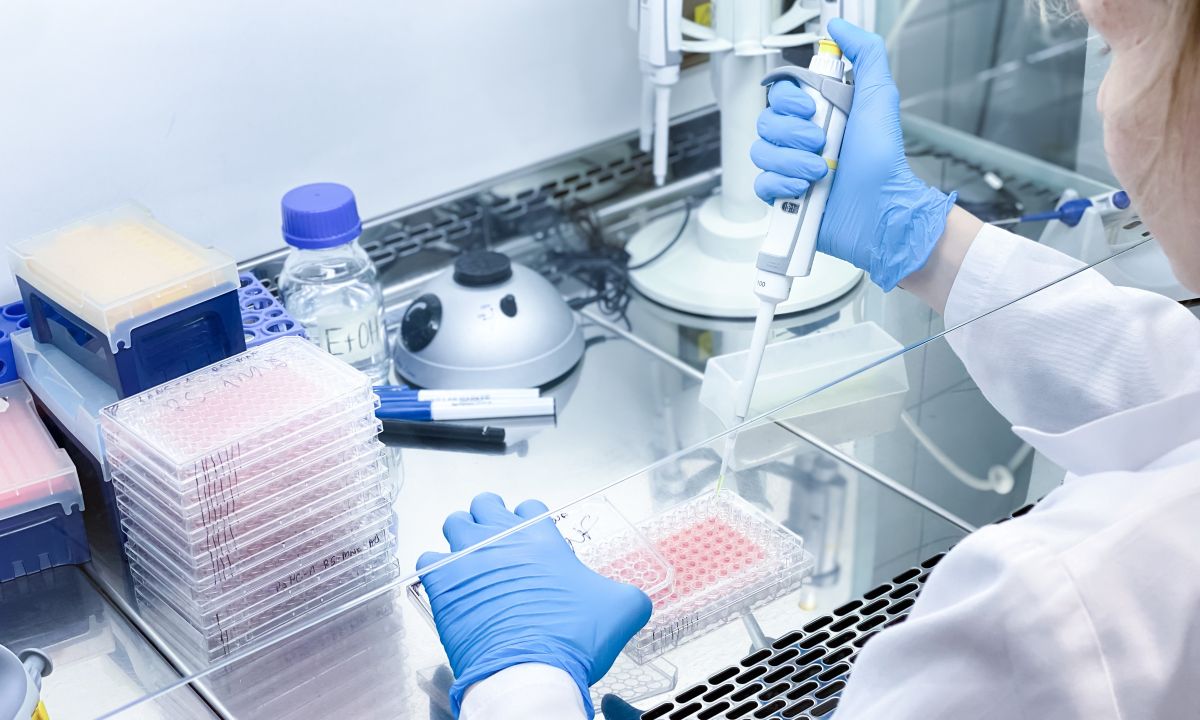
What happened
Moderna and Merck said Aug. 19 that intismeran autogene met its primary endpoint in melanoma patients whose tumors had been surgically removed — the first positive Phase 3 result for a single-patient-designed cancer therapy.
Why it matters
AI is now a direct input into the medicine, not just a research shortcut. Each dose is built from a patient's sequenced tumor, with machine learning predicting which mutations trigger a strong immune response.
What to watch
The Phase 3 answers whether the approach works medically; whether it works economically hinges on scaling one unique dose per patient on a rolling four-to-eight-week turnaround. Watch the 1,137-patient trial size against roughly 112,000 expected U.S. melanoma diagnoses in 2026.
WHO IT HITSThis lands on pharmaceutical manufacturing and supply-chain teams, who now face producing a unique product per patient on a rolling four-to-eight-week turnaround rather than one formulation at scale. It also matters to oncology clinicians and patients awaiting personalized cancer therapy.
Ask the AI about this article →
Summaries like this, in your inbox every morning.
Moderna and Merck's result rests on a different product logic from conventional pharma. Instead of one formulation manufactured at scale, intismeran autogene is assembled around a single patient's sequenced tumor, with machine learning predicting which mutations are most likely to trigger a strong immune response. The companies said the Phase 3 trial met its primary endpoint in melanoma patients whose tumors had been surgically removed, making it the first positive Phase 3 result for this category of treatment.
The immediate constraint is not the prediction algorithms. Moderna built a digital manufacturing system giving staff a real-time view of each patient's treatment as it moves through production, but turnaround currently runs roughly four to eight weeks from biopsy to dose. Compressing that timeline is a logistics and scheduling problem — coordinating sequencing, analysis and delivery one patient at a time. The same personalized approach is being applied to a hantavirus vaccine, which suggests the company views the underlying platform as reusable beyond cancer.
Whether individualized cancer therapy becomes a mainstream category or stays a narrow, high-cost option likely hinges on that scaling question. The Phase 3 result answers whether the approach works medically; the economic test at the scale melanoma demands is separate and still ahead. It appears to depend less on AI's predictive accuracy and more on how fast a personalized product can move from biopsy to treatment.
For example, today's edition would include:
AI-summarized, only the topics you pick — one digest a day via Email, Slack, or Discord.
Free · 30 seconds with Google · unsubscribe anytimeWhat is AIToday? →
Ask AI anything about this article. Q&As are published on this page for other readers too.
Anthropic launched a new Claude tool aimed at financial advisors, and the offering includes integrations with…

Vertiv agreed to buy UtilityInnovation Group for about $1.45 billion, and Broadcom's fiscal Q3 2026 AI semicon…

CrowdStrike rose 12% to $232.08, Zscaler 12% to $183.97, and Palo Alto Networks 11% to $366.40 in midday Monda…

Seagate posted Q4 revenue of $3.63B, up 48.5% YoY, and is shipping Mozaic 4 HAMR drives up to 44 terabytes to…
Charles Schwab and Anthropic announced a joint effort to bring Anthropic's Claude to independent registered in…
Crowdstrike stock hit an all-time high, with shares booming 14% amid AI concerns