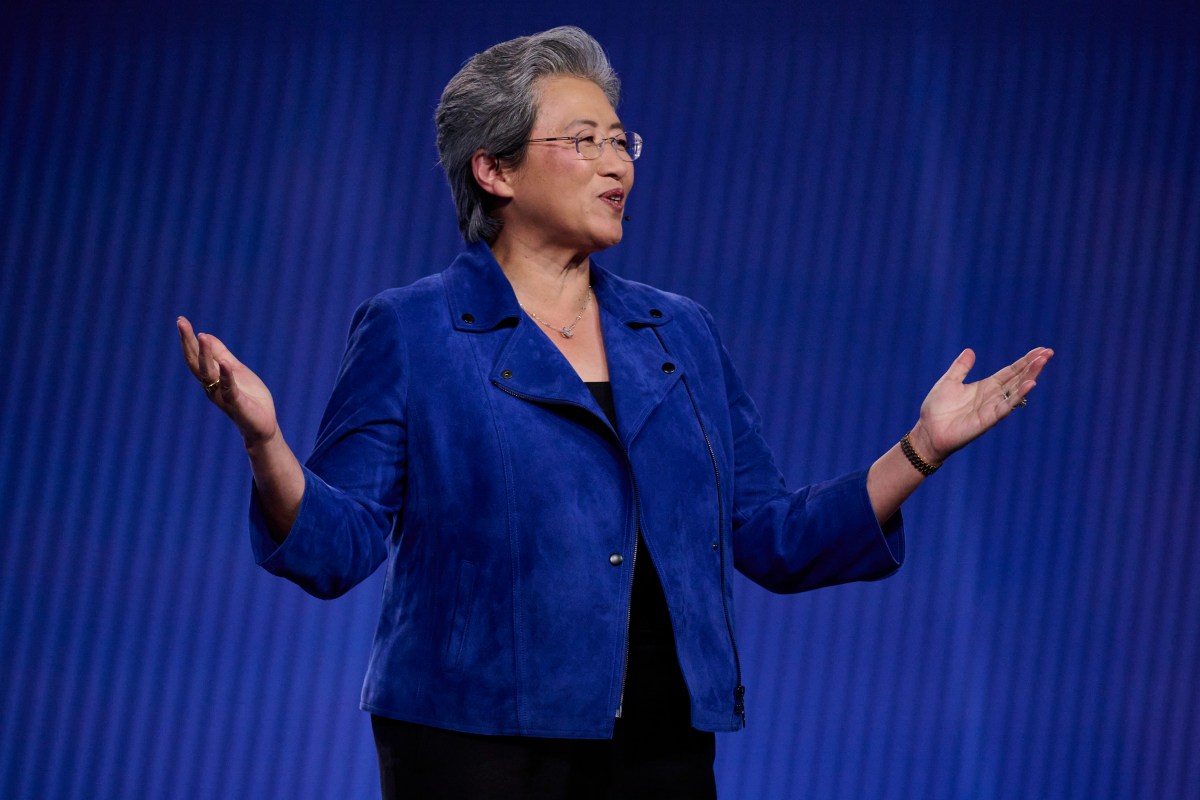
AMD launched Helios, a high-performance rack-scale system for training and deploying large AI models, competing directly with Nvidia's established Vera Rubin and Grace Blackwell systems. The product already has major backers including Microsoft, OpenAI, Meta, Oracle, and Anthropic, with plans for deployment later this year. AMD CEO Lisa Su forecast that the AI accelerator market will grow to about $1.4 trillion(約220兆円) by 2030, driven by the rising computational demands of agentic AI systems.
Summaries like this, in your inbox every morning.
Sign up free →What happened
AMD introduced Helios, a rack-scale system for training and running large AI models, at its Advancing AI conference in San Francisco on Thursday. The system will ship later this year and already counts Microsoft, OpenAI, Meta, Oracle, and Anthropic as customers; Anthropic and AMD announced a partnership Wednesday to deploy up to two gigawatts of GPUs via Helios. AMD also unveiled the Venice-X CPU for data centers, expected to launch in 2027.
Why it matters
Nvidia has dominated the rack-scale AI hardware market with its Vera Rubin and Grace Blackwell systems. Helios beats Vera Rubin on several performance metrics, giving AMD a genuine foothold in a market that powers the world's largest AI labs and their most demanding training workloads.
What to watch
AMD CEO Dr. Lisa Su projected that by 2030, the AI accelerator market will reach about $1.4 trillion(約220兆円)—approaching the size of the entire semiconductor market today—driven by agentic AI (AI systems that reason through multi-step problems and call external tools). Helios will be deployed by customers at gigawatt-scale.
AMD unveiled Helios at its sold-out Advancing AI conference in San Francisco on Thursday, with the system poised to ship later this year. The rack-scale system—which combines many processors into a single high-powered unit designed for data centers—is positioned as the tech industry's "highest performance AI rack," engineered to train and run the most demanding frontier models at massive scale and deployed by customers at gigawatt-scale capacity.
Helios already counts a heavyweight roster of customers: Microsoft, OpenAI, Meta, Oracle, and Anthropic. Microsoft CEO Satya Nadella announced Monday that the company would expand its Azure infrastructure with Helios. Separately, Anthropic and AMD announced a strategic partnership Wednesday focused on deploying up to two gigawatts of GPUs through the new system. Performance-wise, Helios beats Nvidia's Vera Rubin by several metrics, marking a meaningful challenge to Nvidia's established leadership with its Vera Rubin and Grace Blackwell rack-scale systems.
Beyond Helios, AMD introduced the Venice-X CPU, tailored for data centers to handle high-computing workloads, with a launch target of 2027. During her remarks at the conference, AMD Chair and CEO Dr. Lisa Su outlined the broader industry trajectory: by 2030, the AI accelerator market is expected to reach about $1.4 trillion(約220兆円), approaching the size of the entire semiconductor market as of today. She attributed this surge to a "step change in compute demand" driven by agentic AI—systems that must reason through multi-step workflows, call external tools, access data, and iterate until solving a problem. "When you ask the agent to do something, it actually has dozens of steps, and it has to reason, and it has to call tools, and it has to access data, and it has to keep doing it over and over until it solves the problem, and so you need lots of GPUs to do all that," Su explained. She added that GPUs are expected to make up the vast majority of the accelerator market because algorithms remain in their infancy and workloads continue to shift, favoring programmability across the broader silicon ecosystem.
AMD's Helios entry directly challenges Nvidia's long-standing dominance in the rack-scale AI hardware market, where the highest compute-density systems power the training and deployment of frontier AI models at the world's largest labs. The lineup of already-committed customers—spanning cloud providers (Microsoft), AI labs (OpenAI, Anthropic, Meta), and enterprise infrastructure (Oracle)—signals that the market is ready for an alternative, particularly one that claims performance advantages over Nvidia's Vera Rubin. The timing aligns with a fundamental shift in compute demand: as agentic AI systems grow more complex (reasoning through multiple steps, calling tools, iterating until solving problems), the sheer volume of GPU capacity required is climbing, making the entire market more attractive and potentially less dependent on any single vendor's dominance.
AMD's long-term thesis, articulated by CEO Lisa Su, rests on the explosive growth of AI accelerators as a category. By projecting the AI accelerator market to reach about $1.4 trillion(約220兆円) by 2030—nearly matching the size of the entire semiconductor industry today—she is signaling that AMD sees this not as a niche segment but as the next major driver of the chip industry's growth. The emphasis on programmability and the observation that "algorithms are still very much in their infancy" suggests AMD believes the market will remain diverse enough to support competitors who can adapt quickly as workloads evolve.
AI-summarized, only the topics you pick — one digest a day via Email, Slack, or Discord.
Free · takes 30 seconds · unsubscribe anytime
No comments yet. Be the first to share your thoughts!
Log in to join the discussion


Get curated AI news from 200+ sources delivered daily to your inbox. Free to use.
Get Started FreeFree · takes 30 seconds · unsubscribe anytime
1 minute a day. The AI essentials.
200+ sources · Email / LINE / Slack
