AIToday

Elite law firm CEO sees AI spurring consolidation wave

Semafor Tech15h ago
Elite law firm CEO sees AI spurring consolidation wave

Key takeaway

Hogan Lovells has completed what it calls the legal industry's largest-ever merger with Cadwalader, Wickersham & Taft, creating a top-five global firm with 3,000 lawyers and $3.6 billion(約5800億円) in annual revenue. CEO Miguel Zaldivar sees AI as a driver of law firm consolidation, arguing that the technology's high cost and impact on staffing will force smaller firms to merge or risk being displaced by larger, better-resourced competitors.

Summaries like this, in your inbox every morning.

Sign up free →

3 Key Points

  • What happened

    Hogan Lovells completed what it calls the legal industry's largest-ever merger, combining with Cadwalader, Wickersham & Taft to create a top-five global law firm with 3,000 lawyers and $3.6 billion(約5800億円) in annual revenue. CEO Miguel Zaldivar, who took the role in 2019, says the acquisition fills a critical gap in New York that his firm had lacked since its own 2000 merger between Hogan & Hartson (Washington-based, regulation-focused) and Lovells (a City of London firm operating since the 1890s).

  • Why it matters

    Zaldivar argues that AI will force law firms to invest heavily in technology and talent, making scale essential for survival. He told Cadwalader's managing partner Pat Quinn that a $600 million(約960億円) firm cannot afford the AI-driven cost structure shift—where technology moves from third or fourth place in expense priorities to first or second, potentially displacing junior lawyers. Kirkland & Ellis's announcement of a $500 million(約800億円) AI investment underscores the arms race: smaller firms risk being unable to compete without comparable resources.

  • What to watch

    Zaldivar predicts that law firms below $1.2 billion(約1900億円) will face pressure to consolidate or adapt. He expects segmentation: firms that efficiently train large junior classes will capture more work, while others will be displaced. He also signaled that Hogan Lovells will continue hiring in line with its history of retaining staff through crises (notably the 2008 Lehman collapse), rather than matching competitors' record hiring classes.

In Depth

Earlier this month, Hogan Lovells announced the completion of what it calls the legal industry's largest-ever merger: a combination with Cadwalader, Wickersham & Taft that created a top-five global law firm with 3,000 lawyers and $3.6 billion(約5800億円) in annual revenue. The architect of the deal was Hogan Lovells CEO Miguel Zaldivar, who has led the firm since 2019.

Zaldivar's strategic rationale centers on a gap that had persisted since Hogan Lovells itself was formed by a 2000 merger between Hogan & Hartson (a Washington-based regulation-focused firm) and Lovells (a City of London powerhouse serving that market since the 1890s). Despite the 2000 combination's success, Zaldivar said, everyone knew "something was missing, and that was New York." In his 2019 interview for the CEO role, he pledged to the board that the firm would enter New York, but noted that doing so required persuading a top-tier firm to merge rather than building from scratch—a path many national U.S. and British "magic circle" firms had attempted unsuccessfully. Zaldivar first targeted Shearman & Sterling, but they merged with Allen & Overy instead. He then immediately approached Pat Quinn, Cadwalader's managing partner, whom he described as running "the oldest firm on Wall Street." Quinn initially rejected the merger proposal in 2024, but Zaldivar urged him to study the materials with his strategy team. The persuasion worked.

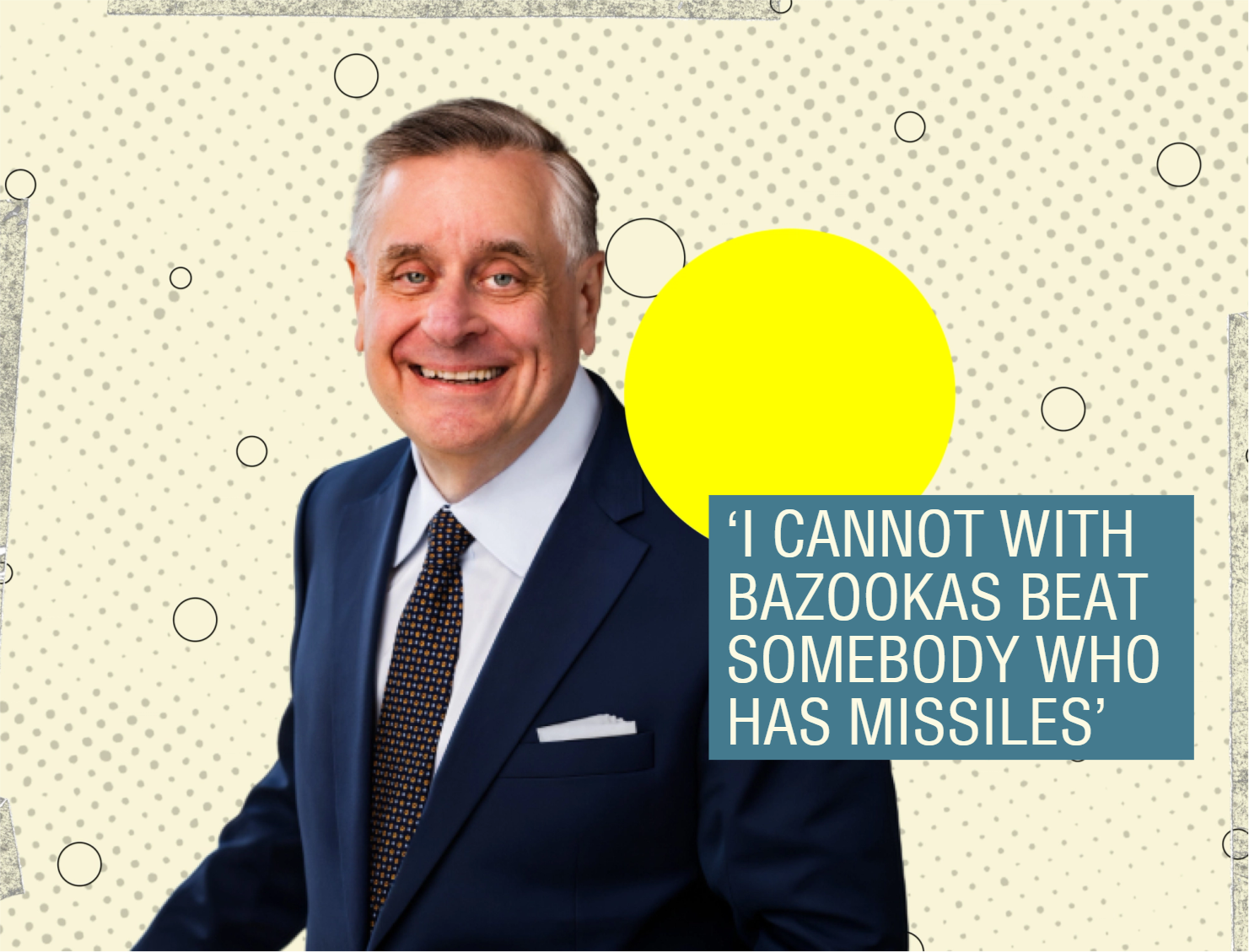
Zaldivar frames the consolidation as part of a broader industry trend driven by AI. He explained his thinking to Quinn directly: as AI transforms the profession, the cost structure of law firms will shift, with technology moving from third or fourth place in expenses to first or second, potentially displacing junior lawyers. He argued that a $600 million(約960億円) firm cannot afford to weather that transition alone, and that even Hogan Lovells—at nearly $3 billion(約4800億円) before the acquisition—lacks sufficient resources. "When Kirkland & Ellis announced that they're going to invest $500 million(約800億円) in AI," Zaldivar said, "you have to think about it and say, 'If I don't build my own resources to fight this war, I cannot with bazookas beat somebody who has missiles.'" He predicts that law firms below $1.2 billion(約1900億円) will face critical questions about their future, because although they have strong lawyers and regional coverage, they lack the resources to protect staff and compete on technology.

Zaldivar's vision for the firm's positioning is to become a "global elite firm" rather than a generalist competitor. He acknowledged that clients will increasingly use readily accessible AI tools in-house for routine work, but argued that elite firms can retain business by combining elite legal judgment with greater efficiency than in-house departments—because a large firm sees one issue ten times, while clients see it once. On the question of how AI will reshape the structure of law firms—whether from a traditional pyramid to a cylinder or torpedo shape with fewer junior lawyers—Zaldivar said he cannot predict the outcome. However, he noted that some competitors are hiring their largest classes in history, suggesting that efficiency and training matter. He also signaled that Hogan Lovells will continue its historical practice of consistent hiring rather than matching competitors' record classes, citing the firm's decision to retain all staff during the 2008 Lehman crisis as a moral legacy he intends to maintain.

Context & Analysis

The merger represents a strategic culmination of Zaldivar's decade-long vision. When he assumed the CEO role in 2019, he identified New York as the critical missing piece for a firm created by merging a Washington-based regulator-focused practice with a London powerhouse. After his initial overture to Shearman & Sterling failed (they chose Allen & Overy), he approached Cadwalader's Pat Quinn with what Quinn initially rejected—only to reconsider after reviewing Zaldivar's materials.

Zaldivar's framing of AI as the fundamental driver of consolidation is grounded in a concrete economic argument: the cost structure of law firms is shifting, with technology moving from third or fourth priority to first or second, while capital requirements for AI investment dwarf what mid-sized firms can support. He argues that firms below $1.2 billion(約1900億円) cannot generate the resources to both invest in AI infrastructure and protect their workforce from displacement—a calculus that makes scale the new competitive advantage. His reference to Kirkland & Ellis's $500 million(約800億円) AI commitment frames the stakes as an escalating arms race rather than gradual change.

FAQ

What two law firms merged, and what was the size of the combined firm?
Hogan Lovells merged with Cadwalader, Wickersham & Taft to create a firm with 3,000 lawyers and $3.6 billion(約5800億円) in annual revenue.
Why did the CEO target Cadwalader specifically?
Zaldivar said Hogan Lovells needed a presence in New York, which had been missing since the firm's creation in 2000. He first pursued Shearman & Sterling, but when they merged with Allen & Overy instead, he pivoted to Cadwalader because it is the oldest firm on Wall Street.
How much is Kirkland & Ellis investing in AI, and why does Zaldivar mention it?
Kirkland & Ellis announced a $500 million(約800億円) AI investment. Zaldivar cited this to illustrate the scale of investment required to compete: smaller firms cannot afford to fall behind in the AI arms race without comparable resources.

Get AI news like this every morning

AI-summarized, only the topics you pick — one digest a day via Email, Slack, or Discord.

Free · takes 30 seconds · unsubscribe anytime

Discussion

No discussion yet for this article

Stay ahead with AI news

Get curated AI news from 200+ sources delivered daily to your inbox. Free to use.

Get Started Free

Free · takes 30 seconds · unsubscribe anytime

1 minute a day. The AI essentials.

200+ sources · Email / LINE / Slack

Get it free →