What happened
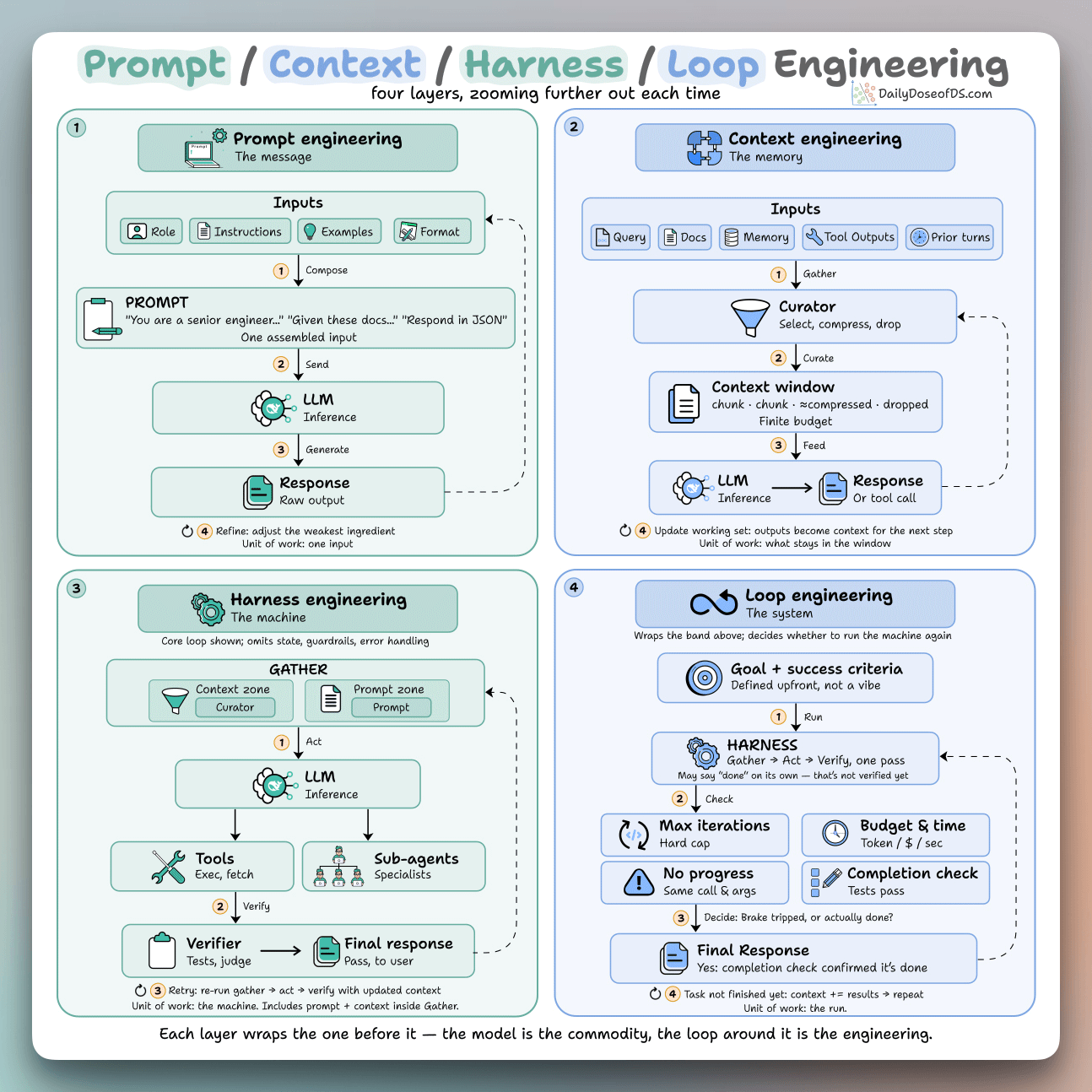
An article breaks down the engineering architecture of AI agents into four nested layers—prompt engineering, context engineering, harness engineering, and loop engineering—each wrapping around the core while-loop that defines how agents work. The outermost loop layer automates the entire run without manual prompts, setting goals and stop conditions upfront instead of writing each prompt by hand.
Why it matters
Most of the difficulty in building production agents lies outside the model itself. Getting the data clean, managing the context window, parsing tool outputs, and knowing when to stop are engineering problems that often take longer to solve than training the model. For teams building agents, this framework clarifies which layer—prompt, context, harness, or loop—needs attention when something fails.
What to watch
The loop layer introduces the hardest problem: knowing when to stop. The article notes that agents must use real signals like turn caps, token caps, no-progress detection, and completion checks—not just the agent's claim that it is done—because the tests may still fail even when the agent reports success.
Summaries like this, in your inbox every morning.
Pick your industry and the AI tools you use, and get news related to your work every day.
Free · 30 seconds with Google · unsubscribe anytimeWhat is AIToday? →
Ask AI anything about this article. The AI reads this article, earlier AIToday articles, and Wikipedia, and cites its sources. Q&As are published on this page for other readers too.

