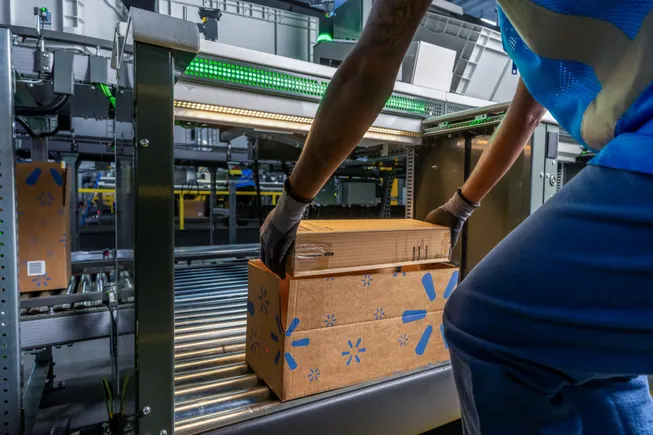
Walmart is embedding AI agents and digital twin simulations throughout its supply chain operations to navigate an unpredictable 2026 marked by tariffs, geopolitical turbulence, and extreme weather. The retailer uses virtual replicas of its logistics network to test how goods will move under stress—such as facility closures or sudden demand shifts—helping associates make faster decisions and balance cost, speed, and product assortment. This represents the supply chain industry's evolution from older statistical models to modern AI agents.
Summaries like this, in your inbox every morning.
Sign up free →What happened
Walmart's supply chain technology team now uses AI models, agents, and digital twin technology to manage its network of product nodes, transportation, and fulfillment. The retailer partners with OpenAI and Google on role-specific AI certifications through its employee platform Squiggly, and data science teams build custom AI tools. The company uses virtual replicas of its logistics network to simulate how goods move under stress — such as facility closures, transportation delays, or sudden shifts in customer demand.
Why it matters
Supply chain leaders face unpredictable disruptions from tariffs, geopolitical events, weather, and extreme environmental events in 2026. Walmart's AI agents allow associates to see how the entire network's resources are leveraged and where bottlenecks exist, rather than optimizing one node at a time. This helps the company balance three core factors — assortment, speed, and cost — and prepare for rapid, unexpected changes that can block product delivery.
What to watch
Walmart-owned Sam's Club debuted a one-hour delivery offering in April. As same-day delivery becomes more commonplace, the supply chain technology team's role managing inbound, outbound, and middle-mile transportation will remain critical. The tools Walmart builds are expected to evolve as AI technologies mature.
Walmart's investment in AI agents and digital twins reflects a fundamental shift in how large retailers manage complex logistics networks. The company's supply chain technology team oversees a sprawling operation—product nodes where goods are received, processed, stored, or shipped; a fulfillment engine that sources inventory; and transportation systems spanning inbound, outbound, and middle-mile routes. As same-day and one-hour delivery offerings (like Sam's Club's April launch) become more commonplace, the stakes for rapid, accurate decision-making have risen.
2026 has emerged as a particularly volatile year for supply chain leaders. Tariffs, geopolitical tensions, extreme weather, and environmental disruptions create barriers that were not always foreseeable or controllable. Walmart's approach—pairing real-time data about weather patterns and customer buying history with AI models and agents—addresses this turbulence by shifting from reactive problem-solving to scenario planning. Digital twins allow teams to simulate how the network will respond to crises like sudden facility closures or demand surges before they occur, reducing the lag between disruption and response.
The platform Walmart has built also encourages internal innovation: partnerships with OpenAI and Google on employee certifications through Squiggly, plus custom tools built by data science teams, signal that the company sees AI as both a top-down optimization layer and a bottom-up capability for frontline workers. As Indira Uppuluri, Walmart's SVP of supply chain technology, noted, the supply chain industry itself has evolved from stochastic models to large language models to AI agents—a trajectory that suggests Walmart's tooling will continue to evolve alongside the technology landscape.
No comments yet. Be the first to share your thoughts!
Log in to join the discussion


Get curated AI news from 200+ sources delivered daily to your inbox. Free to use.
Get Started FreeFree · takes 30 seconds · unsubscribe anytime
1 minute a day. The AI essentials.
200+ sources · Email / LINE / Slack
