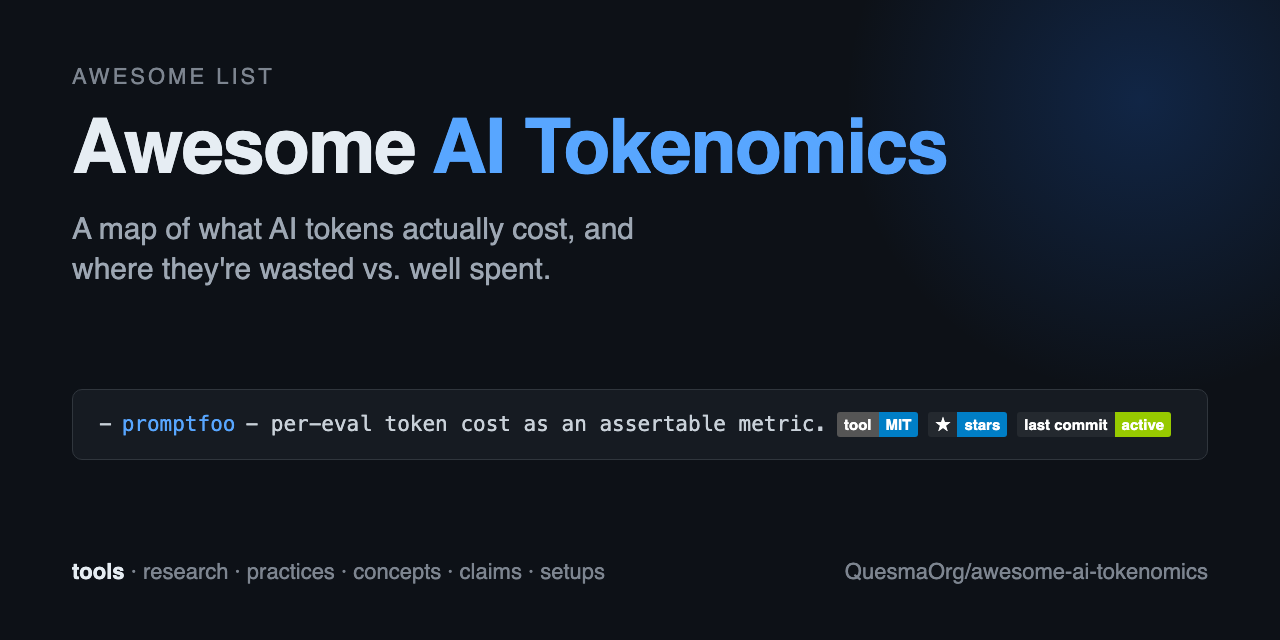
A comprehensive reference has been published documenting how AI token costs compound across different tools and workloads. It identifies where tokens are wasted—through over-eager context compaction, multi-agent orchestration overhead, and unrouted requests to expensive models—and catalogs 197 concrete tools and techniques to measure and reduce spend, including caching strategies that cut usage by up to 84%, routing that sends routine work to cheaper models, and first-party budget caps shipping across major vendors.
Summaries like this, in your inbox every morning.
Sign up free →What happened
A curated field guide to AI token cost tracking and optimization launched with 197 entries covering monitoring dashboards, observability platforms, compression techniques, and routing strategies for controlling AI spending across vendors (Anthropic Claude Code, Cursor, Codex, and others).
Why it matters
Coding agents and multi-agent systems consume tokens in hard-to-predict patterns—caching can cut usage by up to 84%, context compaction can double token spend if misconfigured (as in a Codex CLI upgrade), and vendor subscription arbitrage (running workloads far exceeding plan value) exposes billing unpredictability for technical teams; this guide surfaces concrete practices to measure, govern, and optimize spend.
What to watch
In July 2026, both Claude Code and Codex shipped first-party runaway-loop guardrails within days of each other; Anthropic stopped publishing exact Claude Code usage quotas (now '5x/20x multipliers' only); and native spend controls rolled out across Cursor, GitHub Copilot, and OpenAI within six weeks—signaling a push toward transparency after metered billing's 'bill-shock' backlash.
The "AI Tokenomics" field guide catalogs the emerging infrastructure for measuring and controlling AI token spend, organized into five areas: Monitor (dashboards and observability), Optimize (caching, compression, context engineering, memory, routing, multi-agent systems), Govern (allocation, anomaly detection, billing, budgets, energy, policy, spend management), Understand (buyer incentives and vendor moves), and Measure (benchmarks and cost accounting).
In the Monitor category, tools range from local CLI trackers (ccusage, reading 15 coding-agent sources with caching-aware pricing; CodeZeno, a Windows-taskbar widget for Claude Code quotas) to cloud platforms (Datadog LLM Observability, estimating per-request cost across 800+ models; OpenLIT, an Apache-2.0 self-hosted platform for LLM cost and latency observability). Claude Code Usage Monitor adds burn-rate analytics and P90 limit detection to terminal dashboards; TokenTracker takes a gamified approach with a desktop pet and achievements alongside native widgets.
Optimization entries surface three pain points. First, context engineering: Anthropic's vendor-reported context editing, memory tool, and server-side compaction cut token consumption by 84% in a 100-turn web-search evaluation; Cursor's dynamic context discovery (loading tool schemas and large outputs on demand rather than eagerly) cut context usage by 46.9%; but NVIDIA's RULER benchmark found that only half of models claiming 32K+ token context windows actually maintain output quality at full capacity. Second, compaction hazards: upgrading Codex CLI from v0.116 to v0.118 doubled or tripled token consumption for identical tasks through over-eager context compaction, an unintended token-amplification loop. Third, multi-agent overhead: hierarchical frameworks like CrewAI add a manager-LLM delegation tax (an extra model planning and validating), though its cost is unquantified in published studies.
Routing—choosing which model handles each request—appears throughout the Optimize section. Not Diamond predicts, per input, which LLM will give the best answer at the lowest cost and routes there; RouteLLM (LMSYS's open-source router) sends each query to a cheap or expensive model based on a trained cost threshold; MTRouter picks a different model for each turn of a conversation (not per query) to hit a cost budget without losing quality; OrcaRouter uses a LinUCB bandit algorithm with cost/quality tradeoffs independently confirmed on the RouterArena leaderboard. Antigravity CLI v1.1.5 added per-subagent model-tier routing and an /effort control; OpenCode, an MIT-licensed coding-agent CLI, allows explicit cost- and model-routing configuration in config files.
In the Govern section, Anthropic halted publication of exact Claude Code usage quotas, describing Max plans only as 5x/20x multipliers of Pro with no absolute numbers, signaling a shift toward opacity. Within six weeks in mid-2026, Claude Code and Codex both shipped first-party runaway-loop guardrails. Claude Code v2.1.199 auto-retries rate-limit errors with backoff and raised the default retry ceiling to 300 (from 15); the v2.1.216–219 bundle (2026-07-20 to 07-24) added a concurrent-subagent cap and enforced --max-budget-usd controls. Native spend layers now exist at all major vendors: OpenAI's ChatGPT Enterprise offers a Global Admin Console with credit caps and a Cost API; Anthropic's Claude Enterprise provides org-level spend caps, model defaults, and per-user cost analytics via the Admin API; Vercel AI Gateway caps spend per API key in dollars (minimum $1) with daily/weekly/monthly refresh. PointFive's TokenShift governs coding-agent spend across Claude Code, Cursor, Codex, and 8 other partners, claiming a 10–20% reduction; Revenium tracks spend to the cent at runtime and auto-shutoffs on runaway budgets; Vantage ingests token-level cost data from Anthropic and OpenAI APIs, plus Cursor and cloud spend.
The guide's "Understand" section names the inflection: users had been practicing "subscription arbitrage"—routing agentic workloads worth far more than a subscription's price through cheap Pro/Max plans—until Anthropic tried and then paused a fix. GitHub's move from flat-rate Copilot plans to metered AI Credits exposed the true per-token cost of agentic workflows and triggered a demand-side reaction the community termed "tokenpocalypse," suggesting that many teams had hidden high token consumption under flat-rate plans and now faced bill shock upon transparency.
The guide emerges against a backdrop of vendor-driven change: over the first half of 2026, Cursor, GitHub Copilot, and OpenAI each shipped native admin spend controls—budget caps, credit metering, usage dashboards—within six weeks of each other. This convergence reflects a market pressure point: users had been routing agentic workloads worth far more than subscription prices through cheap Pro/Max plans ("subscription arbitrage"), and Anthropic's attempt to close this loophole prompted a paused-but-ongoing reckoning. Meanwhile, Anthropic stopped publishing exact Claude Code usage quotas, replacing them with relative multipliers (5x/20x for Max vs. Pro), adding opacity to cost planning.
The field guide's 197 entries signal that token efficiency is now a primary concern for engineering teams. Context window management emerges as a critical lever: holding task difficulty constant, LLM output quality degrades as input length grows (Chroma's finding); caching and compression can reduce consumption dramatically—but misconfigured compaction has doubled token spend for identical work. Multi-agent orchestration introduces a hidden tax (manager-LLM delegation overhead in frameworks like CrewAI) that most tools do not yet quantify. Routing—sending routine queries to cheaper or local models and hard ones to frontier models—appears across multiple entries as the simplest lever teams can pull.
AI-summarized, only the topics you pick — one digest a day via Email, Slack, or Discord.
Free · takes 30 seconds · unsubscribe anytime
No comments yet. Be the first to share your thoughts!
Log in to join the discussion




Get curated AI news from 200+ sources delivered daily to your inbox. Free to use.
Get Started FreeFree · takes 30 seconds · unsubscribe anytime
