Conservative voters in Florida are mounting an unexpected political rebellion against data center construction, splitting from Republican leaders who support the industry. A Gallup poll shows seven in 10 Americans oppose data centers in their area, with nearly two-thirds of Republicans and 75 percent of Democrats objecting to local projects. The backlash is bipartisan—driven by environmental concerns, AI ethics, surveillance fears, and quality-of-life worries—but conservatives add anxieties about Chinese infiltration of U.S. technology. For some lifelong Republicans, the issue has become serious enough to threaten their party loyalty.
Summaries like this, in your inbox every morning.
Sign up free →What happened
Residents of Hernando County, Florida, are organizing to oppose hyperscale data center construction in their community, despite the county commission approving a one-year moratorium in June. The effort is part of a nearly 150-protest movement affiliated with Humans First, a conservative organization led by Amy Kremer, and includes a growing backlash across more than 20 Florida counties and municipalities.
Why it matters
A recent Gallup poll found that seven in 10 Americans oppose data center construction in their area, with nearly two-thirds of Republicans and 75 percent of Democrats objecting to local projects. The backlash unites left and right around shared concerns—environmental costs, AI ethics, surveillance risks, and quality-of-life impacts—but adds a partisan edge on the right around fears of Chinese infiltration of U.S. technology. For some lifelong Republicans like organizer Patti Zirhut, the issue has become serious enough to override party loyalty: she says she will vote Democrat if Republican gubernatorial candidate Byron Donalds, a vocal data center supporter who has received over $5 million(約8億円) in tech industry donations, wins the primary.
What to watch
Rep. Donalds, the Republican front-runner in the gubernatorial primary and a data center advocate, is facing attack ads highlighting his tech industry support. He has since announced legislation to prevent data centers from driving up utility costs, signaling tension between his industry backers and his primary voters. In Citrus County, the backlash was strong enough to deter developers: in June, a sponsor withdrew its plan to build an 800-acre data center after the county commission approved a one-year moratorium on rezoning applications.
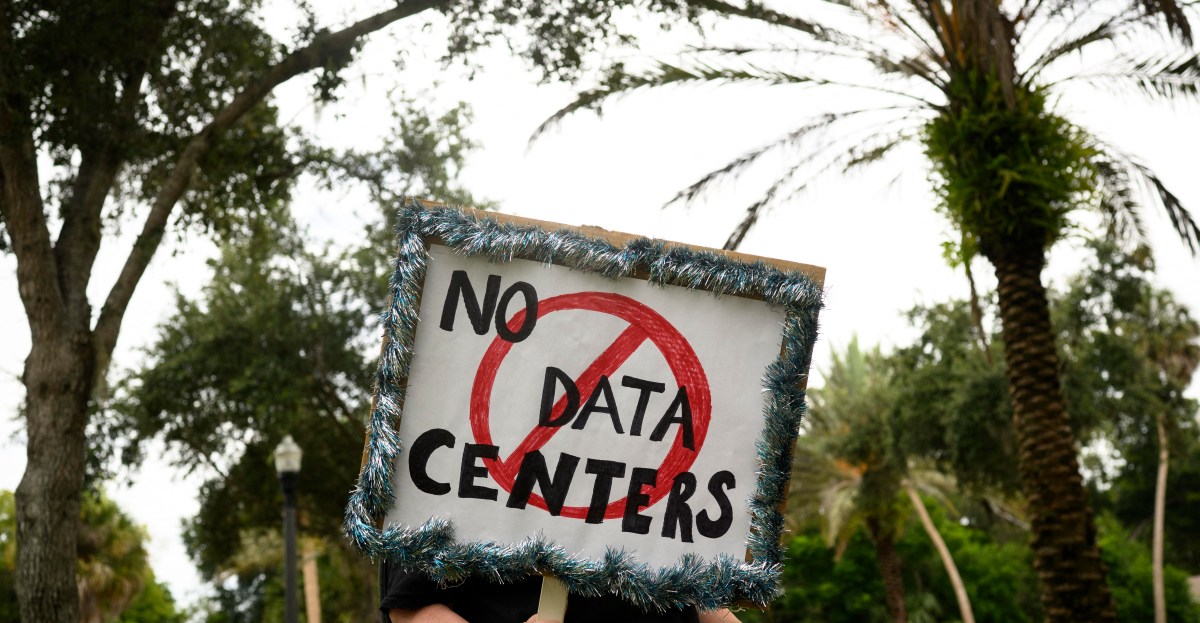
On a humid Saturday morning in central Florida, a small group of residents gathered outside the Spring Hill Branch Library to protest the construction of a hyperscale data center. Though Hernando County had already approved a one-year moratorium on such developments in June, the organizers—coordinated under the banner No Data Centers Hernando County—wanted a permanent ban, not a temporary pause. Carol, a 71-year-old retired country music radio host and self-described conservative, manned a table with flyers and a petition. She spoke of multiple harms: the intense noise emitted by data centers around the clock, harm to bees and other pollinators from the frequencies they emit, stillborn calves born to cows on nearby ranches, and what she saw as reckless dependence on Chinese-sourced computer chips.
The rally was one of nearly 150 protests affiliated with Humans First, described as a conservative social movement dedicated to ensuring that the future of AI rests with everyday people. Humans First is a once-bipartisan offshoot of the Center for AI Safety, led by Amy Kremer, a longtime conservative organizer who was an early leader of the Tea Party and a cofounder of Women for Trump and Women for America First. The concerns animating the conservative backlash—environmental costs, ethical problems with AI ranging from mass government surveillance to mental health effects, and quality-of-life impacts—overlap significantly with left-wing opposition. Yet the conservative wing adds a distinct partisan anxiety: the threat of Chinese infiltration of U.S. technology. A recent Gallup poll found that seven in 10 Americans oppose data center construction in their area; nearly two-thirds of Republicans and 75 percent of Democrats surveyed said they objected to local projects, making the backlash decidedly bipartisan.
In Hernando County, the movement has fractured traditional Republican unity. Patti Zirhut, the local organizer, is a lifelong conservative who initially supported Gov. Ron DeSantis. But she felt betrayed when, in his second term, DeSantis became, in her words, "nothing but pro-development, just inviting everybody here, tearing up our state." Though DeSantis signed a May law requiring hyperscale data centers to cover their own utility costs and allowing local governments to set water use regulations, his administration has given data center developers millions in tax breaks, according to the Tampa Bay Times. The bigger political wound has opened in the gubernatorial primary race. Rep. Byron Donalds, the Republican front-runner and a vocal data center supporter, has received more than $5 million(約8億円) in donations from Leading the Future, a $100 million(約160億円) pro-AI super PAC backed by Andreessen Horowitz and Joe Lonsdale of Palantir, plus $500,000 from American Mission, itself funded by Leading the Future. Donalds has said his vision is to make Florida the financial capital of the world and that data centers will be "a function of American life going forward." For Zirhut and her allies, this represents a capitulation to outside money over local welfare. She told the reporter, "If Byron Donalds wins the primary, I'm voting Democrat. I will not vote for him," adding that she would also consider an independent candidate opposed to data centers. "It's not about the party," she said. "It's about human life."
The backlash has proved potent enough to move political actors. Donalds, feeling pressure from primary voters, announced legislation on Monday to prevent data centers from driving up utility costs—an attempt to navigate between his tech industry backers and his voters. Across the state, more than 20 counties and municipalities have discussed or passed moratoria on data center construction. In Citrus County, a developer withdrew its plan to build an 800-acre data center entirely after the county commission approved a one-year moratorium on rezoning applications for such projects in June. Dan Diorio, executive vice president of state policy and government affairs at the Data Center Coalition, the industry's lobbying group, warned that local moratoriums would "send a signal that the area is closed for business." But that signal is precisely what Zirhut and her fellow organizers want—provided that local, community-rooted development remains welcome.
The data center backlash in Florida reveals a rare crack in partisan polarization—one driven not by national ideology but by hyperlocal economic and environmental grievance. Carol, a retired conservative radio host, and Patti Zirhut, a lifelong Republican IT worker, are fighting the same environmental and social costs that have long animated progressive opposition to big tech infrastructure: water use, energy draw, noise pollution, and surveillance concerns. Yet the conservative wing adds a distinct anxiety: the geopolitical threat of Chinese technology infiltration and dependence. This fusion of shared environmental concern with partisan national-security worry is what gives Humans First, Amy Kremer's organization, its political edge—it mobilizes conservative grassroots energy around an issue that would normally align them with the Left, but frames it through a right-wing lens.
The political crackup is most visible in Florida's gubernatorial race. Gov. Ron DeSantis positioned himself as an AI skeptic and signed a May law requiring data centers to cover their own utility costs and allowing local governments to regulate water use. Yet his administration has simultaneously handed developers millions in tax breaks—a contradiction that has cost him support among conservative locals. Rep. Byron Donalds, the Republican primary front-runner, has gone further in embracing the industry, receiving over $5 million(約8億円) from Leading the Future and other tech-backed groups. For Zirhut and others, this represents a betrayal: she has stated she will vote Democrat rather than for Donalds if he wins the primary. In at least one case, the backlash has proven effective—in Citrus County, a developer withdrew an 800-acre data center proposal after the county approved a moratorium, suggesting that local organizing can move the needle.
AI-summarized, only the topics you pick — one digest a day via Email, Slack, or Discord.
Free · takes 30 seconds · unsubscribe anytime
No discussion yet for this article
Get curated AI news from 200+ sources delivered daily to your inbox. Free to use.
Get Started FreeFree · takes 30 seconds · unsubscribe anytime
1 minute a day. The AI essentials.
200+ sources · Email / LINE / Slack

