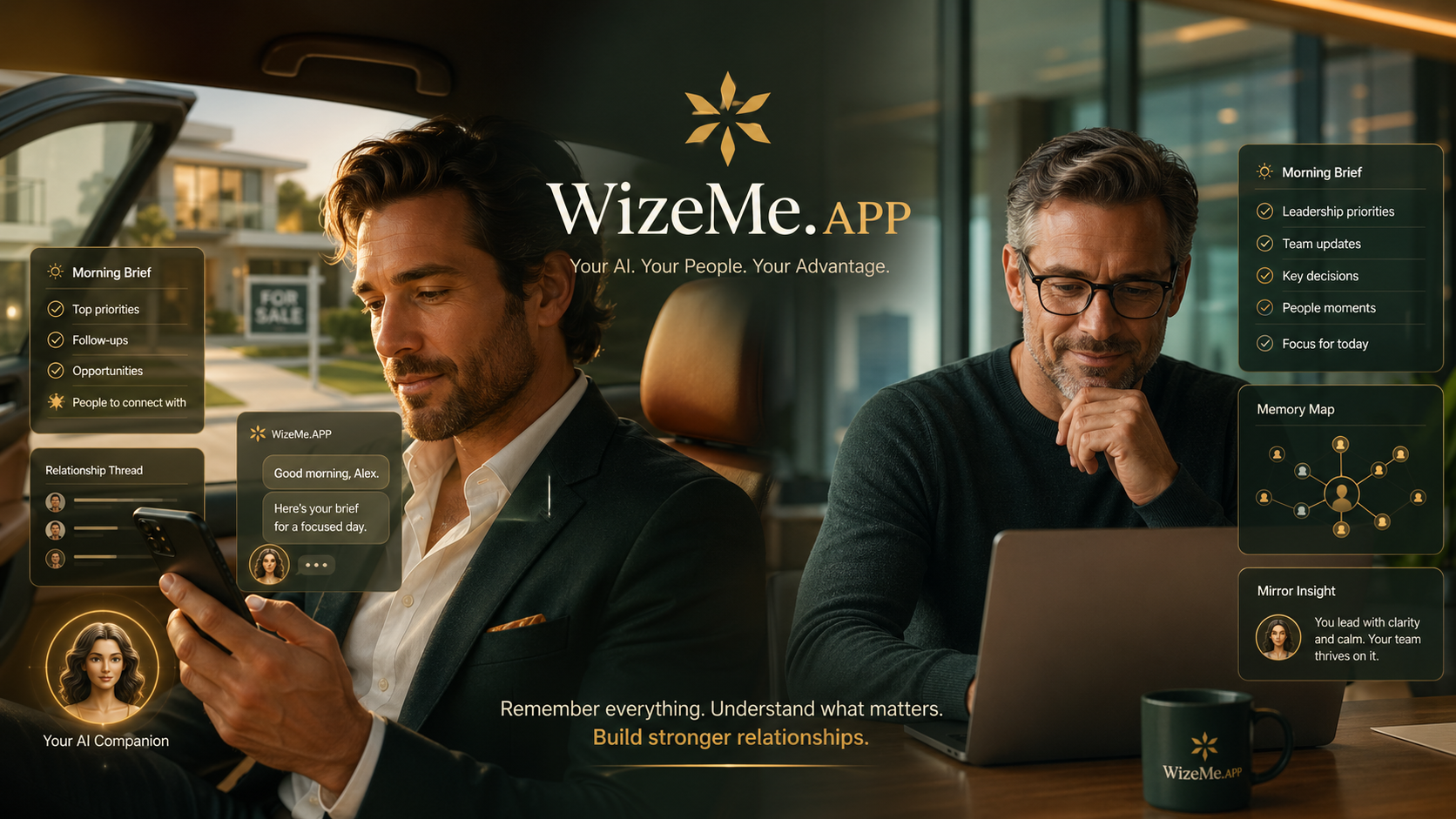
WizeMe has launched an AI continuity product that lets users bring their own context from multiple sources—email, calendar, notes, CRM files—while maintaining control over what the AI remembers and what actions it takes. The product uses a "Trust Layer" that requires evidence and explicit approval before any consequential action, ensuring the AI acts as a memory and decision-support tool rather than an autonomous agent. It is designed for high-context professionals and ambitious individuals who want AI to remember their situation without needing to re-explain themselves.
Summaries like this, in your inbox every morning.
Sign up free →What happened
WizeMe introduces a product that lets users bring approved context from Gmail, Calendar, Notion, Granola, Plaud, CRM files, notes, and more into AI interactions while keeping sources permissioned and labeled. Every consequential action is bound by a Trust Layer that requires evidence, scope, and approval before execution.
Why it matters
The tool is built for founders, operators, professionals, creators, students, caregivers, and ambitious people who need to connect work, family, health, goals, and decisions without re-explaining context each time. It positions itself as a continuity layer that preserves user dignity and agency by ensuring the AI remembers approved context and acts only with explicit permission.
What to watch
WizeMe commits to publishing benchmark artifacts and documentation separately from private product internals so claims can be verified without exposing user data, source code, or API keys—a transparency mechanism intended to build trust in how it handles sensitive information.
WizeMe introduces a continuity layer for AI interactions centered on user-controlled memory and bounded action. The product allows users to bring approved context from multiple sources—including Gmail, Calendar, Notion, Granola, Plaud, CRM files, and notes—into conversations with an AI while keeping those sources permissioned and labeled so their origin is always clear.
The core mechanism is a Trust Layer that governs every consequential action. Before the AI executes any meaningful step, the action must be bound by three constraints: evidence (grounded in the user's approved context), scope (limited to what was specified), and approval (explicit user sign-off). This means the AI acts as a memory and decision-support tool—it can notice what matters and rehearse next moves—but it cannot act autonomously.
WizeMe targets founders, operators, professionals, creators, students, caregivers, and ambitious people whose context spans work, family, health, goals, relationships, and decisions. The pitch is that it reduces re-explaining: instead of repeating your situation, pressure, people, and stakes to the AI each time, you bring that context once, permissioned and labeled, and the AI stays connected to it across conversations. The product explicitly disclaims being a replacement for human judgment; it is a continuity layer.
On privacy and trust, WizeMe commits to a transparency model: it publishes public benchmark artifacts and documentation separately from private product internals, so external parties can verify claims without access to user data, source code, training corpora, API keys, environment files, or other internal secrets. The philosophy is that trust starts with boundaries—the system should say when evidence is not loaded, avoid pretending certainty from a cold start, and keep the human's approval and agency visible and primary.
WizeMe frames itself as a response to a specific problem: professionals and ambitious individuals whose work and life context is already too valuable to keep scattered, yet expensive to consolidate manually each time they need AI assistance. The product's core claim is that by letting users bring their own approved context into AI interactions—while maintaining explicit control over what the AI remembers and what it acts on—it can reduce friction without sacrificing agency or dignity.
The "Trust Layer" is the product's central mechanism: it enforces that memory stays evidence-bound, nothing consequential acts without approval, and sources remain labeled and permissioned. This design reflects a philosophy that user control and transparency should precede convenience. The separate publication of benchmark artifacts from private internals suggests WizeMe is betting that users and developers will trust a system more if its claims can be independently verified without exposing proprietary details.
AI-summarized, only the topics you pick — one digest a day via Email, Slack, or Discord.
Free · takes 30 seconds · unsubscribe anytime
No discussion yet for this article
Get curated AI news from 200+ sources delivered daily to your inbox. Free to use.
Get Started FreeFree · takes 30 seconds · unsubscribe anytime
