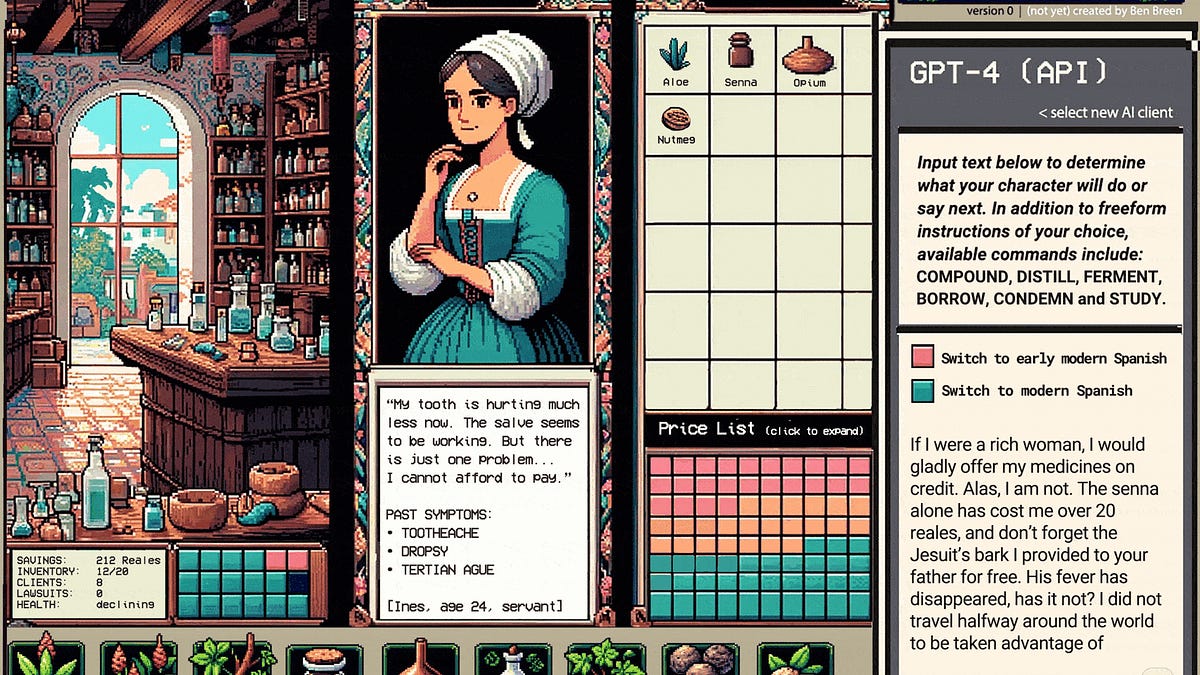
An educator at UC Santa Cruz has developed AI-powered historical simulations that let students role-play in past settings while doing real research, and argues that LLM-based educational games represent a major new use case for generative AI. With over 50% of American university students already using LLMs, education is becoming the most important near-term field for the technology—one where AI's errors are less consequential than in healthcare or finance, yet the impact is enormous because the sector represents 6% of U.S. GDP.
Summaries like this, in your inbox every morning.
Sign up free →What happened
A UC Santa Cruz instructor has spent over a year developing AI-powered historical simulations called "HistoryLens" using ChatGPT, Claude, and Gemini, where students engage in text-based role-playing scenarios tied to actual course content and historical sources, followed by fact-checking and reflection assignments.
Why it matters
Over 50% of American university students are already using LLMs, and education accounts for 6% of U.S. GDP — making classrooms a proven, large-scale field where generative AI can serve learning rather than cheating. Unlike high-stakes domains like healthcare where AI errors are dangerous, educational settings allow for productive confusion and lower-stakes experimentation with these tools.
What to watch
The instructor proposes three fully-realized game concepts — Young Darwin (exploring the Galapagos and cataloging specimens), Mexico City Apothecary (mixing historical medicines and managing an apothecary shop), and Cybernetic Spies (navigating the 1946 Macy conference) — each designed so that winning requires actual historical research and writing, not just selecting correct answers from multiple choice.
For more than a year, an instructor at UC Santa Cruz has been experimenting with using ChatGPT, Claude, and Gemini to create "HistoryLens"—a set of text-based, interactive historical simulations for classroom use. The basic mechanism is simple: the instructor writes a prompt that combines rules, a specific historical setting, event, and source material tailored to course content. Students paste this prompt into their LLM of choice, working alone or in pairs, and then decide how to act within the scenario. A young Charles Darwin can explore the Galapagos; Maria de Lima can manage a seventeenth-century apothecary shop in Mexico City. After students experience the simulation, the instructor leads group discussions where students fact-check the AI's output, research questions the simulation raised, and reflect on what they learned.
The author argues that this approach represents the first stage of a new category of educational games that will reshape how students learn. Two key assumptions underpin this argument. First, education may be the most important near-term field for generative AI. Unlike healthcare, where LLM hallucinations and errors pose unacceptable risks, education has lower stakes and can actually benefit from productive confusion. Moreover, the field is already saturated with LLM use: according to one study, over 50% of American university students are already using these tools. The rollout of OpenAI's free GPT-4o model will likely accelerate this adoption. Education accounts for 6% of U.S. GDP and represents one of the largest employment sectors globally, so the scale of potential impact is enormous.
Second, educational games are a major real-world use case for LLMs. The author proposes three concrete examples. "Young Darwin" places players on the Galapagos Islands, where they explore habitats depicted as grids of emojis, catalog specimens, manage Darwin's thirst and fatigue, and write journal entries describing their findings—winning requires gathering ten specimens and producing high-quality entries before injury or mishap forces a return to the HMS Beagle. "Mexico City Apothecary" casts the player as Maria de Lima, a female apothecary in seventeenth-century Mexico City, mixing medicines according to Galenic techniques, treating patients, and managing the shop's reputation while avoiding the Inquisition—players win after surviving 20 turns without being apprehended, losing their license, or running out of funds. "Cybernetic Spies" takes place over one day at the 1946 Macy cybernetics conference in New York, where players choose to play as anthropologist Margaret Mead or a fictionalized OSS agent based on Jane Foster Zlatovski, converging with other attendees and making choices that affect their objectives.
What makes these games fundamentally different from traditional educational games is their reliance on LLM judgment. A board game like Darwin's Journey uses abstract "knowledge" tokens to represent learning, but winning does not require actual research or writing. LLM-enabled games, by contrast, can assess whether a player's journal entry accurately reflects the mindset of 1830s scientists, or whether a remedy recipe is historically sound. This makes historical thinking and writing—the actual work of historians—the central gameplay mechanic, something that was impossible before large language models. The author envisions these games as having minimal graphics, similar to the game Papers, Please, but with dialogue and events dynamically generated by an LLM. The closest real-world analog is Model UN or Reacting to the Past, a set of educational role-playing scenarios where success depends on original research and sophisticated argumentation.
The author argues that LLMs have already become woven into education—the question is no longer whether they will be used, but how to harness them productively. Over 50% of American university students are already using LLMs, a figure likely to grow after OpenAI released its free GPT-4o model. This makes education arguably the most important near-term field for generative AI, not because it will solve unprecedented problems, but because it is already solving real ones at massive scale. In domains like healthcare, the cost of AI error is prohibitive; in education, the stakes are lower and even productive confusion has value.
The author's HistoryLens experiments, conducted over more than a year at UC Santa Cruz, show that students can use LLMs to role-play in historical settings while simultaneously engaging with primary sources and developing critical thinking skills. The key insight is that generative AI enables a new category of game mechanic: one where winning requires not pattern-matching or accumulating points, but performing actual research and writing something historically accurate. Traditional board and video games, no matter how complex their rules, cannot judge whether a player has written something historically sound. LLMs can. This transforms history from a subject about memorizing facts into one about assessing, critiquing, and recombining data—which is what historians actually do.
AI-summarized, only the topics you pick — one digest a day via Email, Slack, or Discord.
Free · takes 30 seconds · unsubscribe anytime
No comments yet. Be the first to share your thoughts!
Log in to join the discussion



Get curated AI news from 200+ sources delivered daily to your inbox. Free to use.
Get Started FreeFree · takes 30 seconds · unsubscribe anytime
1 minute a day. The AI essentials.
200+ sources · Email / LINE / Slack
