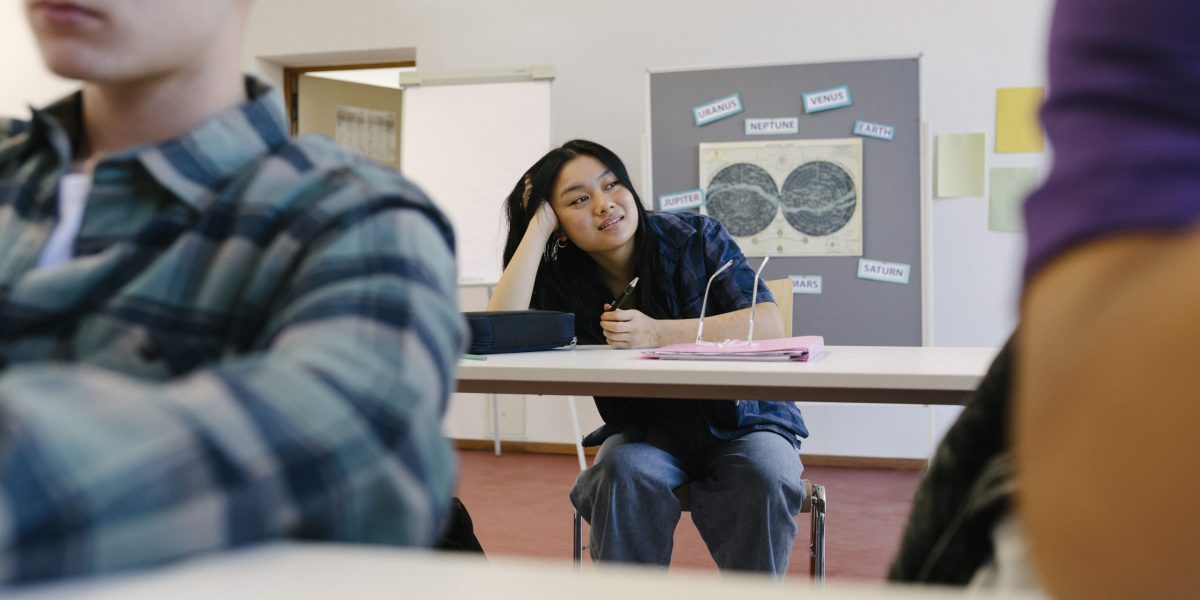
A survey of school professionals conducted from spring 2025 to spring 2026 found that while the vast majority of students use AI for homework, fewer than one-third of school districts have formal policies governing that use.
Teachers' main concern is not academic dishonesty alone, but the inability to assess whether students actually understand the material when polished AI-generated work is submitted.
Existing AI-detection tools are unreliable, and schools are beginning to redesign assignments—such as requiring in-class writing, oral explanations, or written reflections—to ensure they can still measure genuine student learning.
What happened
A survey of 303 educators in Wisconsin and 132 professionals nationally, conducted spring 2025 to spring 2026, found that while 84% of students use AI for homework, only 33% of Wisconsin districts and 29% of national districts have formal AI policies. Teachers report that AI-generated work—polished essays, summaries, and math solutions—makes it harder to assess whether students actually understand the material.
Why it matters
The core concern is not just cheating; it is that teachers cannot reliably tell whether finished work reflects student learning or AI output. In the Wisconsin sample, 47% of respondents cited "difficulty in assessing student learning when AI is used" as a concern (53% nationally). Additionally, 29–40% of respondents noticed "increased student reliance on AI," and 19–33% observed "reduced critical thinking or problem-solving." Lack of clear school policies leaves both teachers and students uncertain about acceptable AI use.
What to watch
AI-detection tools—used regularly by 43% of sixth- through 12th-grade teachers and tested by another 27%—are unreliable, with false-positive rates as high as 50%, false-negative rates as high as 100%, and false-flagging of nonnative English writing at an average rate of 61.3%. Schools are beginning to redesign assignments (e.g., in-class writing, oral explanations, process documentation, or critiques of AI output) to preserve evidence of student understanding.
Ask the AI about this article →
The tension at the heart of this survey is not new to education—teachers have always struggled to verify that finished work represents genuine student understanding. A parent's help, copying from peers, or rote completion without comprehension have long made it hard to interpret assignments as direct evidence of learning. Generative AI amplifies this problem by making polished, seemingly original work instant and nearly indistinguishable from human effort. The gap between policy and practice is stark: 84% of students use AI for homework, yet fewer than one in three districts have set formal rules for when and how it is acceptable. This creates ambiguity not only for teachers trying to assess learning but also for students unsure what is permitted.
The survey reveals that educators' worries extend beyond cheating. While 65–74% cited academic dishonesty and plagiarism as concerns, roughly half of respondents flagged a more fundamental problem: the inability to know whether a student understands what they submit. One-third to two-fifths of respondents observed increased reliance on AI and reduced critical thinking among students. These findings suggest that the challenge is not policing misuse but designing learning tasks that still yield reliable evidence of understanding—a shift some teachers are already making by incorporating oral explanations, in-class writing, process documentation, or assignments that require students to critique AI output rather than generate it from scratch.
For example, today's edition would include:
AI-summarized, only the topics you pick — one digest a day via Email, Slack, or Discord.
Free · takes 30 seconds · unsubscribe anytimeWhat is AIToday? →
Ask AI anything about this article. Q&As are published on this page for other readers too.
Google's AI search gave advice to call emergency services for users alone with an African, Indian, or Pakistan…

The Consumer Affairs Agency said Tuesday it will use generative AI to analyze about 900,000 annual consultatio…

The Supreme Court of Japan has included about ¥60 million in its fiscal 2027 budget request for AI-related exp…

OpenAI stopped running inference on a model involved in the HuggingFace incident, but the post argues this is…

OpenAI announced its support for California Senate Bill 1119, which aims to establish strong, age-appropriate…

A UK study by UK AI Security Institute and Limbic AI surveyed 6,474 British adults