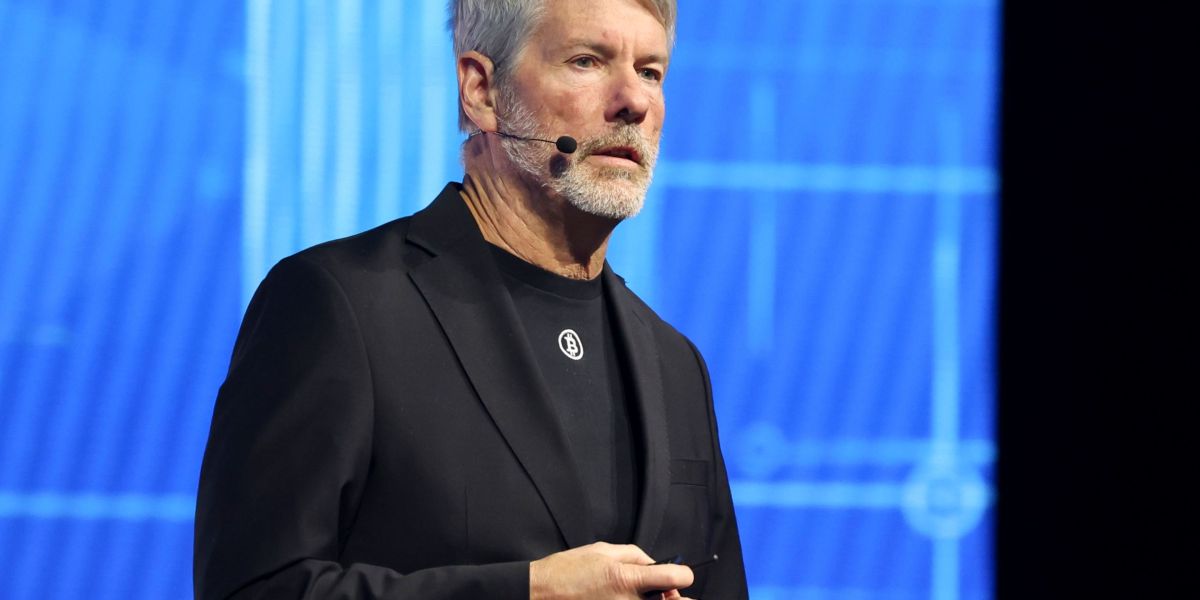
Elon Musk has predicted that AI will eventually make money irrelevant by creating abundance and enabling universal high income, but billionaire Michael Saylor argues this misses a key point: humans are status-oriented and will always spend money on scarcer luxury goods and premium versions of basic necessities.
Saylor points to history—clean water and advanced medicine, once royal luxuries, became commonplace, yet people still pay premium prices for fine dining and luxury cars—suggesting that as AI makes basics free or cheap, demand will simply shift toward status symbols, keeping money and markets central to the economy.
What happened
Elon Musk has predicted that AI will eventually make work optional, goods abundant, and money irrelevant through a 'universal high income.' Michael Saylor, founder of software firm MicroStrategy and a crypto advocate with a net worth of $3.3 billion, disagreed in a recent interview, arguing that money will retain value because humans are 'status-oriented animals' who will always spend on scarcer, luxury goods.
Why it matters
Saylor's counterargument highlights a real tension in AI abundance forecasts: even if technology makes necessities cheap or free, people historically shift spending toward status symbols and premium versions of goods rather than stop valuing money. His examples—from housing to fine dining ($300 restaurant meals in New York despite the ability to feed oneself for three dollars a day)—suggest that as basic needs are met, the desire for differentiation persists, meaning currency and markets may remain central to human behavior.
What to watch
Both Musk and Saylor agree AI will drive significant abundance; other tech leaders including Dennis Hassabis (now chairman of Google Deepmind) and venture capitalist Vinod Khosla have similarly predicted AI will reshape the economy, though Khosla emphasized that government response to job displacement—possibly through universal basic income—will determine whether the benefits are widely shared.
Elon Musk has emerged as one of the technology industry's most optimistic voices on artificial intelligence, predicting that AI will eventually reshape society so fundamentally that work becomes optional, goods and services become abundant, and money could become irrelevant. Central to this vision is the concept of a 'universal high income' driven by AI's productive capacity.
But Michael Saylor, the 61-year-old founder of software firm MicroStrategy—which has made Bitcoin central to its business strategy—offered a pointed rebuttal in a recent Diary of a CEO interview with host Steven Bartlett. When asked if he agreed with Musk's predictions, Saylor acknowledged that AI could indeed make life's necessities dramatically cheaper, or even free. However, he argued that this would not eliminate money's fundamental value because human nature itself will prevent it. 'Everybody doesn't get a Hampton's house. Everybody doesn't get their own private jet. They don't get their own private yacht,' Saylor said, laying out the core of his disagreement: scarcity, he argued, will never disappear entirely, and money will always serve as a mechanism for allocating it.
Saylor's philosophy centers on what he calls humanity's status-oriented nature. As basic goods become abundant through technological progress, people will simply shift their spending toward scarcer goods that confer wealth and status. 'If I give you universal healthcare, people want private healthcare. If I give everybody a house, someone's going to want a house twice as big,' he explained. 'Everybody's always going to have a reason to want something more because we're status-oriented animals.' (With a net worth of $3.3 billion, Saylor spoke from the vantage point of considerable personal wealth.) He framed this dynamic as 'the cynical way to look at it,' acknowledging the less idealistic view of human motivation.
To support this argument, Saylor drew on historical precedent. Technological advances over centuries have made many necessities dramatically cheaper and more widely available. Clean water and advanced medicine, for instance, are now commonplace across much of the developed world despite once being luxuries that even kings and queens could not reliably access. 'Henry VII didn't have dental crowns. He didn't have X-rays,' Saylor noted. '[We] get modern medical care. The infant mortality rate has plunged. Life is safer. Clean water, clean air, right, clean food—and technology gave them to us.' Yet, he argued, this abundance did not eliminate the desire for something better; instead, it raised the baseline for what people consider luxury. As he put it, 'What happened with the explosion of affluence? Massive utilitarian entitlement.' He illustrated this with the car industry: 'Everybody gets a car, but how many people get a Porsche?' The pattern repeats across sectors. When food became cheap and widely available, luxury restaurants did not disappear; they flourished. 'In New York City, you can see that everywhere—why do we go to restaurants and pay $300 to eat at a restaurant because you can actually feed yourself on three bucks a day?'
While Musk and Saylor diverge on the fate of money itself, they converge on a broader point: artificial intelligence is poised to usher in an era of unprecedented abundance. Other technology and venture leaders echo this view. Dennis Hassabis, who recently transitioned to chairman of Google Deepmind, has similarly predicted an era of discovery and renaissance driven by AI. 'In 10, 15 years' time, we'll be in a kind of new golden era of discovery that [is] a kind of new renaissance,' Hassabis said on Fortune's Titans and Disruptors of Industry podcast, pointing to breakthroughs in medicine and energy that could eventually enable humanity to 'travel the stars and … explore the galaxy.' Venture capitalist Vinod Khosla has also argued that AI will usher in bountifulness, though he sounded a cautionary note: the economic benefits will hinge heavily on how governments respond to the job displacement that AI will cause. 'Productivity will favor increasing average incomes but job displacement will do the reverse even as the goods and services produced increases dramatically,' Khosla wrote in 2024. He suggested that 'universal basic income may be the best equalizer' and called for ensuring 'that median income rises along with average income.'
Elon Musk's prediction of AI-driven abundance leading to the obsolescence of money rests on the premise that material scarcity will vanish. Michael Saylor's counterargument—grounded in both human psychology and economic history—suggests that scarcity will simply shift from basic goods to status goods. The body provides concrete evidence for Saylor's position: luxuries that once belonged only to monarchs (dental care, medicine, clean water) are now ubiquitous, yet the desire for differentiation persists. Modern examples reinforce this: food is cheap, yet fine dining commands premium prices; cars are affordable, yet luxury vehicles thrive.
What emerges from this disagreement is not a dispute over whether AI will drive abundance—both Musk and Saylor agree on that—but rather over whether abundance will eliminate money's role in allocating goods and signaling status. Saylor's framing suggests that as technology pushes down the cost of necessities, the definition of 'luxury' simply ratchets upward, and money remains the mechanism by which people signal wealth and status in a world of abundance. Other tech leaders cited in the body, including Dennis Hassabis and Vinod Khosla, support the abundance thesis but acknowledge that distribution and policy (particularly government responses to job displacement) will shape whether that abundance is widely shared.
AI-summarized, only the topics you pick — one digest a day via Email, Slack, or Discord.
Free · takes 30 seconds · unsubscribe anytime
Ask AI anything about this article. Q&As are published on this page for other readers too.
GE Vernova reported second-quarter 2026 revenue of $11.1 billion (up 22% year-over-year) and orders that more…
Dell Technologies reported AI-optimized server revenue of $16.13 billion, up 757% year over year, with managem…
SanDisk reported Q4 2026 earnings on Aug

Marvell Technology is pivoting its business strategy to concentrate on AI networking semiconductors for data c…

Eli Lilly and Company has committed to roll out Veeva Vault CRM across its global operations, adopting Veeva's…

Visa, the global payments network, is positioning itself to profit from AI-driven commerce by securing its rol…

The AI news that matters, in one minute each morning.
Sign up free