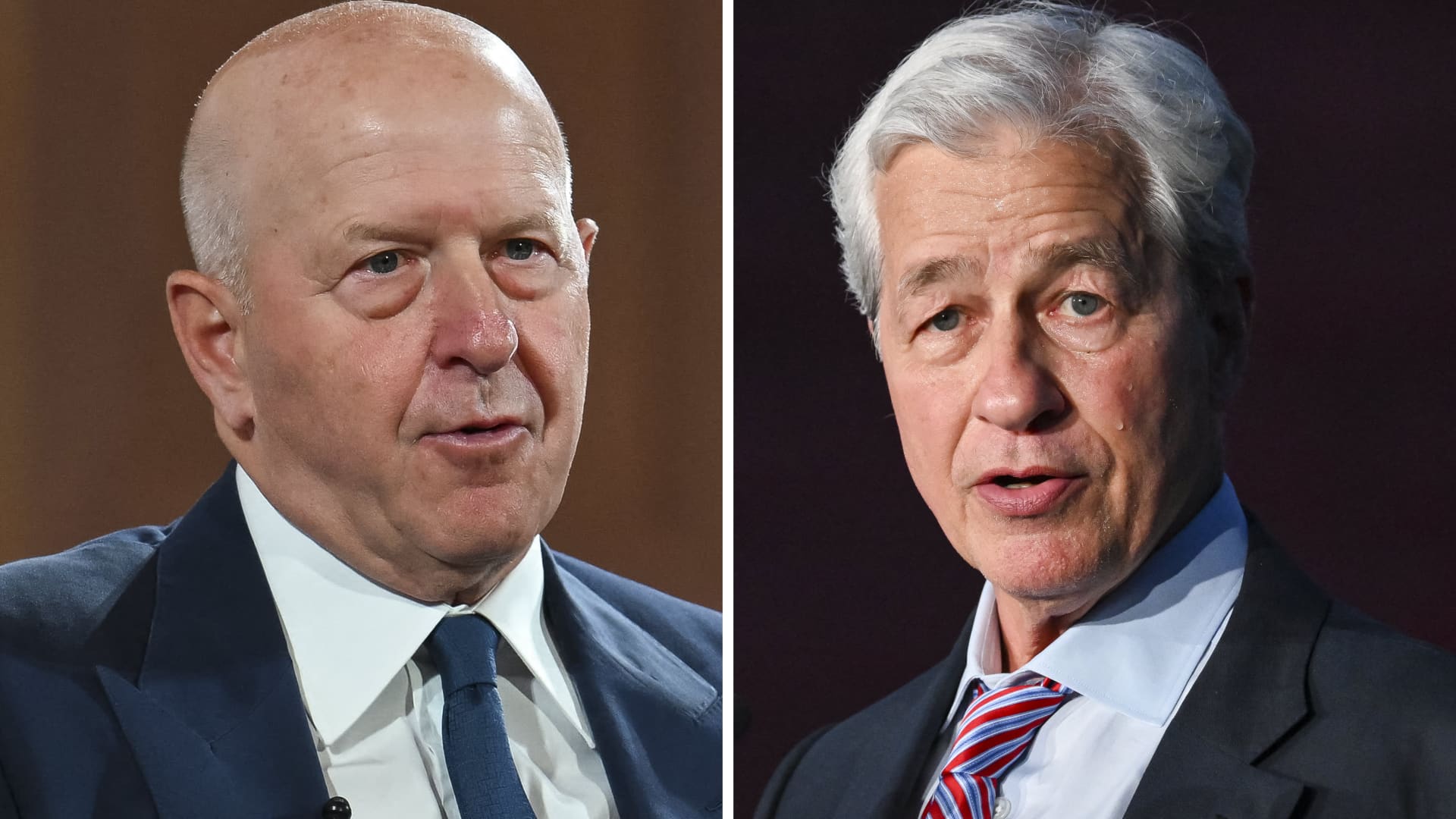
Goldman Sachs and JPMorgan Chase posted record quarterly revenues on Tuesday, proving that the AI investment boom is enriching Wall Street banks far beyond the tech sector. Goldman's revenue jumped 39% to $20.3 billion(約3.2兆円) and JPMorgan's rose 27% to $58 billion(約9.3兆円), fueled by massive gains in equities trading and investment banking tied to AI-driven deal activity. The banks are advising on AI-related transactions, financing data centers and power infrastructure, and benefiting from surging trading flows—creating what Goldman CEO David Solomon called a three-to-five year "AI capex super cycle" that spans every region and industry worldwide.
Summaries like this, in your inbox every morning.
Sign up free →What happened
Goldman Sachs revenue jumped 39% to $20.3 billion(約3.2兆円) and JPMorgan Chase revenue rose 27% to $58 billion(約9.3兆円) in the latest quarter, driven by surging equities trading and investment banking tied to AI-related deal activity. Equities trading revenue alone rose 86% to $6 billion(約9600億円) at JPMorgan and 72% to $7.42 billion(約1.2兆円) at Goldman.
Why it matters
The AI investment cycle is no longer confined to chip makers and software companies—it is now fueling a wave of capital flows, M&A advisory work, data-center financing, and infrastructure deals that benefit major Wall Street banks. JPMorgan CFO Jeremy Barnum told reporters that AI is "everywhere in financial markets," creating what Goldman CEO David Solomon called "an AI capex super cycle" expected to last three to five years and span every region and industry.
What to watch
Goldman shares jumped 8% in afternoon trading and JPMorgan rose 2% following the results. Wells Fargo analyst Mike Mayo said the AI investment boom "reached a tipping point" in the second quarter and raised price targets for both banks. Morgan Stanley is scheduled to report earnings Wednesday.
Goldman Sachs and JPMorgan Chase reported record quarterly revenues on Tuesday, demonstrating that the global artificial intelligence boom is generating substantial profits for major Wall Street banks alongside technology and chip companies. Goldman's revenue jumped 39% to $20.3 billion(約3.2兆円), while JPMorgan saw it rise 27% to $58 billion(約9.3兆円), both driven by massive gains in equities trading and investment banking.
The most dramatic surge appeared in equities trading, where global capital flows and major corporate transactions produced some of the biggest revenue surprises of the quarter. At JPMorgan, equities trading revenue rose 86% to $6 billion(約9600億円), while at Goldman it climbed 72% to $7.42 billion(約1.2兆円)—a combined $4.4 billion(約7000億円) above analyst expectations. Bank of America also benefited, with equity trading revenue rising 70% to $3.6 billion(約5800億円). JPMorgan CFO Jeremy Barnum attributed much of this activity to the AI theme, telling reporters that "These are booming environments with a ton of activity, big IPOs, big index rebalancing, a lot of activity in Asia. A lot of it is downstream of the AI theme, writ large on a global basis." Soofian Zuberi, president and co-head of Global Markets at Bank of America, noted that investors broadened their search for AI beneficiaries beyond the U.S., with American clients diversifying and allocating more money to Asian markets including South Korea, Taiwan and Japan.
Investment banking revenue also soared, with Goldman's climbing 55% to $3.4 billion(約5400億円) and JPMorgan's rising 30% to $3.3 billion(約5300億円)—a combined $1 billion(約1600億円) above expectations. In the quarter, Goldman served as lead advisor on SpaceX's initial public offering and Alphabet's $90 billion(約14兆円) equity issuance, and advised Dominion Energy on its sale to NextEra Energy, all transactions driven by the AI cycle. Bank of America saw investment banking fees jump 50% to $2.1 billion(約3400億円).
Goldman CEO David Solomon told analysts the bank is preparing for what he called "an AI capex super cycle"—referring to capital expenditures for physical assets—that is expected to last three to five years and still in its early stages. "We are in the middle of an AI capex super cycle where there are demands on financing in every single financing instrument, in every region of the world and across every single industry," Solomon said. The banks are advising on AI-related deals, financing data centers and power infrastructure, underwriting debt and equity offerings, and facilitating the surge in trading accompanying the global race to deploy AI technology. Beyond advisory and trading, banks are also beginning to implement the technology internally to streamline their own processes and increase revenue while controlling costs. Goldman shares jumped 8% in afternoon trading following the earnings announcement, while JPMorgan rose 2%. Wells Fargo banking analyst Mike Mayo said the AI investment boom "reached a tipping point" in the second quarter and increased his price targets for Goldman and JPMorgan after the results. Morgan Stanley is scheduled to report earnings on Wednesday.
The earnings results from Goldman Sachs and JPMorgan Chase mark a clear inflection point in how the AI boom is reshaping the financial industry. While previous headlines focused on chip makers like Nvidia and cloud providers like Alphabet capturing the spoils of AI investment, these results show that the AI capex cycle has broadened far beyond semiconductors and software. As JPMorgan CFO Jeremy Barnum explained, AI is now "everywhere in financial markets," creating cascading opportunities for banks to advise on transactions, finance infrastructure, and capture trading flows from a global reshuffling of capital.
The scale of the activity is striking. Combined equities trading revenue at Goldman and JPMorgan alone surpassed analyst expectations by $4.4 billion(約7000億円), while combined investment banking revenue beat expectations by $1 billion(約1600億円). This suggests that the pace and scope of AI-related capital deployment—from data center construction to corporate restructurings—has outpaced even Wall Street's own forecasts. Wells Fargo analyst Mike Mayo's assessment that the AI boom "reached a tipping point" in the second quarter, coupled with his raising of price targets for both banks, reflects a belief that this is not a temporary surge but a structural shift in where capital is flowing and what financial services will be in highest demand.
No comments yet. Be the first to share your thoughts!
Log in to join the discussion


Get curated AI news from 200+ sources delivered daily to your inbox. Free to use.
Get Started FreeFree · takes 30 seconds · unsubscribe anytime
1 minute a day. The AI essentials.
200+ sources · Email / LINE / Slack
