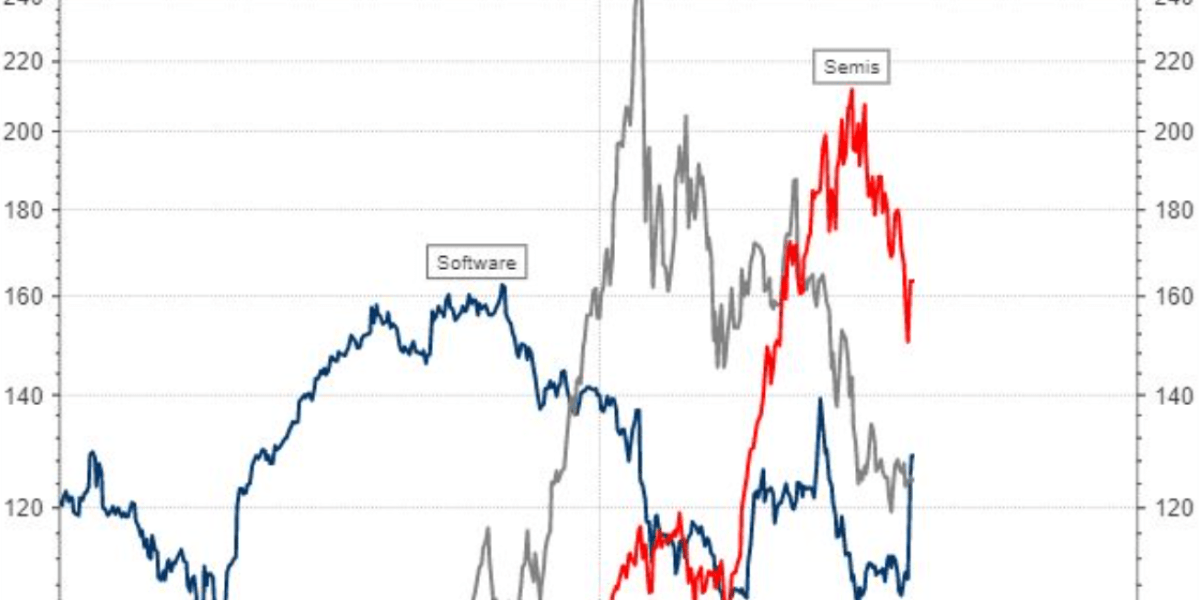
Rather than a single AI bubble destined to pop, strategist Dhaval Joshi argues the market is experiencing a rolling sequence of sector-specific booms and busts—software, semiconductors, and silver have each experienced sharp rallies followed by crashes as investors repriced their assumptions about which companies can sustain high margins.
The pattern has held so far because capital has simply cycled from one inflated sector to the next, but a tightening in monetary policy, a sharp capex downturn, or a non-mild recession could break the cycle and trigger a broad selloff.
What happened
Strategist Dhaval Joshi argues the AI market is experiencing rapid boom-and-bust cycles across sectors rather than a single bubble. Software stocks rallied on productivity hopes, then crashed as investors feared AI agents would destroy the SaaS subscription model; silver spiked as a data-center conductor but fell when investors realized the price surge was unjustified; semiconductor stocks surged on perceived pricing power, but are now unwinding as investors question whether chipmakers can sustain their high margins.
Why it matters
Joshi describes this as a "profit margin bubble" rather than an earnings bubble—the question is whether companies can maintain their stratospheric margins, not whether valuations fit current earnings. Hyperscalers' capital expenditure is already eating into free cash flow, with Google posting its first free cash flow negative result and Microsoft, Alphabet, Amazon, Meta, and Oracle projected to see capex overtake free cash flow by 2027. The rolling pattern has so far prevented a correlated market crash, but if monetary policy tightens or a non-mild recession hits, the entire sequence could unwind at once.
What to watch
Joshi forecasts AI capex will likely peak in late 2026 or the first half of 2027. He cites DDR3 RAM—a 20-year-old chip—as an example of the pattern: it has surged 600% in less than a year. He flagged crypto as a possible next candidate if AI and blockchains produce synergies, and emphasized the discipline is spotting which narrative inflates next and which supposed competitive "moat" turns out to be unsustainable.
Ask the AI about this article →
Joshi's framework rejects the binary question—"Is AI a bubble?"—in favor of a pattern-recognition approach: which sector's narrative is inflating today, and which will deflate tomorrow? The evidence he marshals is concrete: software crashed after investors realized AI agents threaten recurring revenue; silver prices nearly tripled before being reassessed as unjustified by fundamentals; semiconductor margins are now under scrutiny after investors initially priced in seemingly unlimited pricing power. His distinction between a "profit margin bubble" and an earnings bubble is central: the worry is not that current earnings don't justify valuations, but that the margins underpinning those earnings are unsustainable and will normalize sharply.
The structural condition enabling this rolling sequence is that each deflation has been isolated enough to avoid triggering a broad selloff; capital has simply rotated to the next inflated narrative. Joshi points to the real constraint on this cycle: highly accommodative monetary policy. If that changes—if real interest rates or real bond yields rise sharply, or if the capex cycle unwinds violently—the rotation could reverse into a correlated exit from risky assets. His forecast of capex peaking in late 2026 or early 2027 also hints that the end of the sequence may already be visible on the horizon.
For example, today's edition would include:
AI-summarized, only the topics you pick — one digest a day via Email, Slack, or Discord.
Free · takes 30 seconds · unsubscribe anytimeWhat is AIToday? →
Ask AI anything about this article. Q&As are published on this page for other readers too.
Visko raised $10 million in pre-seed funding from Llama Ventures and opened public access to its first foundat…

U.S. markets ended August higher, with the S&P 500 up 2.6% and the Nasdaq up 3.9%

Neurovia AI, an Abu Dhabi-based company, is pitching Saudi security agencies software that it says can compres…

AI company Runway has unveiled Solaris, the first model in a new category it calls "Interface World Models." I…

John Deere introduced JD, a conversational AI tool that lets farmers ask open-ended questions about their hist…
Nvidia CEO Jensen Huang said on Fox Business that AI is creating 'hundreds of thousands' of jobs, including in…