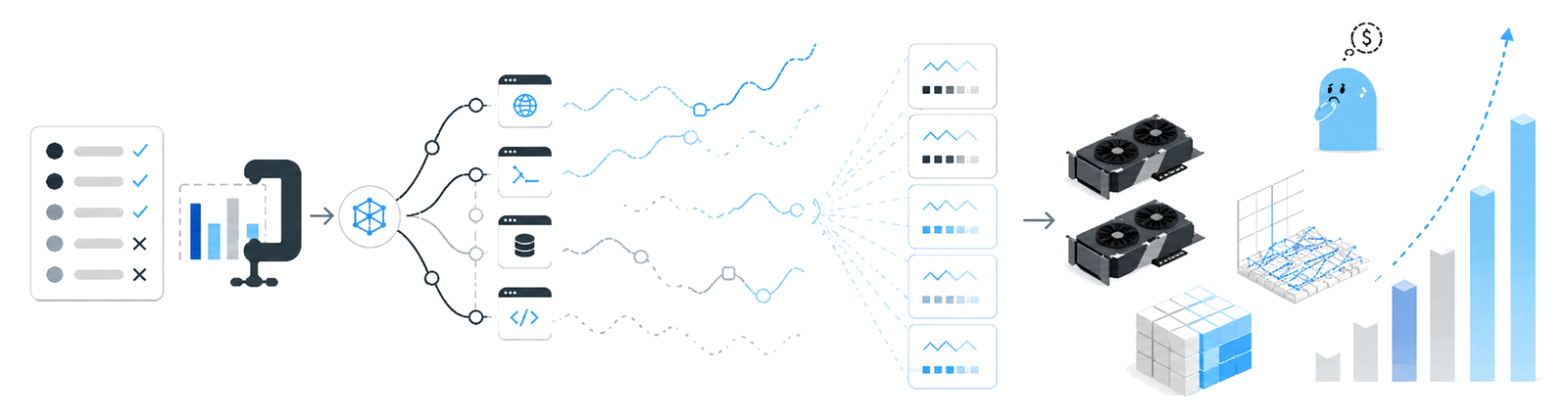
The Holistic Agent Leaderboard spent about $40,000 to run 21,730 agent rollouts across 9 models and 9 benchmarks. A single GAIA run on a frontier model can cost $2,829 before caching. Exgentic found a 33× cost spread on identical tasks depending on scaffold choice (the specific instructions and structure given to an AI agent).
Static benchmarks like HELM were compressible by 100× to 200× through techniques like Flash-HELM and tinyBenchmarks, which found that model rankings could be preserved using far fewer test items. Agent benchmarks are messier: cost varies by four orders of magnitude across different tasks, and compression yields only 2× to 3.5× reductions while preserving rank fidelity.
In scientific machine learning, evaluation costs now exceed training costs by roughly two orders of magnitude. The Well requires 3,840 H100-hours for a full four-baseline sweep and 960 H100-hours to evaluate a single new architecture, reversing the traditional deep-learning model where training dominated compute budgets.
Pricing variations between models create cost spreads independent of accuracy gains. Claude Opus 4.1 charges $15 per million input tokens and $75 per million output, while Gemini 2.0 Flash charges $0.10 and $0.40—a two-order-of-magnitude spread on input alone.
Summaries like this, in your inbox every morning.
Pick your industry and the AI tools you use, and get news related to your work every day.
Free · 30 seconds with Google · unsubscribe anytimeWhat is AIToday? →
Ask AI anything about this article. The AI reads this article, earlier AIToday articles, and Wikipedia, and cites its sources. Q&As are published on this page for other readers too.

